Hive product
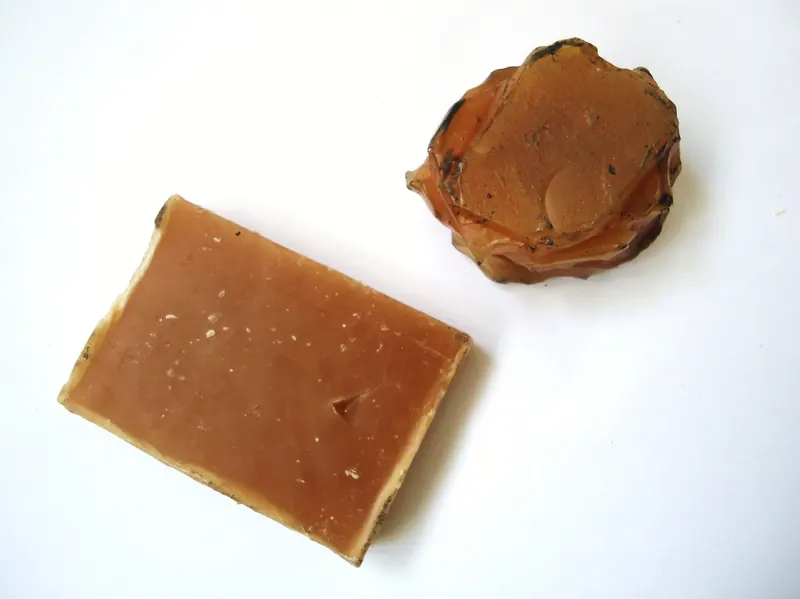
Beeswax
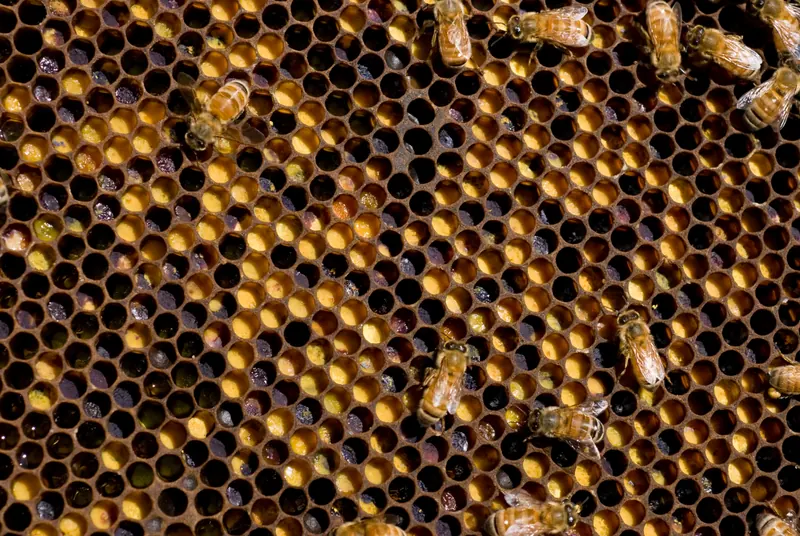
Beeswax is secreted as small platelets by wax glands on the abdomen of young worker bees, who build comb from it. It is a complex mixture of at least 284 compounds, mainly esters, with hydrocarbons and free fatty acids. Adulteration with cheaper paraffin is a known problem that can only be detected with chemical tests.
What we know
How to recognise it
Composition
Pure beeswax from the western honey bee, Apis mellifera, consists of at least 284 different compounds.
Confirmed fact[1]FAO counts 21 major compounds, each making up more than 1% of pure beeswax, which together account for 56% of the wax; the other 44% are diverse minor compounds.
Confirmed fact[1]A JECFA assessment gives typical shares of linear wax monoesters and hydroxymonoesters at 35 to 45%, and of complex wax esters at 15 to 27%.
Confirmed fact[2]The same assessment gives odd-numbered straight-chain hydrocarbons at 12 to 16%, free fatty acids at typically 12 to 14%, and free primary fatty alcohols at about 1%.
Confirmed fact[2]
Production
Young worker bees secrete beeswax as small platelets from eight wax glands on the underside of the abdomen, and use it to build the comb.
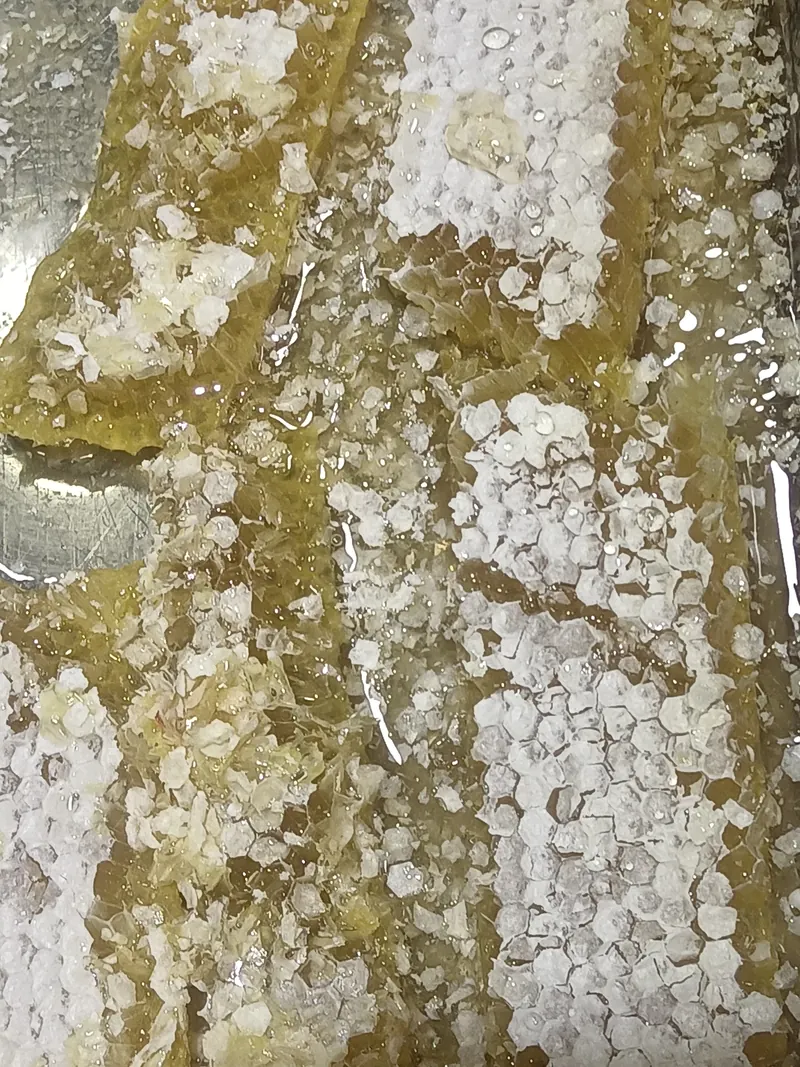
Confirmed fact[1]Commercial beeswax is obtained from honeycombs after the honey is removed, by melting the combs with hot water, steam or solar heat.
Confirmed fact[2]In frame hives, wax yield is only about 1 to 2% of honey production by weight, compared with 10 to 15% in top-bar and traditional beekeeping.
Statistical estimate[1]
Standards and rules
Beeswax is easy to adulterate, usually with cheap paraffin waxes, and the adulteration can only be detected with chemical tests.
Confirmed fact[1]A conference abstract presented at EurBee 8 (2018) reported that more than 65% of 137 comb foundation and wax block samples from 15 European countries, collected 2016 to 2018, were adulterated with paraffin, at shares from 5 to 93%.
Observation[4]EFSA's 2020 assessment of beeswax adulterated with paraffin or stearin recommended that purity testing combine at least two physico-chemical parameters with advanced methods, to detect adulterants reliably at levels below 5%.
Confirmed fact[3]
Honey Odyssey describes composition, origin and tradition. It does not give medical advice or health claims.
Continue
Sources
- Krell, R. (1996). Value-added products from beekeeping. FAO Agricultural Services Bulletin 124. Rome: Food and Agriculture Organization of the United Nations. Chapter 4: Wax. Link
- Kuznesof, P. M. (first draft), reviewed by Whitehouse, D. B. Beeswax: Chemical and Technical Assessment (CTA). Prepared for the 65th meeting of the Joint FAO/WHO Expert Committee on Food Additives (JECFA), June 2005. Rome: FAO. Link
- European Food Safety Authority (EFSA) (2020). Risk assessment of beeswax adulterated with paraffin and/or stearin/stearic acid when used in apiculture and as food (honeycomb). EFSA Supporting Publications, EN-1859. Link
- Svečnjak, L., Prđun, S., Baranović, G., Damić, M., & Rogina, J. (2018). Alarming situation on the EU beeswax market: the prevalence of adulterated beeswax material and related safety issues. Abstract in: EurBee 8, 8th European Congress of Apidology, Ghent, Belgium, 18 to 20 September 2018, pp. 114 to 115. Indexed in CROSBI, Croatian Scientific Bibliography. Link
Last checked: 20 October 2026. Every statement on this page was compared with the source it cites.