Hive product
Bee pollen and bee bread
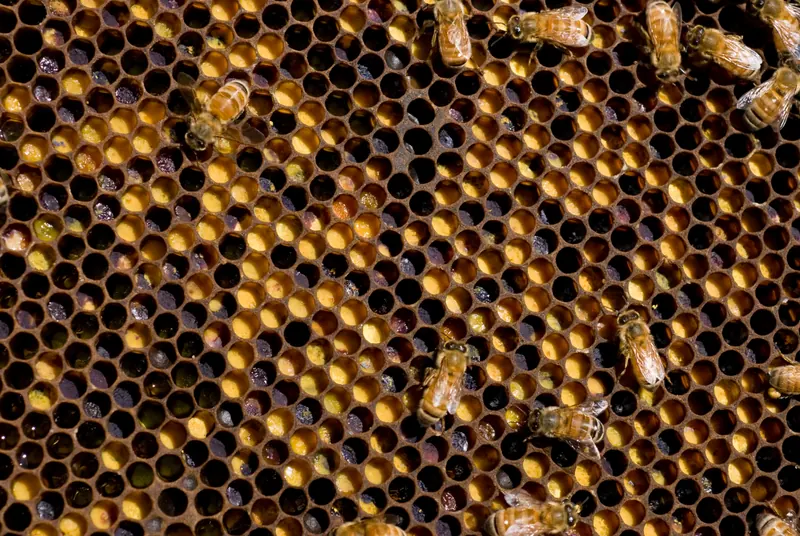
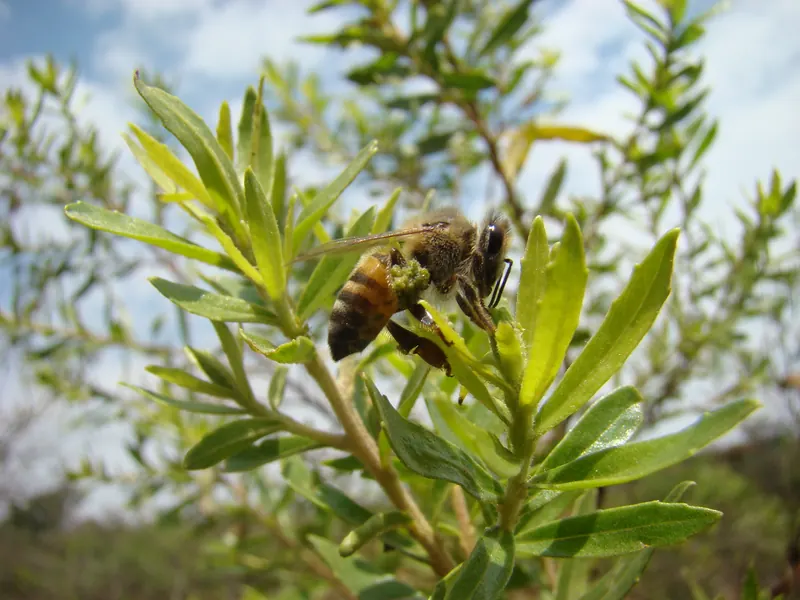
Bee pollen is flower pollen that foragers agglutinate with nectar and salivary substances and carry home as pellets in the pollen baskets on their hind legs. Stored in the comb, it becomes bee bread; whether it is fermented or simply preserved is debated. Pollen is the colony's main source of protein, lipids and minerals, and its plant origin can be identified by pollen analysis.
What we know
Origin and plant
Not all pollen is equally nutritious: FAO notes that some types, such as pine and eucalyptus, are insufficient even for raising honey bee larvae.
Reported by the farm[1]
How to recognise it
The botanical origin of bee pollen can be determined by pollen analysis under the microscope.
Confirmed fact[2]
Composition
While honey is the colony's energy source, pollen is the bees' main source of the other important nutrients, including proteins, minerals and fats.
Confirmed fact[2]Campos et al. give the composition of dried bee pollen as 10 to 40 g protein and 1 to 13 g lipids per 100 g dry weight.
Confirmed fact[2]
Crystallisation and storage
FAO describes stored pollen as undergoing a lactic acid fermentation that preserves it, and calls the final product beebread.
Reported by the farm[1]A 2014 study questioned the idea of long-term microbial predigestion, concluding that stored pollen is a preservative environment, mainly because of added honey, nectar and bee secretions, rather than being converted by microbes.
Open question[3]FAO says harvested pollen needs to be dried to less than 10% moisture content.
Confirmed fact[1]
Production
Bee pollen is flower pollen that worker honey bees agglutinate with nectar or honey and salivary substances; it is collected at the hive entrance.
Confirmed fact[2]Foragers carry these loads home as pellets in the pollen baskets, or corbiculae, on their hind legs.
Confirmed fact[2]Bee bread, or hive-stored pollen, is flower pollen mixed with nectar and stored in the comb; it is the source of proteins, lipids and minerals eaten by nurse bees.
Confirmed fact[3]Pollen traps strip pellets from returning foragers, but their efficiency rarely exceeds 50%.
Confirmed fact[1]
Standards and rules
A draft quality standard proposed by Campos et al. sets total protein at no less than 15 g/100 g and total sugars at no less than 40 g/100 g.
Statistical estimate[2]
Honey Odyssey describes composition, origin and tradition. It does not give medical advice or health claims.
Continue
Sources
- Krell, R. (1996). Value-added products from beekeeping. FAO Agricultural Services Bulletin 124. Rome: Food and Agriculture Organization of the United Nations. Chapter 3: Pollen. Link
- Campos, M. G. R., Bogdanov, S., Almeida-Muradian, L. B., Szczesna, T., Mancebo, Y., Frigerio, C., & Ferreira, F. (2008). Pollen composition and standardisation of analytical methods. Journal of Apicultural Research and Bee World, 47(2), 156 to 163. Link
- Anderson, K. E., Carroll, M. J., Sheehan, T., Mott, B. M., Maes, P., & Corby-Harris, V. (2014). Hive-stored pollen of honey bees: many lines of evidence are consistent with pollen preservation, not nutrient conversion. Molecular Ecology, 23(23), 5904 to 5917. https://doi.org/10.1111/mec.12966 (PMC4285803) Link
Last checked: 20 October 2026. Every statement on this page was compared with the source it cites.