Honeydew honey
Honeydew honey
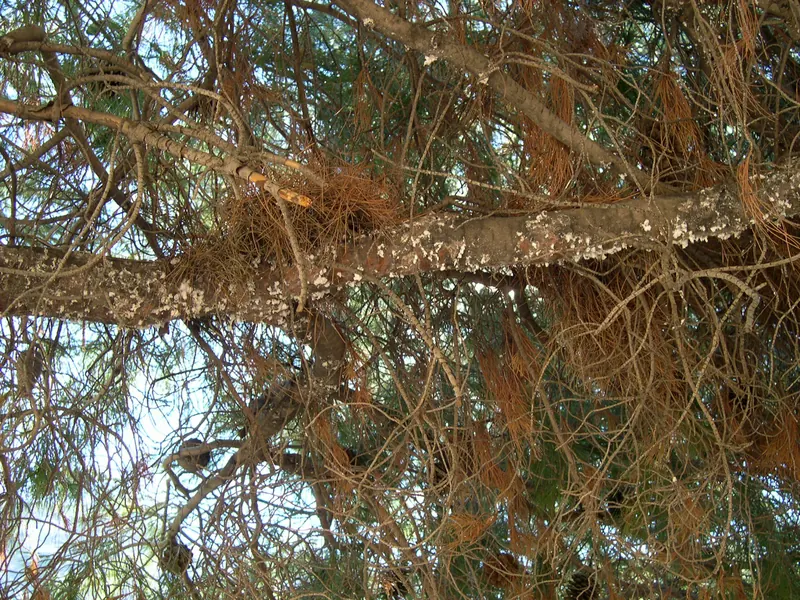
Honeydew honey is made mainly from excretions of plant sucking insects on living plants, such as fir, spruce, pine and oak. It shows high colour values and electrical conductivity. EU law requires an electrical conductivity of not less than 0.8 mS/cm and at least 45 g/100 g fructose plus glucose.
What we know
Origin and plant
How to recognise it
Under the microscope, honeydew honeys show numerous honeydew elements such as mould hyphae and spores and single-celled algae.
Confirmed fact[1]For silver fir (Abies alba) honeydew honey, sensory analysis describes the colour tone as a normal honey colour with green fluorescence.
Observation[1]For silver fir (Abies alba) honeydew honey, both the odour and the aroma are described as woody and warm.
Observation[1]
Composition
Standards and rules
EU law defines honeydew honey as honey obtained mainly from excretions of plant sucking insects (Hemiptera) on the living parts of plants, or from secretions of living parts of plants.
Confirmed fact[2]The Codex Alimentarius standard uses the same idea: honey coming mainly from Hemiptera excretions on living plants or from secretions of living plant parts.
Confirmed fact[3]Under Directive 2001/110/EC, honeydew honey, chestnut honey and their blends must have an electrical conductivity of not less than 0.8 mS/cm, except blends with certain honeys the directive lists separately (such as heather, lime and eucalyptus).
Confirmed fact[2]The directive sets fructose plus glucose for honeydew honey, and its blends with blossom honey, at not less than 45 g/100 g.
Confirmed fact[4]In an annex meant for voluntary use by commercial partners, the Codex standard also gives a minimum electrical conductivity of 0.8 mS/cm for honeydew and chestnut honey and their blends.
Confirmed fact[3]
Honey Odyssey describes composition, origin and tradition. It does not give medical advice or health claims.
Continue
Sources
- Persano Oddo L., Piro R. (2004) Main European unifloral honeys: descriptive sheets. Apidologie 35 (Suppl. 1), S38-S81. Link
- Council Directive 2001/110/EC of 20 December 2001 relating to honey, consolidated version of 23.06.2014 (incorporating Directive 2014/63/EU), EUR-Lex. Link
- Codex Alimentarius Commission. Codex Standard for Honey, CODEX STAN 12-1981. Adopted in 1981, revisions 1987 and 2001. FAO/WHO. Link
- Council Directive 2001/110/EC of 20 December 2001 relating to honey. Official Journal of the European Communities L 10, 12.1.2002, p. 47-52. Link
Last checked: 20 October 2026. Every statement on this page was compared with the source it cites.