Decision 03 of 8
Where to put an apiary
The forage within flight range, not the plot itself, decides the site; law, neighbours and sprayed fields then narrow the choice.
Applies to: Beginning beekeepers in Germany, Austria and Switzerland; honey bees, Apis mellifera Region: Central Europe (Germany, Austria, Switzerland)
Decide first: Why keep bees, and how many colonies to start with
This decision fixes: the site of the first hives, which fixes the forage, the water, the microclimate and the neighbours the colonies will have; whether the site is on your own land or on someone else's land under an agreement; whether a permanent beehouse or buildings are needed, which in parts of Switzerland triggers building permits and distance rules and in Bavaria calls for a lease or purchase instead of a verbal agreement; which legal distances to boundaries, roads and sensitive places apply, by country and state or canton
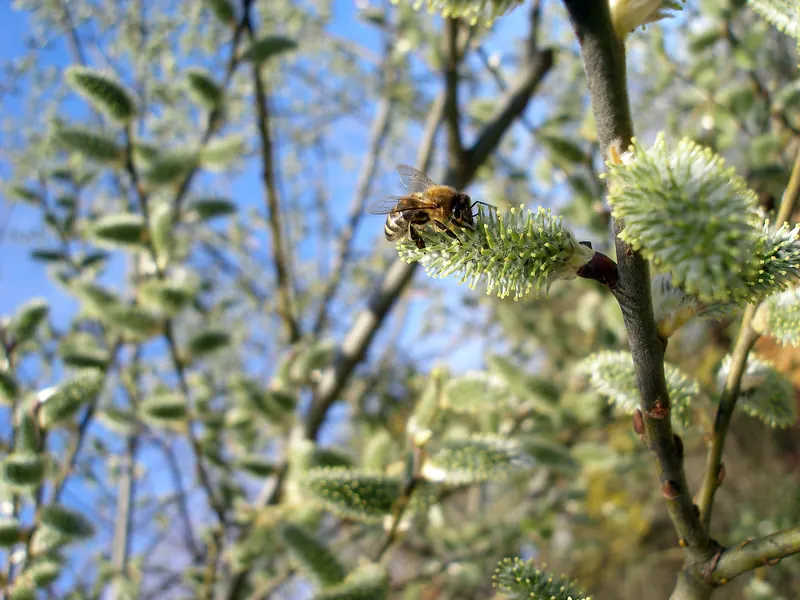
Forage within flight range decides more than the plot
In a British study decoding waggle dances over two years, the mean foraging distance rose from 493 m in spring to 2156 m in summer, a foraged area of about 15 square kilometres.Confirmed fact, source 1 The same study found that in spring the colonies danced mostly for sites within 500 m of the hives, so early forage must be close while summer forage may be far.Confirmed fact, source 1 Swiss beginner guidance published on the site of the Wallierhof education centre of canton Solothurn says that forage 500 m away already costs the bees noticeably more effort, and practitioners regard 750 to 1000 m as no longer worthwhile.Reported by the farm, source reported 2 The Bavarian bee institute calls the choice of site one of the central decisions for the success of a beekeeping operation.Confirmed fact, source 3 The Bavarian institute names fruit blossom, oilseed rape, dandelion and the forest (honeydew) as the main flows, with robinia, lime, sunflower and heather mattering in some areas; late-mown meadows, set-aside, field margins and gardens carry the colonies between these mass flows.Confirmed fact, source 4
Water, sun, wind and the direction of the entrances
The Bavarian institute recommends a water source no further than 400 m from the hives, such as a stream, pond, spring or wetland, because water can become scarce from late April to mid May when pollen intake and brood rearing peak.Confirmed fact, source 4 Wind-exposed sites should be avoided; forest edges, hedges, field copses or buildings usually give enough shelter for bees flying in and out.Confirmed fact, source 4 Direct midday sun should be avoided because hives heat up strongly in hot summers; the Bavarian institute recommends half-shade.Confirmed fact, source 4 Cold-air pools and frost hollows, where snow lies especially long, give clearly poorer spring development than sunny sites.Confirmed fact, source 4 Entrances facing south-east or south-west are often recommended, but the Bavarian institute calls this secondary, because plants produce most nectar around midday anyway.Confirmed fact, source 4
Access, paths, neighbours, and land that is not yours
The access road should be passable by car with a trailer, because full supers, feed and hives are heavy loads to deliver and collect.Confirmed fact, source 4 Colonies placed beside hiking trails, car parks, rest areas or playgrounds are often disturbed by people; Bavarian guidance suggests screening the stand with native trees and shrubs.Confirmed fact, source 4 Swiss beginner guidance advises choosing the stand so that the largest possible distances to neighbouring plots, roads and hiking trails are kept; it also suggests, where possible, more than 300 m to the nearest beekeeper.Reported by the farm, source reported 2 For hives on someone else's land, the Bavarian institute says a verbal agreement with the owner is often enough as long as the hives stay mobile; payment in honey is often agreed instead of money.Reported by the farm, source reported 4 If buildings must be put up, the Bavarian institute says the site should be secured long term by a lease contract or purchase; a verbal agreement is then not enough.Confirmed fact, source 4
Germany: no fixed distance, but § 906 BGB and local custom
In Germany, § 906 of the Civil Code lets a neighbour prohibit effects from another plot only if they impair the use of his plot more than insignificantly.Confirmed fact, source 5 Even a significant impairment must be tolerated under § 906 (2) BGB if it comes from a locally customary use and cannot be prevented by measures that are economically reasonable for such users.Confirmed fact, source 5 The Bavarian bee institute states that there are no statutory rules on a protective distance to the neighbour in Germany.Confirmed fact, source 4 As a rule of thumb for Bavaria, the institute expects no problems at 5 to 20 m from the neighbour, depending on the local situation, where beekeeping is locally customary.Statistical estimate, source est. 4 Whether beekeeping is locally customary is judged by comparing with surrounding places of similar size and structure, according to the Bavarian institute's legal briefing on hive sites.Confirmed fact, source 6
Austria and Switzerland: distances and permits set by state or canton
In Upper Austria, when a home apiary is newly set up, re-established or extended, at least 10 m must be kept from the entrances to the neighbouring boundary opposite the flight front, unless the neighbours agree to less, a flight barrier of the prescribed size is in place, the entrances sit at least 3 m above an unbuilt neighbouring plot, or the mayor permits a smaller distance of not less than 3 m.Confirmed fact, source 7 Upper Austria allows less than 10 m if, at least 4 m in front of the entrances, a suitable flight barrier such as a wall, fence or dense planting rises at least 2 m above them; to plots with hospitals, old people's homes, schools, kindergartens, playing fields, lidos, campsites and the like, 50 m from the entrances applies.Confirmed fact, source 7 In Vienna the entrances of each hive must be at least 7 m from the boundary opposite the flight front, reducible by neighbour agreement, a flight barrier of the prescribed size, raised entrances or a Magistrat permit; from public roads 10 m and from motorways 50 m apply, which only a flight barrier of the prescribed size can replace.Confirmed fact, source 8 In Burgenland, placing migratory colonies on someone else's land requires the consent of the person entitled to the land, and neighbours must consent if the flight front is closer than 15 m to the boundary.Confirmed fact, source 9 In the canton of Zurich, beehouses and hive boxes outside building zones need a building permit whatever their construction, fixed or mobile, and boundary, forest, road and watercourse distances must be kept.Confirmed fact, source 10
Pesticide-treated fields around the site
Germany's Bee Protection Ordinance forbids applying bee-hazardous plant protection products to flowering plants or to other plants while bees are visiting them.Confirmed fact, source 12 The same German ordinance adds that within 60 m of an apiary bee-hazardous products may be applied during the hours of daily bee flight only with the beekeeper's consent, so a farmer needs to know where your hives stand.Confirmed fact, source 12 In Switzerland the Bee Health Service received fifteen suspected poisonings in 2023 and confirmed two strong ones from plant protection products; one was traced to a spraying on a rape field near the apiary.Reported by the farm, source reported 13 If poisoning by plant protection products is suspected in Bavaria, fast action is required; samples go to the bee poisoning unit of the Julius Kühn Institute, and the analysis is free for affected beekeepers.Confirmed fact, source 14 A joint fruit-growers and beekeepers code for the Basel region (2014) treats mutual contact as the basis of good relations, and asks beekeepers to accept sprays used within the SAIO fruit production guidelines.Reported by the farm, source reported 11
The chain of decisions
- 01Why keep bees, and how many colonies to start withthe first decision
- 02Learning before the first beeafter: Why keep bees, and how many colonies to start with
- 03Where to put an apiaryafter: Why keep bees, and how many colonies to start with
- 04Choosing the hive and the frame: a decision for yearsafter: Why keep bees, and how many colonies to start with; Learning before the first bee
- 05Where the bees come fromafter: Choosing the hive and the frame: a decision for years; Where to put an apiary
- 06Equipment and the first budget: what you need and what it costsafter: Choosing the hive and the frame: a decision for years; Why keep bees, and how many colonies to start with
- 07Registration and the law: what must happen before and after the first beesafter: Where to put an apiary; Where the bees come from
- 08The first season: what the first year looks likeafter: Where the bees come from; Registration and the law: what must happen before and after the first bees; Equipment and the first budget: what you need and what it costs
Sources
- Couvillon MJ, Schürch R, Ratnieks FLW (2014). Waggle Dance Distances as Integrative Indicators of Seasonal Foraging Challenges. PLoS ONE 9(4): e93495. doi:10.1371/journal.pone.0093495 Link
- Wie beginne ich mit der Imkerei? Tipps für Neueinsteiger (07.01.2022). Bildungszentrum Wallierhof, Kanton Solothurn (Fachstelle Bienen BL/BS/SO), PDF hosted at wallierhof.so.ch Link
- Schulungsunterlagen Basisteil, Anfängerkurs. Bayerische Landesanstalt für Weinbau und Gartenbau (LWG), Institut für Bienenkunde und Imkerei, Veitshöchheim (undated) Link
- Standort / Platzwahl für Bienenvölker (Wo stelle ich meine Bienen hin?). Bayerische Landesanstalt für Weinbau und Gartenbau (LWG), Fachzentrum Bienen, Veitshöchheim (undated) Link
- Bürgerliches Gesetzbuch (BGB) § 906 Zuführung unwägbarer Stoffe. Bundesministerium der Justiz, gesetze-im-internet.de Link
- Wo darf ich meine Bienen hinstellen? Rechtliche Fragen zum Bienenstandort (slides). LWG Institut für Bienenkunde und Imkerei, Veitshöchheim (undated) Link
- Gesetz vom 15. April 1983 über das Halten und die Zucht von Bienen (Oö. Bienenzuchtgesetz), LGBl. Nr. 45/1983, consolidated version 12.01.2015, § 3 and § 9. FAOLEX database Link
- Wiener Bienenzuchtgesetz, LGBl. für Wien Nr. 56/2000, § 3. FAOLEX database Link
- Burgenländisches Bienenzuchtgesetz, LGBl. Nr. 14/1965, § 10 Zustimmung des Verfügungsberechtigten über das Grundstück. RIS Rechtsinformationssystem des Bundes Link
- Bienenhäuser (Bauen ausserhalb von Bauzonen, nichtlandwirtschaftliche Bauten). Kanton Zürich, Baudirektion, Amt für Raumentwicklung and Amt für Landschaft und Natur Link
- Gute Imkerpraxis: Gewährleistung der Bestäubung von Obstkulturen. Baselbieter Obstverband, Bienenzüchterverband Beider Basel, Fachstelle Bienen der Kantone BL, BS, SO (BZ Wallierhof), LZ Ebenrain, 24 March 2014 Link
- Verordnung über die Anwendung bienengefährlicher Pflanzenschutzmittel (Bienenschutzverordnung) § 2 Abs. 3. Bundesministerium der Justiz, gesetze-im-internet.de Link
- Bienenvergiftungen 2023. apiservice / Bienengesundheitsdienst (BGD), Switzerland, published 2024 (contact Marianne Tschuy) Link
- Bienenschäden durch Pflanzenschutzmittel: Handlungsleitfaden und Ansprechpartner. Bayerische Landesanstalt für Landwirtschaft (LfL), Institut für Pflanzenschutz, 2nd edition January 2023 Link
Last checked: 21 October 2026. Every statement in this article was compared with the source it cites. Spotted an error? Report it.