Decision 08 of 8
The first season: what the first year looks like
A season by season sketch of the first year with bees in Central Europe, from a spring nucleus to the first winter.
Applies to: Beginning beekeepers in Central Europe, mainly Germany (practical guidance from German state institutes; laws for DE, AT, CH; CZ and PL only via loss figures); honey bees, Apis mellifera Region: Central Europe
Decide first: Where the bees come from, Registration and the law: what must happen before and after the first bees, Equipment and the first budget: what you need and what it costs
This decision fixes: how much time the first year will take and when, so the beginner can plan holidays and work around the swarm season and late summer; that the first year is about building a colony and keeping it alive, not about harvesting honey; that late summer feeding and the legally required varroa control are fixed parts of the calendar, not optional extras, and must be learned before August; when a problem must be reported to the bee inspector or the veterinary authority rather than handled alone
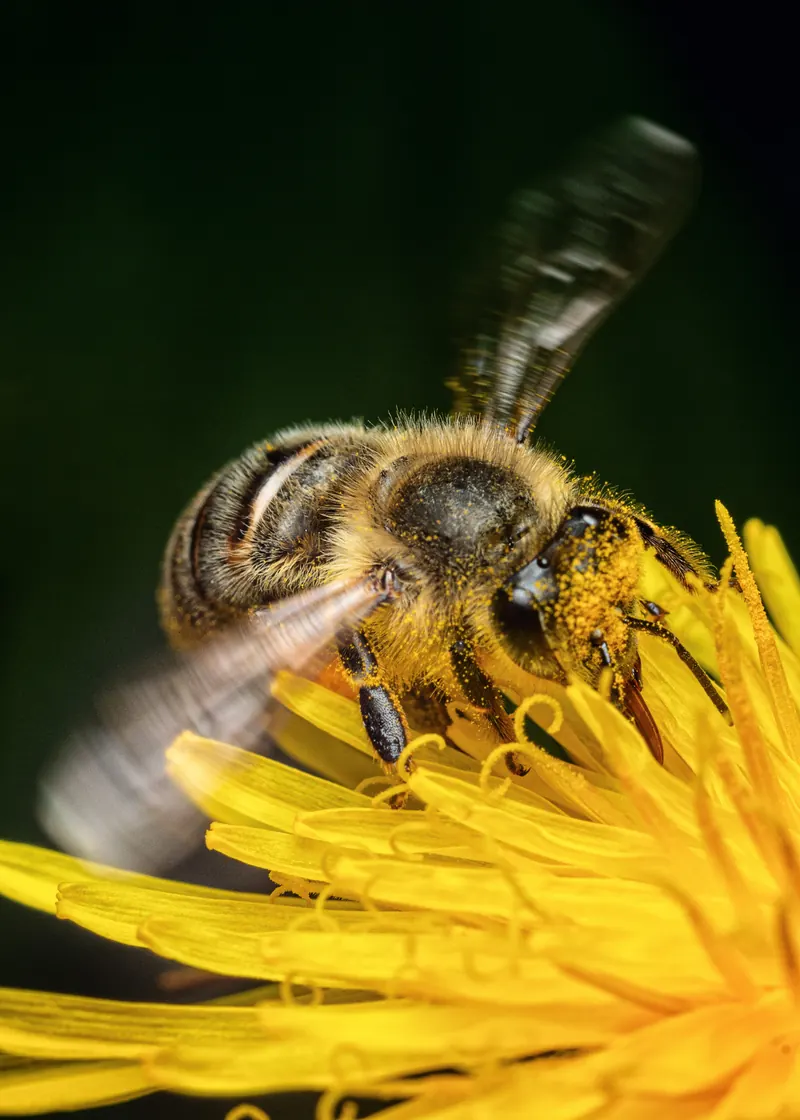
Spring to early summer: a nucleus is not yet a colony
The Bavarian bee institute (LWG) describes a young colony (Ableger, Jungvolk) as something built during the swarm season from an established colony, meant to stand as a productive colony only the following year.Confirmed fact, source 4 A nucleus formed in May that raises its own queen starts laying after three to four weeks, according to the Kirchhain institute (Hesse, Germany).Confirmed fact, source 3 Young colonies are smaller than established ones and, with the aim of overwintering, should be growing again from mid June, writes the Bavarian bee institute (LWG).Confirmed fact, source 17 The LWG says a fresh nucleus must be fed without fail whenever there is no nectar flow; the drawn out foundation shows whether the nucleus is in order and when it needs the next sheet.Confirmed fact, source 4 The LWG advises giving a nucleus only two expansion frames at first when it is moved into a full box: too many at once are merely walked over by the bees, used as a doormat, and the queen then does not like to lay in them.Confirmed fact, source 16
How often to look inside, and why not more often
The Bavarian bee institute states plainly that every inspection is a disturbance for the bees and should therefore be done only with a purpose.Confirmed fact, source 1 The LWG rhythm for Bavaria: every two weeks from mid or late March to the end of April, weekly during the swarm season until about mid June, then every two weeks again.Confirmed fact, source 1 An inspection answers a short list of questions: is the queen there, is there room for brood and stores, is there enough food, is varroa below the damage threshold.Confirmed fact, source 1 The same institute adds that the colony does not have to be taken apart completely each time to read those signs.Confirmed fact, source 1 In late winter the Hohenheim institute (Baden-Württemberg) says queenrightness and food can often be judged from outside: lift the hive from behind, and watch whether foragers bring pollen on a sunny day.Confirmed fact, source 15
Swarm season and the question of honey
Natural colony reproduction, which is swarming, usually peaks in May in Bavaria, according to the LWG calendar of the bee year.Confirmed fact, source 7 Weekly checks in the swarm season are the institutes' standard; the first signs, play cups and eggs in queen cells, can often be answered by giving more space, early rather than late.Confirmed fact, source 2 The second tool the institutes name for beginners is splitting: taking brood combs for a nucleus or bees for an artificial swarm steers the swarm urge early.Confirmed fact, source 2 In Bavaria the LWG calendar puts the spring flow harvest at the end of May or early June and the summer flow harvest around mid July.Confirmed fact, source 7 Institute guidance treats a first year colony as something to build and feed, not to harvest: the LWG says one does not overwinter nuclei, one overwinters colonies.Confirmed fact, source 4
Late summer: feeding for winter and the varroa duty
In Bavaria the main feeding phase begins in August and should be finished around 10 September; the LWG tells beekeepers to start in good time.Confirmed fact, source 6 The Kirchhain institute (Hesse) gives amounts by hive size: one box of German standard or Zander frames needs 14 to 15 kg of stores, two boxes 20 to 22 kg, stored by mid September.Confirmed fact, source 5 For a first year colony the Kirchhain target is at least one full box and 14 kg of stores by wintering in October.Confirmed fact, source 3 In Germany varroa control is a legal duty: the Bee Diseases Regulation obliges the owner of an infested apiary to treat all colonies on the stand against varroosis every year.Confirmed fact, source 9
Winter: rest, losses, and the numbers to expect
After the autumn work the LWG asks beekeepers to leave colonies in peace for the rest of the winter, with only occasional rounds of the stand so that damage after storms or other disturbances is caught in time.Confirmed fact, source 8 Some loss is normal. In the COLOSS survey for winter 2019/20 the overall loss rate was 18.1 percent across 37 countries; Germany 18.4, Austria 13.2, Switzerland 13.2, Czechia 20.8, Poland 13.9.Confirmed fact, source 12 The same study found that smaller operations lose more colonies than larger ones, which is the beginner's category.Confirmed fact, source 12 German losses swing from year to year: the Mayen institute survey gave 11 to 13 percent for winter 2022/23, while for winter 2024/25 it reported that just under 80 percent of the colonies wintered in 2024 survived, a loss of a little over 20 percent, noticeably above the long term mean.Confirmed fact, source 11 Austria reported 9.7 percent winter losses for winter 2025/26 (the University of Graz release of May 2026 speaks of the past winter) from more than 1,100 beekeepers; Switzerland reported 15 percent for winter 2022/23 from about 1,451 beekeepers (apisuisse survey with Agroscope).Confirmed fact, source 13
Beginner mistakes, and who to call
The Mayen institute says most winter losses are not fate but, in most cases, trace back to elevated varroa loads and therefore lie in the beekeeper's hands.Confirmed fact, source 11 Robbing is the classic feeding mistake. Kirchhain lists its causes: sloppy work, leaky feeders, strongly scented feed, and feeding by day in sun and warmth. Often the beekeeper causes it.Confirmed fact, source 5 Starvation in late winter is another named cause of loss; the Hohenheim institute describes the sign: many dead bees head first in the cells above the brood area.Confirmed fact, source 15 In Switzerland the cantonal veterinary office of Basel-Stadt states that anyone who keeps or looks after bees must report suspected cases to the bee inspector, and that American foulbrood and European foulbrood are diseases to be controlled and therefore notifiable; other cantons run their own inspectorates under the same federal animal disease rules.Confirmed fact, source 14 In Austria the owner of a colony must report any suspicion of a disease covered by the Bee Diseases Act to the district authority without delay and must carry out the measures the authority orders.Confirmed fact, source 10
The chain of decisions
- 01Why keep bees, and how many colonies to start withthe first decision
- 02Learning before the first beeafter: Why keep bees, and how many colonies to start with
- 03Where to put an apiaryafter: Why keep bees, and how many colonies to start with
- 04Choosing the hive and the frame: a decision for yearsafter: Why keep bees, and how many colonies to start with; Learning before the first bee
- 05Where the bees come fromafter: Choosing the hive and the frame: a decision for years; Where to put an apiary
- 06Equipment and the first budget: what you need and what it costsafter: Choosing the hive and the frame: a decision for years; Why keep bees, and how many colonies to start with
- 07Registration and the law: what must happen before and after the first beesafter: Where to put an apiary; Where the bees come from
- 08The first season: what the first year looks likeafter: Where the bees come from; Registration and the law: what must happen before and after the first bees; Equipment and the first budget: what you need and what it costs
Sources
- Bayerische Landesanstalt für Weinbau und Gartenbau (LWG), Fachzentrum Bienen, Veitshöchheim: Volkskontrollen (PDF of the institute web page) Link
- Poker, V. (Landwirtschaftskammer NRW, Bienenkunde Münster): Schwarmkontrolle. Bienen@Imkerei Infobrief 08/2023, 21 April 2023, joint newsletter of the German state bee institutes Link
- Petzoldt-Treibert, K. (LLH Bieneninstitut Kirchhain): Jungvolkpflege. Bienen@Imkerei Infobrief 13/2025, 13 June 2025 Link
- Bartsch, B. and LWG Veitshöchheim: Bildung Jungvolk / Am Bienenstand. Bienen@Imkerei Infobrief 09/2021, 30 April 2021 Link
- Petzoldt-Treibert, K. (LLH Bieneninstitut Kirchhain): Füttern und Räuberei. Bienen@Imkerei Infobrief 20/2025, 1 August 2025 Link
- Bayerische Landesanstalt für Weinbau und Gartenbau (LWG), Fachzentrum Bienen: Spätsommerpflege (institute web page, PDF) Link
- Fischer, J. (Fachberater für Bienenzucht, LWG Institut für Bienenkunde und Imkerei): Das Bienenjahr (slide deck, 2022 file) Link
- Bayerische Landesanstalt für Weinbau und Gartenbau (LWG), Fachzentrum Bienen: Herbst- und Winterarbeiten (institute web page, PDF) Link
- Bienenseuchen-Verordnung (BienSeuchV), § 15 Varroatose. Bundesministerium der Justiz, gesetze-im-internet.de Link
- Bienenseuchengesetz, BGBl. Nr. 290/1988 (Austria), §§ 1, 3, 4. Rechtsinformationssystem des Bundes (RIS) Link
- Otten, C. (Fachzentrum Bienen und Imkerei, DLR Westerwald-Osteifel, Mayen): Jahresrückblick. Bienen@Imkerei Infobrief 29/2025, 19 December 2025 Link
- Gray, A., Adjlane, N., Arab, A., Ballis, A., Brusbardis, V., Charrière, J.-D. et al. (2022): Honey bee colony loss rates in 37 countries using the COLOSS survey for winter 2019-2020: the combined effects of operation size, migration and queen replacement. Journal of Apicultural Research, doi:10.1080/00218839.2022.2113329 Link
- University of Graz, news release, 20 May 2026: A good winter for honeybees: mortality rate in Austria below ten per cent (survey led by Robert Brodschneider) Link
- Kanton Basel-Stadt, Gesundheitsdepartement, Kantonales Veterinäramt: Bieneninspektorat (official page) Link
- Wallner, K. (Landesanstalt für Bienenkunde, Universität Hohenheim): Frühjahrsdurchsicht / Am Bienenstand. Bienen@Imkerei Infobrief 04/2021, 12 March 2021 Link
- Feuchtmeyer, R. (Staatliche Fachberaterin für Bienenzucht Oberpfalz, LWG): Jungvolkpflege. Bienen@Imkerei Infobrief 15/2020, 12 June 2020 Link
- Müller-Engler, G. (LWG Institut für Bienenkunde und Imkerei, Veitshöchheim): Alles neu macht der Mai! Neue Bienenvölker, neue Königinnen! Bienen@Imkerei Infobrief 13/2022, 27 May 2022 Link
Last checked: 21 October 2026. Every statement in this article was compared with the source it cites. Spotted an error? Report it.