Decision 04 of 8
Choosing the hive and the frame: a decision for years
The frame standard chosen on day one decides every later box, foundation sheet and colony purchase, so choose the system your region's beekeepers and advisers use.
Applies to: Beginning beekeepers in Central Europe (DE, AT, CH, CZ, PL); honey bees, Apis mellifera Region: Central Europe
Decide first: Why keep bees, and how many colonies to start with, Learning before the first bee
This decision fixes: the frame standard (comb size) that all boxes, foundation and bought colonies must match; magazine hive or trough hive, which fixes how the colony is opened and how the back is loaded; wood or polystyrene, which fixes how boxes are repaired and heat treated; how many hives and spare boxes are bought before the first colony arrives
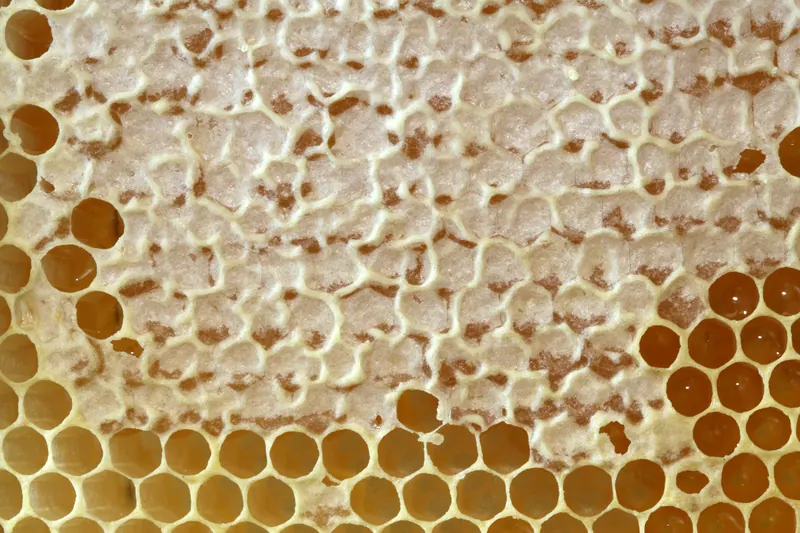
Why the frame standard binds you to your neighbours
The Bavarian bee institute LWG sums up its frame advice in one line: use one uniform system throughout the apiary.Confirmed fact, source 1 A Polish agricultural advisory centre tells beginners to think the hive model through beforehand, because the decision is not meant to be changed later.Confirmed fact, source 7 In Bavaria the LWG lists what a widespread standard system buys you: easier sourcing of bees, easier sourcing of material, and a wider choice of tools.Confirmed fact, source 2 The same institute notes that advisory recommendations in Germany mostly refer to standard systems, so an unusual frame leaves you partly outside the advice.Confirmed fact, source 2 Foundation sheets are made to the frame size, so every later purchase of wax is tied to the frame chosen at the start, as the LWG states.Confirmed fact, source 2
The standards in the Bavarian LWG table: Deutsch-Normal, Zander, Dadant, Langstroth
The LWG frame table lists the Zander frame with 477 mm in its LL column, 420 mm in its L column and 220 mm height, 22 mm wide, with about 8.0 dm2 of comb area; the sheet does not define LL and L.Confirmed fact, source 1 The Deutsch-Normalmass frame is listed with 394 mm in the LL column, 370 mm in the L column and 223 mm height, 25 mm wide, about 7.3 dm2 of comb; the LWG lists low cost thanks to wide distribution as an advantage of the Zander or Deutsch-Normal two-brood-box magazine systems, not of Normalmass alone.Confirmed fact, source 1 In the same table the Dadant brood frame is 483 by 448 by 285 mm (about 10.8 dm2) and the Langstroth frame 482 by 448 by 232 mm (about 8.8 dm2).Confirmed fact, source 1 The LWG describes Dadant as a hive whose brood box is extended sideways by hanging in more frames, and whose brood box is relatively heavy because it holds more wood.Confirmed fact, source 1 The LWG separates one-brood-box systems, which use different frame sizes for brood and honey, from two-brood-box systems, which use one frame size for both.Confirmed fact, source 2
Switzerland, Czechia and Poland have their own standards
Agroscope, the Swiss federal research centre, describes most Swiss beekeepers as using Swiss hives in bee houses opened from the rear, with Dadant and multi-storey hives as minorities.Reported by the farm, source reported 3 A 2015 survey article in the Swiss beekeepers' journal counted five systems in use in Switzerland: the CH-Kasten or Schweizermass, Dadant, Zander, Langstroth and Deutsch-Normal-Mass.Reported by the farm, source reported 4 The same journal gives the comb developed by Charles Dadant in the USA in 1863 as 43.5 by 30.0 cm for the brood chamber and the Langstroth comb as 44.8 by 23.2 cm; it describes the Dadant Blatt magazine as narrower and taller than the standard Dadant and places it mainly in France, Italy and French-speaking Switzerland.Confirmed fact, source 4 In Czechia the 39 by 24 cm frame was pushed through at a beekeepers' congress in Prostějov in 1904, and a museum study calls it still among the most common sizes in the country.Confirmed fact, source 5 In the Kujawy and Dobrzyń region of Poland the advisory centre names Wielkopolski, ordinary Warszawski, extended Warszawski and Dadant hives as the most popular, and says Dadant or extended Warszawski hives suffice for a stationary apiary while Wielkopolski hives suit an apiary that will be moved.Reported by the farm, source reported 7
Magazine hive or trough hive
The LWG defines the difference by how the hive is extended: a storage or trough hive is extended frame by frame, a magazine hive box by box.Confirmed fact, source 2 The same institute lists trough or storage hives and divided honey supers under back-friendly systems.Confirmed fact, source 2 In Switzerland the Schweizerkasten and other rear-opening hives are installed inside a bee house, which ties the choice of hive to the choice of building.Confirmed fact, source 4 The 2015 Swiss survey of specialist shops concluded that magazine hives are slowly but surely replacing rear-opening hives and with them the traditional Schweizerkasten.Reported by the farm, source reported 4 The LWG warns beginners in Bavaria not to take over outdated systems, giving hive floors without a mesh and slide-in tray as the example.Confirmed fact, source 8
Wood or polystyrene
The LWG lists the strengths of wood: spruce or Weymouth pine of about 20 to 25 mm, which you can build yourself, repair and heat treat.Confirmed fact, source 2 For plastics the LWG notes light weight and exact fit but brittleness with age, and for polystyrene light weight, exact fit and insulation.Confirmed fact, source 2 In its hive sheet the LWG states under Material that no special insulation is required for a hive; the sheet lists insulation as the property of polystyrene boxes in the same breath, so a Bavarian beginner need not choose polystyrene for warmth alone.Confirmed fact, source 9 The Czech national qualification standard for beekeepers expects minor carpentry repairs on hives because wood moves with the weather.Confirmed fact, source 6 In Austria the organic association BIO AUSTRIA excludes foamed and extruded plastics for housing bees, so polystyrene hives rule out that certification.Confirmed fact, source 10
How many hives and boxes to buy at the start
The LWG gives 3 to 5 units as the entry level for Bavarian beginners, and stresses that these numbers are only an orientation.Confirmed fact, source 11 An LWG sheet written for school apiaries says the start should be two colonies, not one, because some interventions are easier with two, and that the stock can then be built up from the existing colonies.Confirmed fact, source 12 The LWG cost example for three colonies lists three magazine hives, three additional boxes for feeding, nucs and varroa treatment, and 120 frames.Confirmed fact, source 8 The same sheet notes that widespread systems make replacement purchases and later additions easier when the apiary grows.Confirmed fact, source 8 In Czechia the Ministry of Agriculture reported in 2013 that, from 2010, the EU and national beekeeping support programme could contribute to the cost of four new hives for beginning beekeepers.Reported by the farm, source reported 13
The chain of decisions
- 01Why keep bees, and how many colonies to start withthe first decision
- 02Learning before the first beeafter: Why keep bees, and how many colonies to start with
- 03Where to put an apiaryafter: Why keep bees, and how many colonies to start with
- 04Choosing the hive and the frame: a decision for yearsafter: Why keep bees, and how many colonies to start with; Learning before the first bee
- 05Where the bees come fromafter: Choosing the hive and the frame: a decision for years; Where to put an apiary
- 06Equipment and the first budget: what you need and what it costsafter: Choosing the hive and the frame: a decision for years; Why keep bees, and how many colonies to start with
- 07Registration and the law: what must happen before and after the first beesafter: Where to put an apiary; Where the bees come from
- 08The first season: what the first year looks likeafter: Where the bees come from; Registration and the law: what must happen before and after the first bees; Equipment and the first budget: what you need and what it costs
Sources
- Bayerische Landesanstalt für Weinbau und Gartenbau (LWG), Fachzentrum Bienen: Welches Rähmchen soll ich verwenden? (frame table after Bayerischer Imkerkalender 2003), undated PDF Link
- Bayerische Landesanstalt für Weinbau und Gartenbau (LWG), Fachzentrum Bienen: Imkerliche Betriebsmittel, version 12.12.2018 Link
- Agroscope, Swiss Bee Research Centre: Beekeeping in Switzerland (web page, undated) Link
- Vollmer, J.: Mit welchen Beuten wird in der Schweiz geimkert? and Wie sind die Bienenbeuten von Langstroth, Dadant, Zander & Co. entstanden? Schweizerische Bienen-Zeitung 03/2015, pp. 20 to 23 (BienenSchweiz) Link
- Sekereš, J.: Úly bratří Mrštíků, stručná historie a zpráva o konzervátorském zásahu. RegioM 2015, Regionální muzeum v Mikulově Link
- Národní soustava kvalifikací: Hodnotící standard, Chovatel/chovatelka včel (41-035-H), authorising body Ministerstvo zemědělství, valid from 21.10.2022 Link
- Kujawsko-Pomorski Ośrodek Doradztwa Rolniczego w Minikowie, Oddział w Zarzeczewie: Zakładamy pasiekę (leaflet), 2016 Link
- Bayerische Landesanstalt für Weinbau und Gartenbau (LWG), Fachzentrum Bienen: Was kostet mich der Start? (undated PDF) Link
- Bayerische Landesanstalt für Weinbau und Gartenbau (LWG), Fachzentrum Bienen: Die Qual der Wahl, die Beute (undated PDF) Link
- BIO AUSTRIA (Marthe, E.): Beratungsblatt Produktionsrichtlinien Bienen, version 22.07.2025 Link
- Bayerische Landesanstalt für Weinbau und Gartenbau (LWG), Fachzentrum Bienen: Wie komme ich zu Bienen? (undated PDF) Link
- Bayerische Landesanstalt für Weinbau und Gartenbau (LWG), Fachzentrum Bienen: Die Vorarbeiten (undated PDF) Link
- Ministerstvo zemědělství ČR with Český svaz včelařů: Situační a výhledová zpráva Včely, November 2013 Link
Last checked: 21 October 2026. Every statement in this article was compared with the source it cites. Spotted an error? Report it.