Decision 01 of 8
Why keep bees, and how many colonies to start with
The first decision is what you want from bees; it sets the number of colonies and the time you must set aside.
Applies to: Beginning beekeepers in Central Europe (DE, AT, CH, CZ, PL); honey bees, Apis mellifera Region: Central Europe
This decision fixes: the purpose of the apiary (a hobby close to nature, honey that pays for the hobby, or income); the number of colonies in the first season, usually two to five, not one; the time the beekeeper must set aside each year; whether income is a realistic aim at all, and roughly what colony count that would take; the calendar: courses and preparation in the winter before, colonies bought in spring
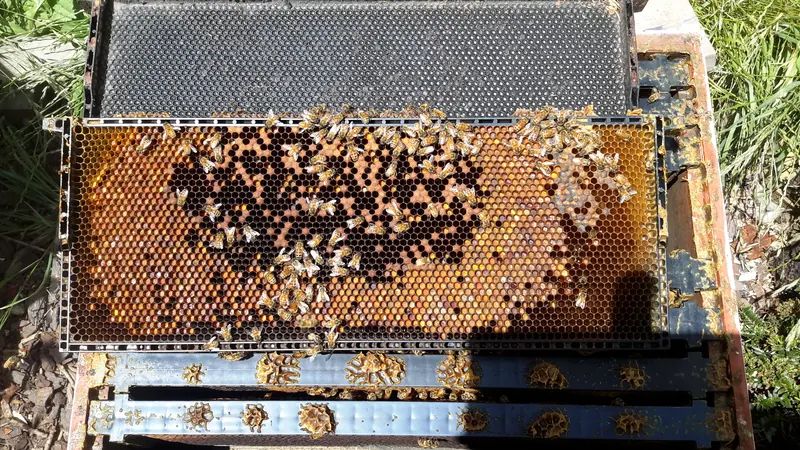
Four reasons to keep bees, and why the reason comes first
The German beekeepers' federation presents beekeeping as a hobby that lets a person work actively for the conservation of nature.Reported by the farm, source reported 1 The same federation says honey sales can finance the hobby itself; it does not present honey as a source of income.Reported by the farm, source reported 1 In Austria, the agriculture ministry reports that part time and hobby beekeepers make up almost 99 percent of all beekeepers.Confirmed fact, source 3 The Bavarian course material ties colony numbers to the beekeeper's aim: entry, hobby, part time income or main income each have their own range.Reported by the farm, source reported 2
How many colonies to begin with
In its guide for school beekeeping projects, the Bavarian bee institute advises two colonies at the start, not one, because some interventions are easier to carry out with two colonies.Reported by the farm, source reported 4 The Bavarian beginner course material gives three to five units (colonies) as the entry size, and stresses that bees mean work and the figures are only a guide.Reported by the farm, source reported 2 Guidance published by the canton of Solothurn, Switzerland, recommends buying two to four colonies, because too few colonies can mean total loss of a new apiary.Reported by the farm, source reported 5 In Czechia, the agriculture ministry's 2013 report notes that since 2010 state support has been available for four new hives for beginning beekeepers.Confirmed fact, source 6 A nucleus colony bought in the current season usually still needs feeding that year and brings no significant honey, according to the Bavarian course material.Reported by the farm, source reported 2
How much time a colony takes
The Solothurn guidance warns that the unavoidable time for running the apiary must be considered before buying bees.Reported by the farm, source reported 5 In Switzerland the basic course for new beekeepers run by BienenSchweiz sections takes 18 half days spread over two years.Confirmed fact, source 7 In Lower Austria the state beekeeping school's basic training consists of an eight hour basic course and six four hour practical courses.Confirmed fact, source 8 Agroscope's 2004 survey of Swiss beekeeping found an average holding of 10 colonies per beekeeper in 2003.Confirmed fact, source 9
What a colony yields in Germany, Austria and Switzerland
The federation's survey of about 9,000 apiaries gave a national average of 30.7 kg per colony for 2020, against a ten year mean of about 32 kg.Confirmed fact, source 10 In the cool, wet year 2021 the same survey, with about 9,100 German apiaries, gave an average total of only 18 kg per colony.Confirmed fact, source 11 The Austrian agriculture ministry, on its page with 2021 figures, gives 20 to 25 kg of honey per colony per year.Statistical estimate, source est. 3 In Switzerland the apisuisse survey of 817 beekeepers reported 23.6 kg per colony for 2025, against 5.1 kg of spring and 11 kg of summer honey per colony in 2024, and a long term mean of about 20 kg.Confirmed fact, source 12
Income needs many colonies
The Bavarian course material classes up to about 30 units as hobby, up to about 150 as part time income and from about 150 as main income.Reported by the farm, source reported 2 A Bavarian bee institute leaflet on start up costs says profit in the business sense is not to be expected at current average apiary sizes; through honey sales beekeeping becomes for many at least a cost neutral occupation.Reported by the farm, source reported 15 In Austria the ministry counts few professional beekeepers with more than 150 colonies, while the average beekeeper kept 13.7 colonies in 2021.Confirmed fact, source 3 Agroscope's 2004 analysis found an average Swiss apiary self supporting only if the beekeeper's own labour is not paid; hourly earnings were 7.80 francs in 2003 and negative in 2000.Confirmed fact, source 9 In Poland the national horticulture institute reports that 692 professional holdings keep about 190,000 colonies in 2024.Confirmed fact, source 13
When to decide: the winter before the first season
The Solothurn guidance says colonies are usually bought after wintering, so not before the end of March; swarms in April and May are called an ideal start.Reported by the farm, source reported 5 The Bavarian course material recommends buying colonies in spring so that a beginner does not carry the overwintering risk at the very start.Reported by the farm, source reported 2 The Hohenheim bee institute held its 2024 beginners' information day on 20 January, covering law, location, buying colonies, costs and time before the season.Confirmed fact, source 14 In Lower Austria the state beekeeping school's in person basic courses for 2025/26 fall mostly between January and March, before the bees fly.Confirmed fact, source 8 The Swiss umbrella organisation says a basic course is not required by law but is strongly recommended; the Solothurn guidance calls keeping bees taking on responsibility.Reported by the farm, source reported 7
The chain of decisions
- 01Why keep bees, and how many colonies to start withthe first decision
- 02Learning before the first beeafter: Why keep bees, and how many colonies to start with
- 03Where to put an apiaryafter: Why keep bees, and how many colonies to start with
- 04Choosing the hive and the frame: a decision for yearsafter: Why keep bees, and how many colonies to start with; Learning before the first bee
- 05Where the bees come fromafter: Choosing the hive and the frame: a decision for years; Where to put an apiary
- 06Equipment and the first budget: what you need and what it costsafter: Choosing the hive and the frame: a decision for years; Why keep bees, and how many colonies to start with
- 07Registration and the law: what must happen before and after the first beesafter: Where to put an apiary; Where the bees come from
- 08The first season: what the first year looks likeafter: Where the bees come from; Registration and the law: what must happen before and after the first bees; Equipment and the first budget: what you need and what it costs
Sources
- Deutscher Imkerbund e.V. (D.I.B.), Wege zur Imkerei (Imkern lernen), web page, Wachtberg, read 2026-10-21 Link
- Bayerische Landesanstalt für Weinbau und Gartenbau (LWG), Institut für Bienenkunde und Imkerei, Schulungsunterlagen Basisteil, Anfängerkurs Bienenhaltung, Veitshöchheim, undated PDF (course curriculum version 2018) Link
- Bundesministerium für Land- und Forstwirtschaft, Klima- und Umweltschutz, Regionen und Wasserwirtschaft (Austria), Rund 456.000 Bienenvölker in Österreich, web page with 2021 figures Link
- Bayerische Landesanstalt für Weinbau und Gartenbau (LWG), Fachzentrum Bienen, Bienen in der Schule: Grundüberlegungen und Vorarbeiten, Veitshöchheim, undated PDF Link
- Bildungszentrum Wallierhof, Kanton Solothurn, Tipps für Neueinsteiger: Wie beginne ich mit der Imkerei?, PDF dated 07.01.2022 Link
- Ministerstvo zemědělství ČR (with Český svaz včelařů), Situační a výhledová zpráva Včely, listopad 2013 Link
- BienenSchweiz (apisuisse), Imker/-in werden, web page, read 2026-10-21 Link
- NÖ Imkerschule Warth / Landimpulse (LAKO), Kurse 2025/26 für die Imkerei, PDF course programme, Lower Austria Link
- Fluri P., Schenk P., Frick R., Bienenhaltung in der Schweiz, ALP forum 2004 Nr. 8, Zentrum für Bienenforschung, Agroscope Liebefeld-Posieux, Bern, 2004 Link
- Deutscher Imkerbund e.V., press release Honigernte in Deutschland durchschnittlich, Wachtberg, 25.09.2020 (survey by Fachzentrum Bienen und Imkerei Mayen) Link
- Deutscher Imkerbund e.V., press release Kühler Wetterverlauf sorgte für schlechteste Honigernte seit fünf Jahren, Wachtberg, 12.10.2021 Link
- apisuisse, Medienmitteilung Überdurchschnittliche Honigernte für Schweizer Imkerinnen und Imker, Appenzell, 9 December 2025 Link
- Semkiw P., Stan pszczelarstwa w Polsce w 2024 roku, Instytut Ogrodnictwa PIB, Zakład Pszczelnictwa w Puławach, task 8.2 for MRiRW, Puławy 2024 (preliminary version) Link
- Universität Hohenheim, Landesanstalt für Bienenkunde, with Bezirksimkerverein Filder e.V., Informationsveranstaltung für Anfänger, 20 January 2024, PDF flyer Link
- Bayerische Landesanstalt für Weinbau und Gartenbau (LWG), Fachzentrum Bienen, Was kostet mich der Start? Wirtschaftliche Aspekte für Einsteiger, Veitshöchheim, undated PDF Link
Last checked: 21 October 2026. Every statement in this article was compared with the source it cites. Spotted an error? Report it.