Megachilidae
Osmia cornuta
Horned mason bee, European orchard bee
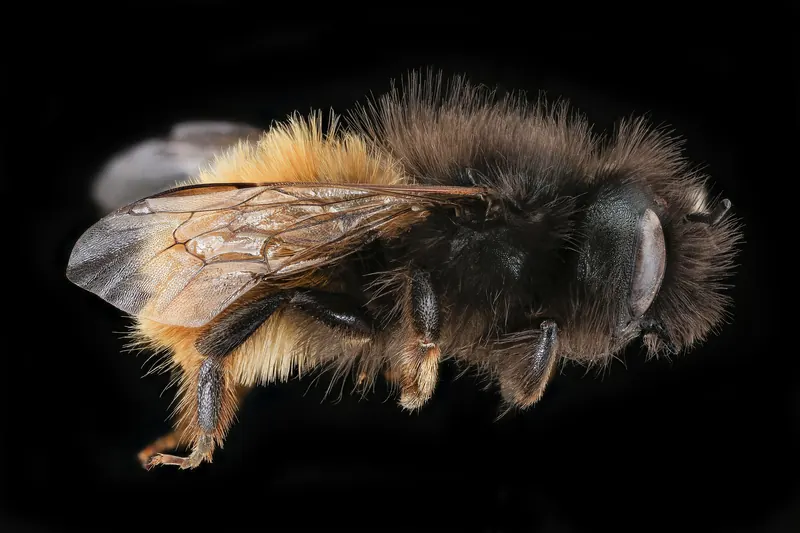
The horned mason bee is a solitary European mason bee that flies in early spring, in time with fruit tree bloom. Females nest in existing holes, separating cells with mud walls, and have small horns on the face. It is used to pollinate almond and pear orchards and has recently been found in Britain and Canada.
What we know
How to recognise it
Females have a hollowed face plate (clypeus) with small horns sticking out at the sides.
Confirmed fact[3]
Where it lives
Life cycle and colony
It is a solitary bee, but many females like to nest close together in the same place.
Confirmed fact[2]It has one generation a year and spends the winter as an adult inside its cocoon.
Confirmed fact[2]Adults fly from about February to April, at the same time as fruit trees bloom.
Confirmed fact[1]Males start to emerge a few days before the females.
Confirmed fact[1]
Nest
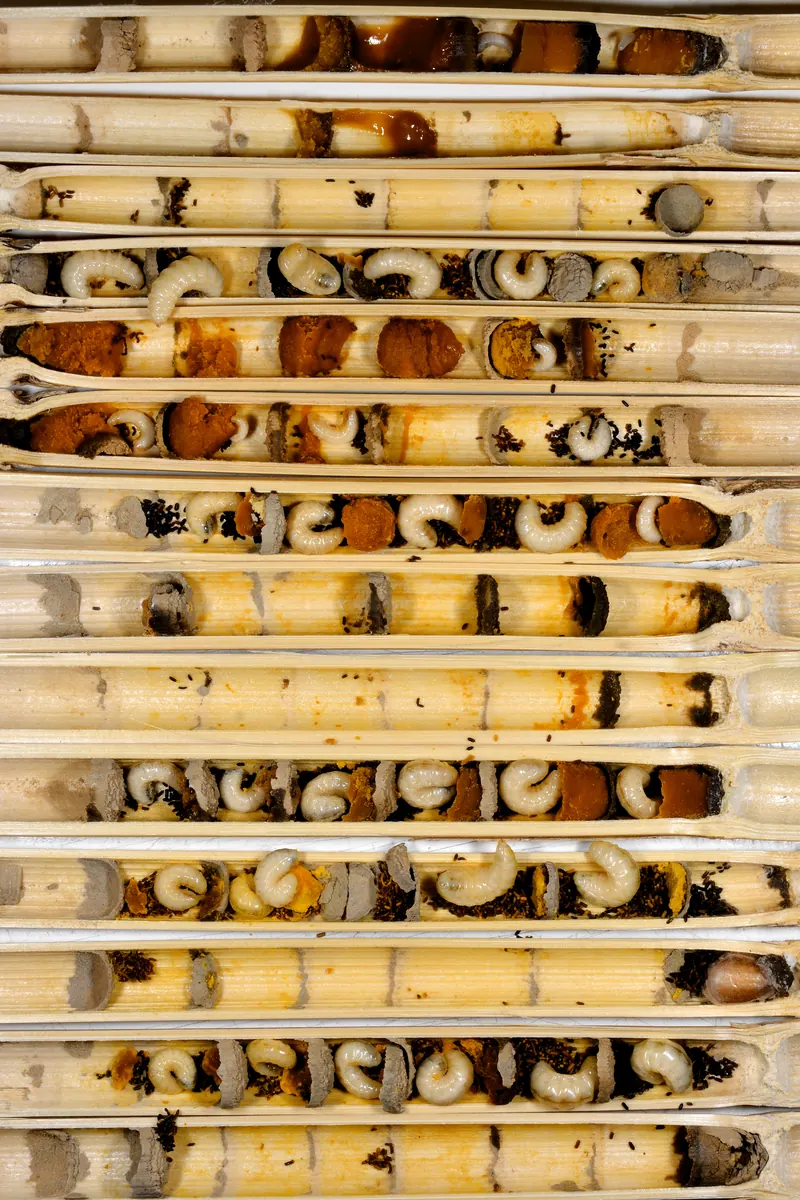
Females nest in holes that already exist, building a row of cells separated by walls of mud.
Confirmed fact[1]
Flowers and food
It collects pollen from many kinds of plants, but prefers trees and shrubs of the rose family.
Confirmed fact[3]
Bees and people
In almond orchards, about three females per tree are considered enough to get the most pollination.
Confirmed fact[1]It is used in pear orchards, whose flowers make low-sugar nectar and so fail to attract honey bees.
Confirmed fact[2]Thousands were released in Logan, Utah, in 1978, but after nests were found the next year the species was not recorded there again.
Confirmed fact[3]
Conservation
Scientists suggest it could compete with the native blue orchard bee for nest sites and flowers where the two overlap in North America.
Open question[3]
Where it has been recorded
Each hexagon contains at least one record of Osmia cornuta shared with GBIF: museum specimens, surveys and photographs.
82,848 records
- Germany29,188
- Netherlands27,801
- Belgium12,421
- France5,237
- Switzerland2,017
- Austria2,004
GBIF.org occurrence data for taxon key 5039293, retrieved 2026-10-19. Observation[5]
Records show where the bee has been found and reported, not its full range or its abundance. Isolated points far from the main cluster can be misidentifications, captive or imported bees, or genuine rare finds.
More from this part of the bee family tree
Sources
- Bosch, J. (1994). The nesting behaviour of the mason bee Osmia cornuta (Latr) with special reference to its pollinating potential (Hymenoptera, Megachilidae). Apidologie 25: 84-93. Link
- Maccagnani, B., Burgio, G., Stanisavljević, L.Ž. and Maini, S. (2007). Osmia cornuta management in pear orchards. Bulletin of Insectology 60(1): 77-82. Link
- Getz, M.P., Best, L.R., Melathopoulos, A.P. and Warren, T.L. (2024). The establishment and potential spread of Osmia cornuta (Hymenoptera: Megachilidae) in North America. Environmental Entomology 53(6), doi:10.1093/ee/nvae100 (text read from the bioRxiv preprint 10.1101/2024.06.18.599626). Link
- Bees, Wasps & Ants Recording Society (BWARS). Osmia cornuta Latreille, 1805 (species page, placeholder account). Link
- GBIF.org (2026). Occurrence search and density maps for Osmia cornuta, taxon key 5039293. Link
Last checked: 20 October 2026. Every statement on this page was compared with the source it cites. Spotted an error? Report it.