Apidae
Tetragonisca angustula
Jatai, Mariola, Angelita
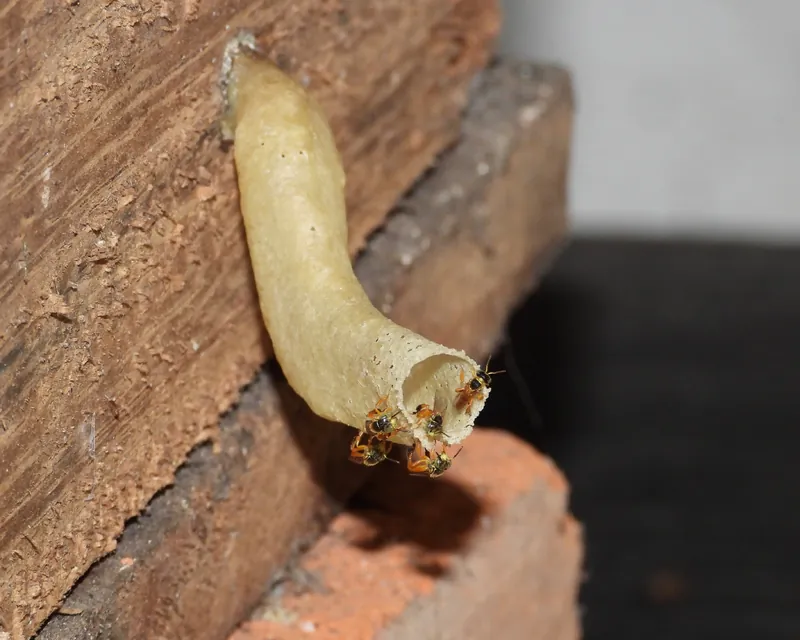
Tetragonisca angustula, the jatai, is a tiny common stingless bee found from Veracruz in Mexico to Misiones in Argentina. Colonies of up to 10,000 workers nest in cavities behind a wax entrance tube guarded by larger soldier bees, the first physical soldier caste documented in a bee. People keep it in hives, though it yields little honey.
What we know
Where it lives
It is a common species whose range runs from Veracruz in Mexico to Misiones in Argentina.
Confirmed fact[1]
Life cycle and colony
Jatai colonies can contain up to 10,000 workers.
Confirmed fact[1]This study provided evidence of a physical soldier subcaste in a bee, something not previously documented in social bees or wasps.
Confirmed fact[1]Soldiers are reared in low but sufficient numbers, about 1 to 2 percent of emerging workers.
Confirmed fact[1]
Nest
Behaviour
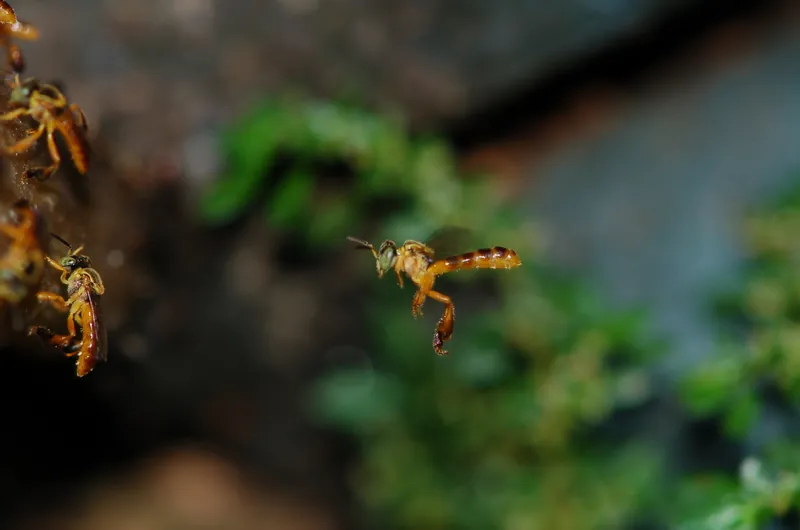
A second group of guards hovers in the air near the entrance tube.
Confirmed fact[1]Both kinds of guard are about 30 percent heavier than foragers and differently shaped: foragers have relatively larger heads, guards have larger legs.
Confirmed fact[1]When challenged by the obligate robber bee Lestrimelitta limao, an important natural enemy, larger guards could fight the much larger robber for longer before being defeated.
Confirmed fact[1]Jatai is one of the main targets of Lestrimelitta limao raids, and in the Brazilian study area attacks frequently ended in the death of the colony.
Confirmed fact[1]Unlike many ants, jatai guards use their jaws not to cut or crush an enemy but to grab and clamp onto it.
Confirmed fact[1]Colonies keep more soldiers in areas where attacks by Lestrimelitta robber bees are more common.
Confirmed fact[2]
Bees and people
Where it has been recorded
Each hexagon contains at least one record of Tetragonisca angustula shared with GBIF: museum specimens, surveys and photographs.
9,908 records
- Brazil5,523
- Colombia1,241
- Costa Rica1,205
- Mexico1,051
- Guatemala171
- Venezuela114
GBIF.org occurrence data for taxon key 1339480, retrieved 2026-10-19. Observation[4]
Records show where the bee has been found and reported, not its full range or its abundance. Isolated points far from the main cluster can be misidentifications, captive or imported bees, or genuine rare finds.
More from this part of the bee family tree
Sources
- Gruter, C., Menezes, C., Imperatriz-Fonseca, V.L. & Ratnieks, F.L.W. (2012). A morphologically specialized soldier caste improves colony defense in a neotropical eusocial bee. Proceedings of the National Academy of Sciences USA 109(4): 1182-1186. https://doi.org/10.1073/pnas.1113398109 Link
- Gruter, C., Segers, F.H.I.D., Menezes, C., Vollet-Neto, A., Falcon, T., von Zuben, L., Bitondi, M.M.G., Nascimento, F.S. & Almeida, E.A.B. (2017). Repeated evolution of soldier sub-castes suggests parasitism drives social complexity in stingless bees. Nature Communications 8: 4. https://doi.org/10.1038/s41467-016-0012-y Link
- Bradbear, N. (2009). Bees and their role in forest livelihoods. Non-Wood Forest Products 19. FAO, Rome. Chapter 6, Meliponiculture of stingless bees, pp. 51-53. Link
- GBIF.org (2026). Occurrence search and density maps for Tetragonisca angustula, taxon key 1339480. Link
Last checked: 30 October 2026. Every statement on this page was compared with the source it cites. Spotted an error? Report it.