Apidae
Tetragonula carbonaria
Stingless bee, Sugarbag bee
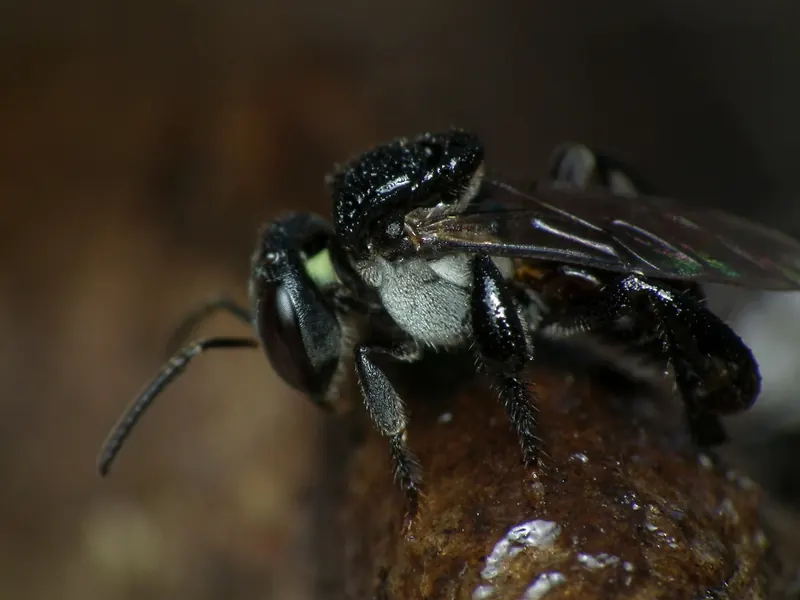
A tiny dark stingless bee of coastal eastern Australia, from Queensland to southern New South Wales. Colonies of several thousand bees live in tree trunks or boxes and build a spiral-shaped brood comb. It makes a thin honey that can be eaten as bush tucker and is increasingly used to pollinate macadamia orchards.
What we know
How to recognise it
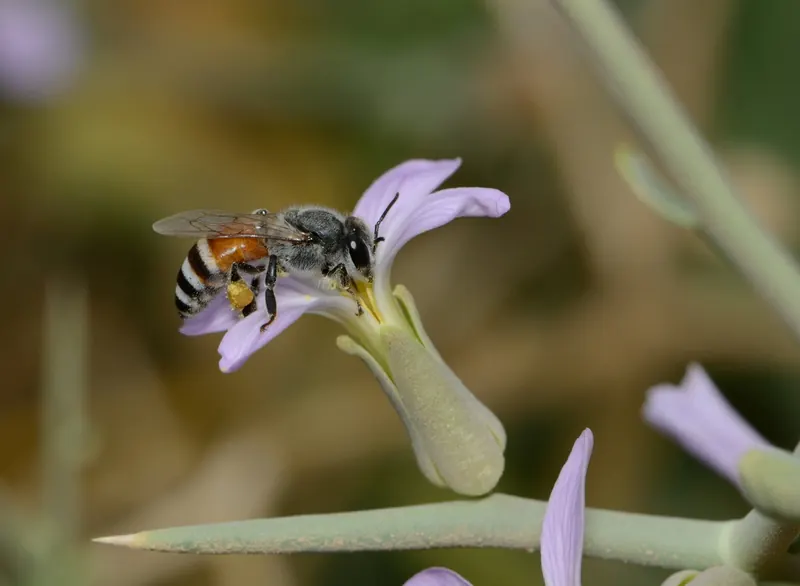
These are small, dark bees about 4 to 5 mm long.
Confirmed fact[1]
Where it lives
It lives in coastal areas of eastern Australia, from Queensland to southern New South Wales.
Confirmed fact[1]
Life cycle and colony
The queen lays a single egg in each brood cell already stocked with honey and pollen, and a worker quickly seals the cell.
Confirmed fact[1]
Nest
Nests are usually in the trunks of large trees and can hold several thousand bees.
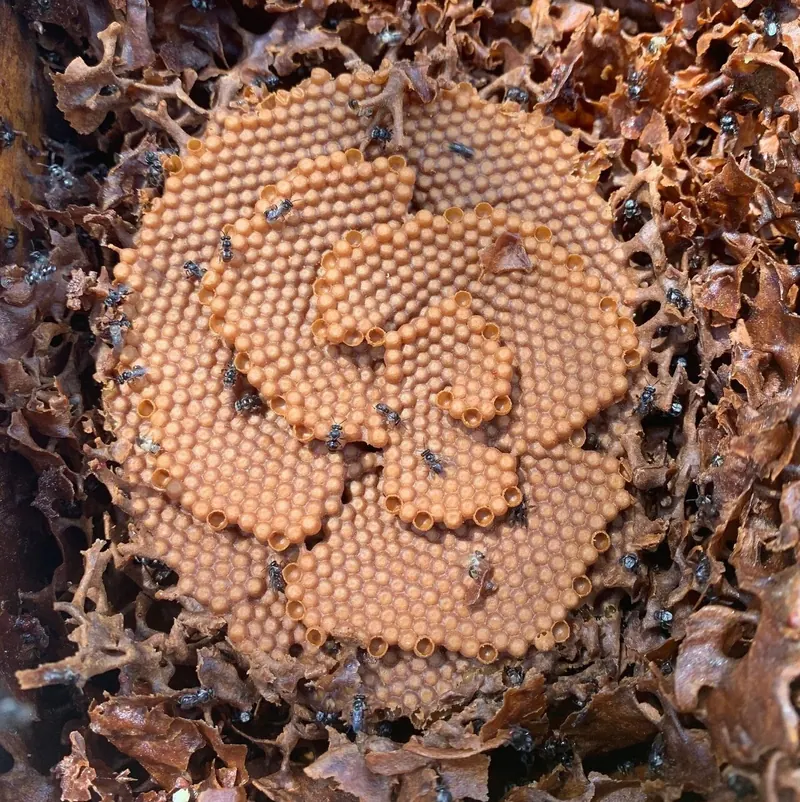
Confirmed fact[1]Nests are made of wax and resin, with a spiral brood comb, in standing trees (living or dead) averaging 55 cm across, or in specially built boxes.
Confirmed fact[2]Pollen and nectar are kept in pot-like structures near the outer edge of the nest.
Confirmed fact[1]
Flowers and food
Recorded flower visits include fruit trees, sunflowers and many native plants such as Eucalyptus, Banksia, Melaleuca, Telopea (waratah) and Xanthorrhoea (grass trees).
Confirmed fact[2]
Behaviour
Its brood comb can form a spiral or even a double spiral, built in layers as workers add new cells to the edge of each terrace.
Confirmed fact[3]Workers can lead nestmates to good food sources using a chemical scent trail.
Confirmed fact[1]Colonies can be attacked by the related Tetragonula hockingsi in a series of aerial battles; scientists say many features of these fights remain unexplained.
Open question[6]
Bees and people
Like other Tetragonula bees, it has no sting and is harmless to people.
Confirmed fact[1]It makes a thin honey that can be eaten as bush tucker, and it is also known as the sugarbag bee.
Confirmed fact[1]In macadamia orchards it mainly collects pollen and touches the flower's stigma closely; caged flowers visited only by these bees set as many nuts as open flowers.
Confirmed fact[4]It is increasingly used as a managed pollinator in Australian macadamia orchards, where newly placed colonies at first favour macadamia pollen.
Confirmed fact[5]
Where it has been recorded
Each hexagon contains at least one record of Tetragonula carbonaria shared with GBIF: museum specimens, surveys and photographs.
2,898 records
- Australia2,838
- Japan1
GBIF.org occurrence data for taxon key 1344544, retrieved 2026-10-19. Observation[7]
Records show where the bee has been found and reported, not its full range or its abundance. Isolated points far from the main cluster can be misidentifications, captive or imported bees, or genuine rare finds.
More from this part of the bee family tree
Sources
- Australian Museum (2024). Stingless Bee, Tetragonula carbonaria. The Australian Museum, Sydney (updated 06/09/24). Link
- Australian Faunal Directory. Species Tetragonula carbonaria (Smith, 1854). Australian Biological Resources Study, Canberra. Link
- Cardoso, S. S. S., Cartwright, J. H. E., Checa, A. G., Escribano, B., Osuna-Mascaró, A. J. & Sainz-Díaz, C. I. (2020). The bee Tetragonula builds its comb like a crystal. Journal of the Royal Society Interface 17(168): 20200187. Link
- Heard, T. A. (1994). Behaviour and pollinator efficiency of stingless bees and honey bees on macadamia flowers. Journal of Apicultural Research 33(4): 191-198. Link
- Allison, C. E., Makinson, J. C., Spooner-Hart, R. N. & Cook, J. M. (2025). The impact of colony deployment timing on Tetragonula carbonaria crop fidelity and resource use in macadamia orchards. Plants 14(15): 2313. Link
- Cunningham, J. P., Hereward, J. P., Heard, T. A., De Barro, P. J. & West, S. A. (2014). Data from: Bees at war: interspecific battles and nest usurpation in stingless bees. Dryad dataset, doi:10.5061/dryad.2ng61 (abstract of the associated journal article). Link
- GBIF.org (2026). Occurrence search and density maps for Tetragonula carbonaria, taxon key 1344544. Link
Last checked: 20 October 2026. Every statement on this page was compared with the source it cites. Spotted an error? Report it.