Apidae
Anthophora plumipes
Hairy-footed flower bee
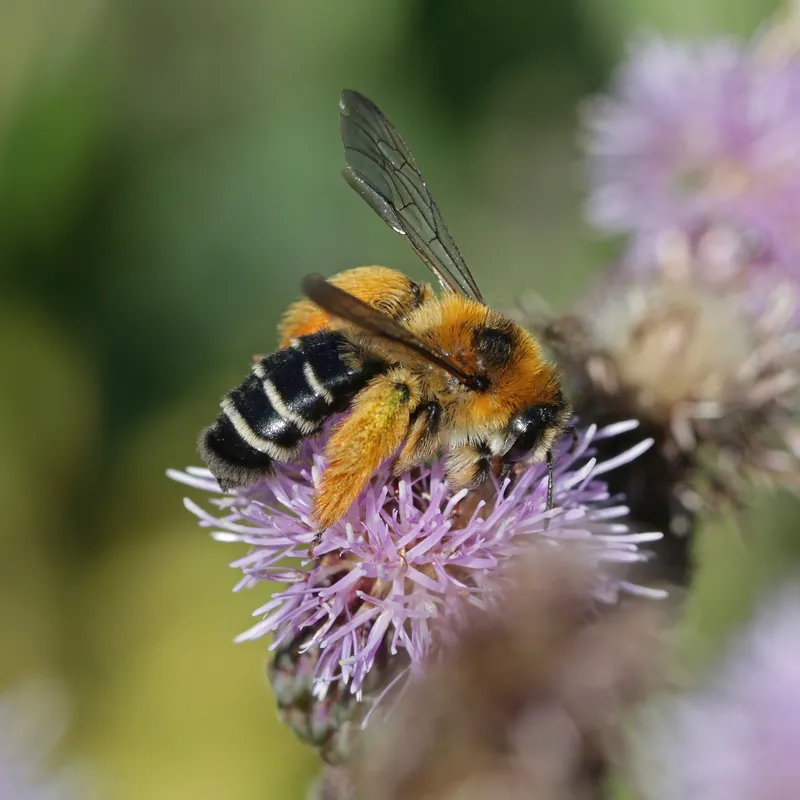
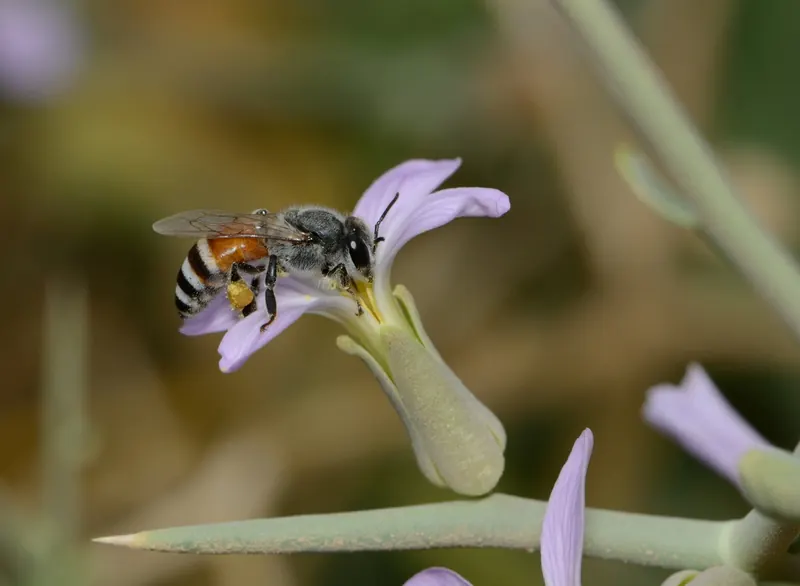
A fast-flying spring bee of gardens and cliffs, found across Eurasia from Britain to Japan and introduced to the eastern United States. Males are reddish brown, females black with orange hairs on the hind legs. Females nest in groups in vertical soil faces or soft walls, and the adults wait out the winter inside their sealed cells.
What we know
How to recognise it
Where it lives
In Britain it occurs through much of England and Wales, with recent records from Edinburgh in Scotland.
Confirmed fact[1]It is widely distributed across Eurasia, from Britain east to China and Japan and south to North Africa.
Confirmed fact[1]It was introduced to North America in 1980 at the USDA bee laboratory in Beltsville, Maryland, from stock originating in Europe and southern China.
Confirmed fact[2]In the United States it is now commonly found in early spring across the Washington D.C. metropolitan area, where it nests in the ground under porches.
Confirmed fact[2]
Life cycle and colony
Nest
Flowers and food
It has a particular fondness for lungwort (Pulmonaria) flowers.
Confirmed fact[1]
Behaviour
Bees and people
In Cambridgeshire it is an important pollinator of autumn-sown field beans.
Confirmed fact[1]
Where it has been recorded
Each hexagon contains at least one record of Anthophora plumipes shared with GBIF: museum specimens, surveys and photographs.
58,944 records
- United Kingdom21,126
- Netherlands9,278
- Germany7,703
- Belgium6,752
- Switzerland3,703
- France2,834
GBIF.org occurrence data for taxon key 1344087, retrieved 2026-10-19. Observation[4]
Records show where the bee has been found and reported, not its full range or its abundance. Isolated points far from the main cluster can be misidentifications, captive or imported bees, or genuine rare finds.
More from this part of the bee family tree
Sources
- Else, G. R. (2006, updated 2021; identification notes by N. Jones 2011). Anthophora plumipes (Pallas, 1772). Species account, Bees, Wasps & Ants Recording Society (BWARS). Link
- Droege, S. (2008). North American (North of Mexico) Introduced and Alien Bee Species. USGS Patuxent Wildlife Research Center, July 2008 (archived NBII document). Link
- Stone, G. N. (1993). Endothermy in the solitary bee Anthophora plumipes: independent measures of thermoregulatory ability, costs of warm-up and the role of body size. Journal of Experimental Biology 174(1): 299-320. Link
- GBIF.org (2026). Occurrence search and density maps for Anthophora plumipes, taxon key 1344087. Link
Last checked: 30 October 2026. Every statement on this page was compared with the source it cites. Spotted an error? Report it.