Apidae
Peponapis pruinosa
Squash bee, Pruinose squash bee, Hoary squash bee
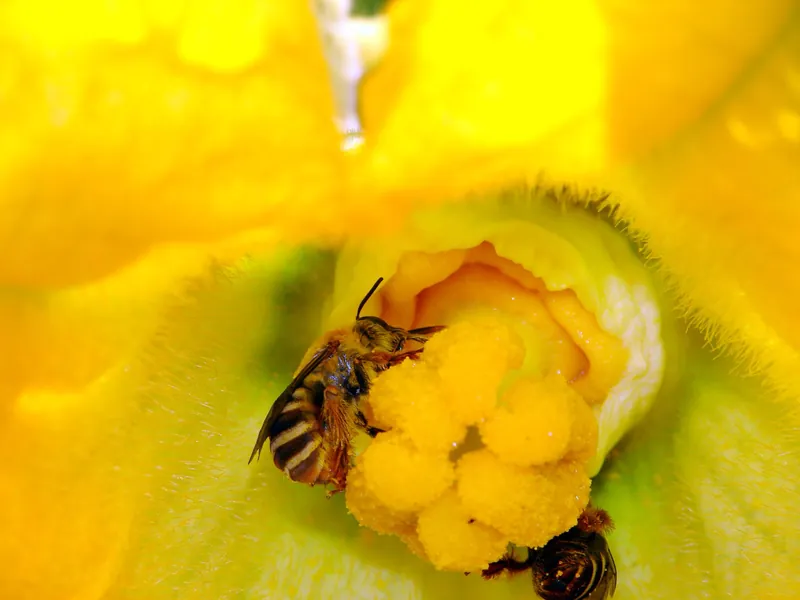
The squash bee is a solitary, ground-nesting bee of North America that collects pollen only from squash, pumpkin and gourd flowers. It forages from sunrise, and males sleep in the wilted blossoms by noon. It followed the human spread of squash crops out of Mexico and is a key pollinator in gardens and farms.
What we know
How to recognise it
Where it lives
Squash bees occur throughout much of the United States and Mexico.
Confirmed fact[1]It is the most widespread squash bee, found from Quebec south into Mexico wherever squashes are grown.
Confirmed fact[2]Squash was first domesticated in Mexico, and genetic evidence shows the squash bee spread across North America by following the human spread of its Cucurbita pollen hosts during the Holocene.
Confirmed fact[3]
Life cycle and colony
Like most North American native bees, squash bees are solitary and nest in the ground.
Confirmed fact[1]In North Carolina, adults are active in midsummer, from June to August.
Confirmed fact[1]The next generation of bees spends most of the year sealed inside those underground nest cells.
Confirmed fact[1]
Nest
Females usually build their nest cells 6 to 12 inches (about 15 to 30 cm) underground, often right under the squash plants.
Confirmed fact[1]
Flowers and food
Squash bees gather pollen only from plants in the genus Cucurbita, which includes squashes, pumpkins and gourds.
Confirmed fact[1]
Behaviour
Bees and people
Only 6 to 10 squash bee visits are needed to fully pollinate a female squash flower.
Confirmed fact[1]
Conservation
Because the bees nest in the soil under squash plants, tilling a squash bed at any time of year can destroy them.
Confirmed fact[1]
Where it has been recorded
Each hexagon contains at least one record of Peponapis pruinosa shared with GBIF: museum specimens, surveys and photographs.
11,174 records
- United States10,582
- Canada408
- Mexico183
- Germany1
GBIF.org occurrence data for taxon key 1339646, retrieved 2026-10-19. Observation[4]
Records show where the bee has been found and reported, not its full range or its abundance. Isolated points far from the main cluster can be misidentifications, captive or imported bees, or genuine rare finds.
More from this part of the bee family tree
Sources
- Frank, S. and Youngsteadt, E. (2015, revised 2024). Squash Bees in the Home Garden. NC State Extension Publications, North Carolina State University. Link
- Cane, J.H. (USDA ARS Bee Biology and Systematics Laboratory, Logan, Utah). Squash Bees. Pollinator of the Month, Celebrating Wildflowers, USDA Forest Service. Link
- Lopez-Uribe, M.M., Cane, J.H., Minckley, R.L. and Danforth, B.N. (2016). Crop domestication facilitated rapid geographical expansion of a specialist pollinator, the squash bee Peponapis pruinosa. Proceedings of the Royal Society B: Biological Sciences 283(1833): 20160443. doi:10.1098/rspb.2016.0443. Abstract read on Penn State Pure. Link
- GBIF.org (2026). Occurrence search and density maps for Peponapis pruinosa, taxon key 1339646. Link
Last checked: 30 October 2026. Every statement on this page was compared with the source it cites. Spotted an error? Report it.