Apidae
Apis dorsata
Giant honey bee, Rock bee
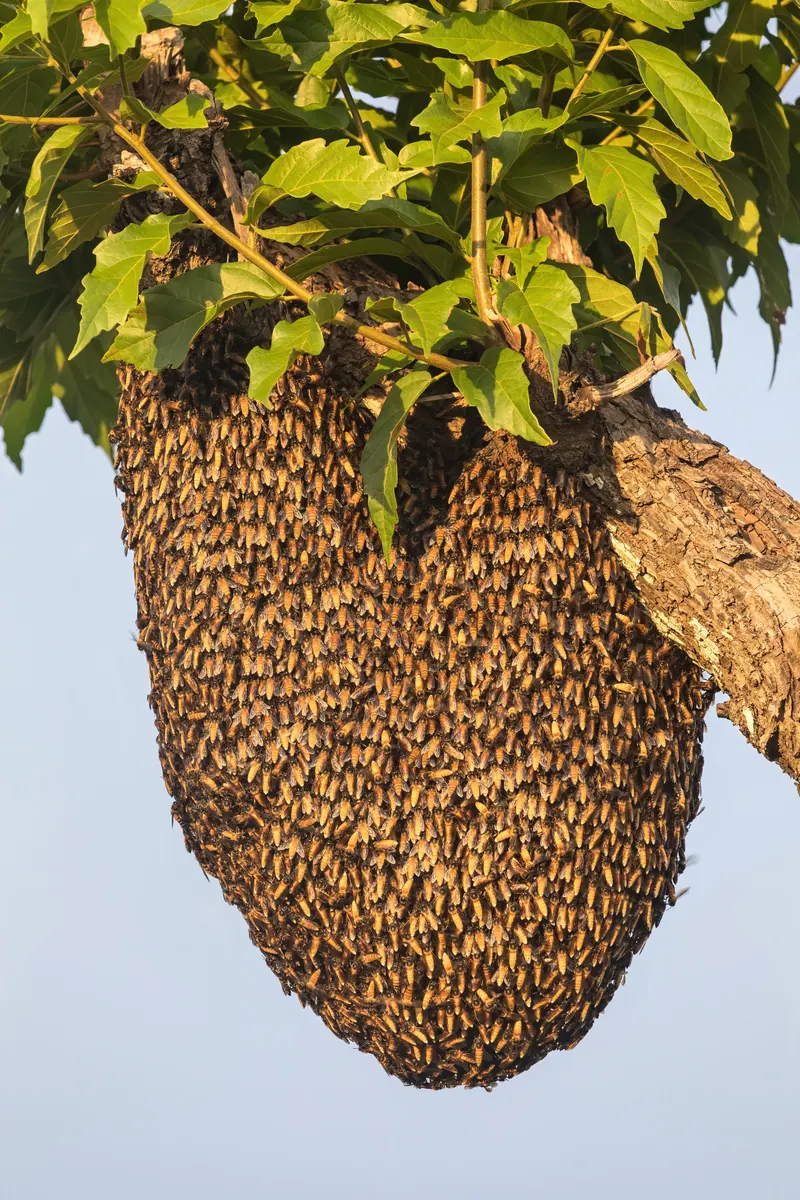
The giant honey bee lives across southern Asia. Each colony builds one huge exposed comb high under a tree branch or cliff, covered by a living curtain of up to 100,000 workers. Colonies can make seasonal long-distance migrations, and honey hunters traditionally harvest the nests on moonless nights.
What we know
How to recognise it
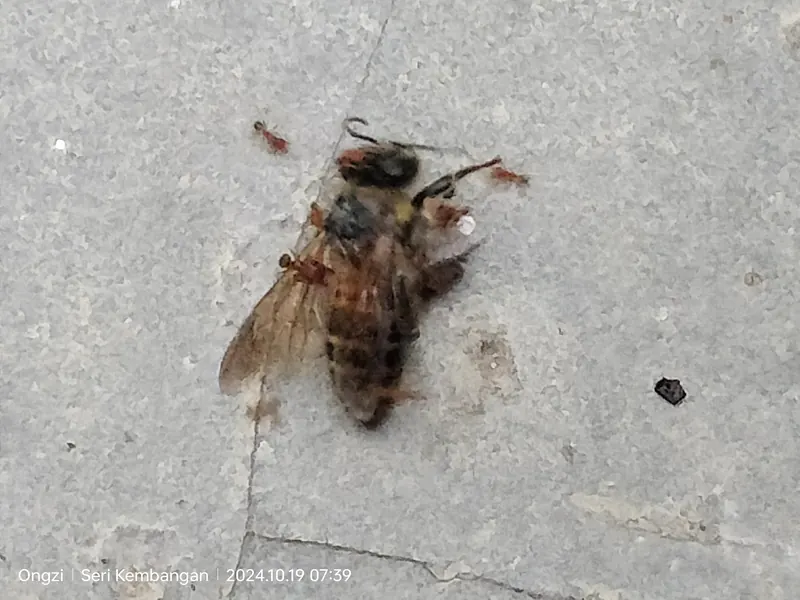
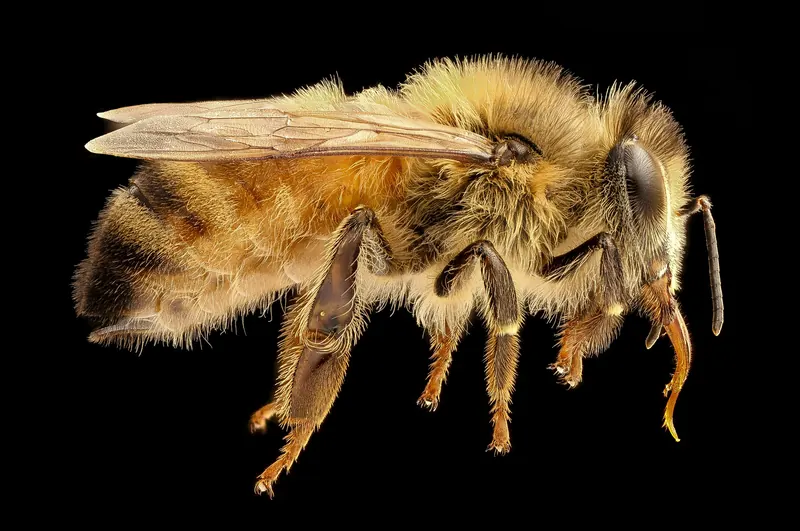
It looks very similar to the western honey bee but is larger.
Confirmed fact[1]
Where it lives
Life cycle and colony
Nest
Each colony builds a single, large comb out in the open, hanging under a tree branch or a cliff.
Confirmed fact[1]The comb is very large: one guide gives up to 150 cm long and 70 cm tall, while an FAO account describes combs as much as one metre wide.
Confirmed fact[1]Nests are usually built high up, from about 3 to 25 metres above the ground.
Confirmed fact[2]Colonies often nest close together: 10 to 20 nests in one tall tree is not unusual.
Confirmed fact[2]
Behaviour
A migrating colony has been seen returning to the exact same branch six months later.
Observation[1]When threatened, the bees perform shimmering: a wave that ripples across the surface of the bee curtain in a fraction of a second.
Confirmed fact[1]A mass of defending workers can chase attackers over long distances, sometimes more than 100 metres.
Confirmed fact[2]
Bees and people
Honey hunters traditionally harvest giant honey bee nests on a moonless night, so that fewer bees are flying.
Confirmed fact[1]
Conservation
The giant honey bee is the natural host of Tropilaelaps mites, which are parasites of honey bees.
Confirmed fact[1]
Where it has been recorded
Each hexagon contains at least one record of Apis dorsata shared with GBIF: museum specimens, surveys and photographs.
11,435 records
- India4,856
- Thailand1,713
- Malaysia1,070
- Indonesia868
- Philippines469
- Sri Lanka437
GBIF.org occurrence data for taxon key 1341978, retrieved 2026-10-19. Observation[3]
Records show where the bee has been found and reported, not its full range or its abundance. Isolated points far from the main cluster can be misidentifications, captive or imported bees, or genuine rare finds.
More from this part of the bee family tree
Sources
- Jack, C. J., Lucky, A., & Ellis, J. D. (2016, revised 2019). Giant Honey Bee (suggested common name) Apis dorsata Fabricius (Insecta: Hymenoptera: Apidae). University of Florida IFAS Extension, Featured Creatures EENY646/IN1119. https://doi.org/10.32473/edis-in1119-2016 Link
- Akratanakul, P. (1990). Beekeeping in Asia, Chapter 1: Honeybees of the genus Apis. FAO Agricultural Services Bulletin 68/4. Rome: FAO. Link
- GBIF.org (2026). Occurrence search and density maps for Apis dorsata, taxon key 1341978. Link
Last checked: 20 October 2026. Every statement on this page was compared with the source it cites. Spotted an error? Report it.