Apidae
Amegilla cingulata
Blue-banded bee, Common blue-banded bee
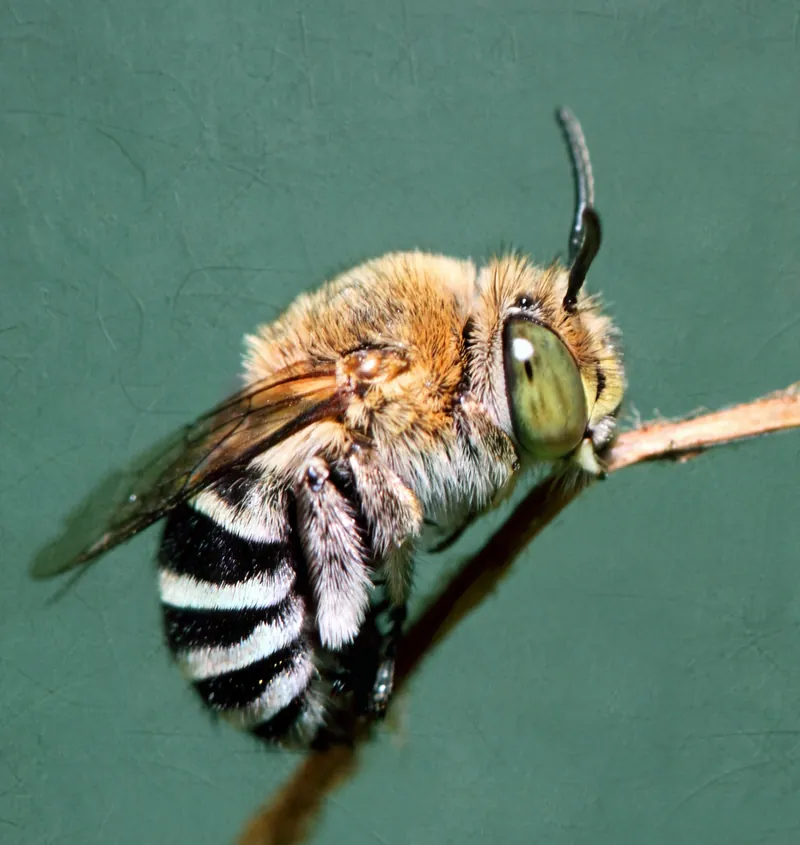
An Australian bee with metallic blue hair bands across the abdomen and orange hair on the thorax, found along the east coast of New South Wales and Queensland. It is solitary and nests in groups in decomposing sandstone. Like other blue-banded bees it is a buzz pollinator that visits many flowers, including tomato.
What we know
How to recognise it
Females are about 14 mm long with a 9 mm forewing; males are about 13 mm long with an 8 mm forewing.
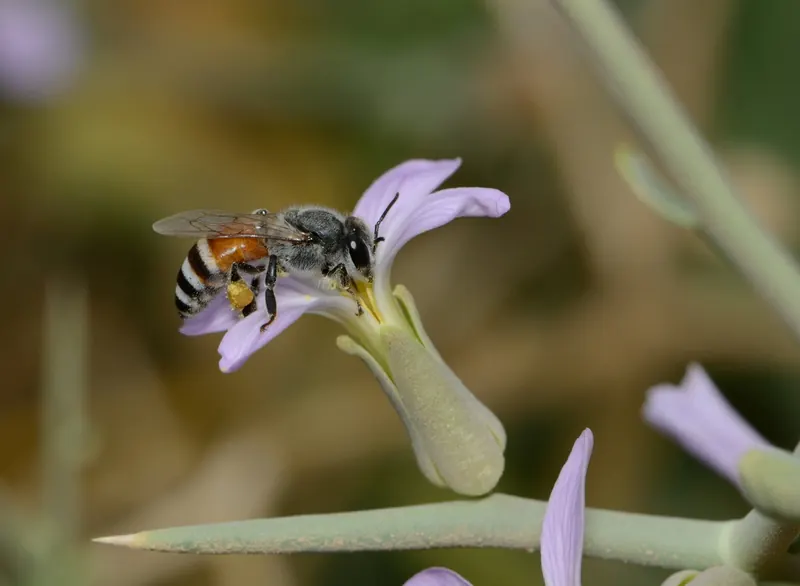
Confirmed fact[1]Both sexes are easy to recognise by metallic blue hair bands across the abdomen and orange hair on the top of the thorax.
Confirmed fact[1]The thoracic hair, especially in females, is consistently bright orange, and the blue abdominal bands are seldom tinged with orange.
Confirmed fact[1]
Where it lives
This bee lives along the east coast of New South Wales and Queensland in eastern Australia.
Confirmed fact[1]
Life cycle and colony
Adults are solitary, flying, nectar-feeding bees according to the Australian Faunal Directory.
Confirmed fact[3]
Nest
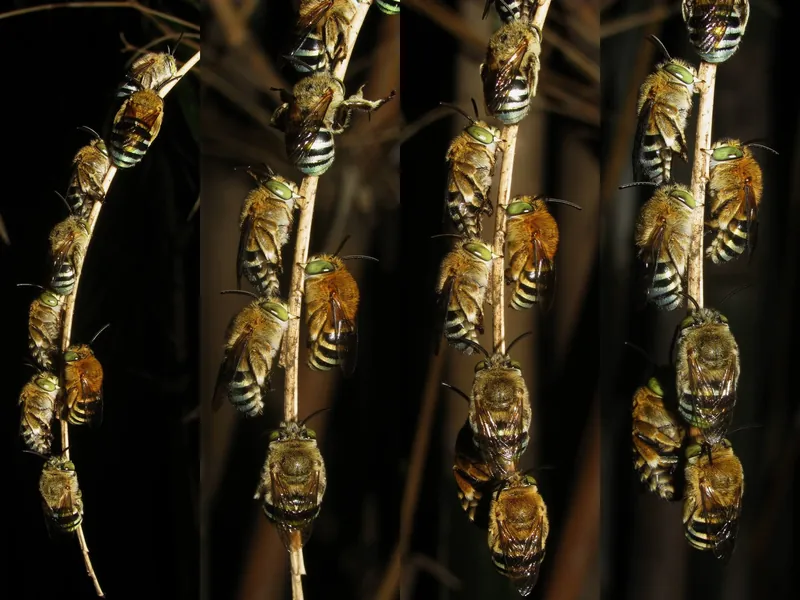
Females nest in groups, digging their burrows in decomposing sandstone.
Confirmed fact[3]An old museum specimen now treated as this species was labelled as taken from a tunnelled cell in the plaster wall of an old house.
Observation[1]Some blue-banded bee species are known to nest in sand, loam or clay soils, and also in soft sandstone, clay washouts and mud bricks.
Confirmed fact[2]In this genus, nests are often found in large aggregations that are re-used for many generations.
Confirmed fact[2]
Flowers and food
Behaviour
Like other Amegilla, it belongs to the group of buzz-pollinating bees.
Confirmed fact[2]
Bees and people
Where it has been recorded
Each hexagon contains at least one record of Amegilla cingulata shared with GBIF: museum specimens, surveys and photographs.
1,825 records
- Australia1,766
- Austria16
- Estonia8
- Ukraine8
- Netherlands7
- Pakistan7
GBIF.org occurrence data for taxon key 1339786, retrieved 2026-10-19. Observation[4]
Records show where the bee has been found and reported, not its full range or its abundance. Isolated points far from the main cluster can be misidentifications, captive or imported bees, or genuine rare finds.
More from this part of the bee family tree
Sources
- Leijs, R., Batley, M. and Hogendoorn, K. (2017). The genus Amegilla (Hymenoptera, Apidae, Anthophorini) in Australia: A revision of the subgenera Notomegilla and Zonamegilla. ZooKeys 653: 79-140. doi:10.3897/zookeys.653.11177. Species treatment of Amegilla (Zonamegilla) cingulata, pp. 110-115, read via Plazi TreatmentBank. Link
- Leijs, R., Batley, M. and Hogendoorn, K. (2017). The genus Amegilla (Hymenoptera, Apidae, Anthophorini) in Australia: A revision of the subgenera Notomegilla and Zonamegilla. ZooKeys 653: 79-140. doi:10.3897/zookeys.653.11177. Introduction and general sections, read on the publisher's site. Link
- Australian Faunal Directory (Australian Biological Resources Study, Department of Climate Change, Energy, the Environment and Water). Species Amegilla (Zonamegilla) cingulata (Fabricius, 1775). Accessed 29 October 2026. Link
- GBIF.org (2026). Occurrence search and density maps for Amegilla cingulata, taxon key 1339786. Link
Last checked: 30 October 2026. Every statement on this page was compared with the source it cites. Spotted an error? Report it.