Apidae
Bombus lapidarius
Red-tailed bumblebee, Large red-tailed bumble bee
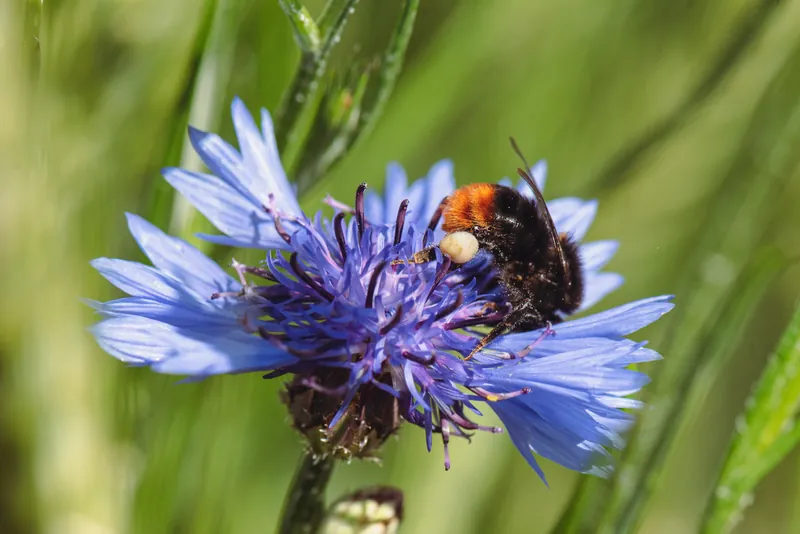
A black bumblebee with a bright red tail, widespread across Europe from the Arctic Circle in Finland to the mountains of Morocco and east into Russia and the Caucasus. Queens emerge in March and found underground nests in old mammal nests that grow to 100 to 300 workers. It has no clear flower preferences and is common in gardens, open countryside and woodland.
What we know
How to recognise it
Queens and workers are black with extensive red over the last quarter of the abdomen and no yellow bands on the thorax.
Confirmed fact[1]Males also have the red tail but usually carry extensive yellow markings on the face and thorax.
Confirmed fact[1]Adults are about 10 to 23 mm long: queens about 20 to 22 mm, workers 11 to 16 mm and males 14 to 16 mm.
Confirmed fact[2]
Where it lives
It is widely distributed throughout Britain and Ireland and has been extending its range into northern Scotland in recent decades.
Confirmed fact[1]It is very widespread across central Europe and reaches north to the Arctic Circle in Finland, though it is uncommon beyond the latitude of Stockholm.
Confirmed fact[3]Its most southern record is in Morocco, in the alpine zone of Jbel Siroua, where a separate subspecies occurs.
Confirmed fact[3]It lives in a wide range of habitats and is regularly seen in gardens as well as open countryside and woodland.
Confirmed fact[1]
Life cycle and colony
Nest
Nests are underground and are started in old mammal nests.
Confirmed fact[1]
Flowers and food
It shows no clear flower preferences, though it is said to be fond of visiting yellow flowers.
Confirmed fact[1]
Behaviour
In a genetic study on arable farmland in the UK, its estimated maximum foraging range was about 450 m from the nest, shorter than the 758 m estimated for the buff-tailed bumblebee.
Statistical estimate[4]In the same study it had the highest estimated nest density of the four species compared, about 117 nests per square kilometre.
Statistical estimate[4]
Conservation
In Britain it is not regarded as scarce or threatened.
Confirmed fact[1]
Where it has been recorded
Each hexagon contains at least one record of Bombus lapidarius shared with GBIF: museum specimens, surveys and photographs.
364,422 records
- United Kingdom94,715
- Netherlands86,296
- Germany55,540
- Belgium27,905
- Switzerland25,700
- Sweden17,584
GBIF.org occurrence data for taxon key 1340301, retrieved 2026-10-19. Observation[5]
Records show where the bee has been found and reported, not its full range or its abundance. Isolated points far from the main cluster can be misidentifications, captive or imported bees, or genuine rare finds.
More from this part of the bee family tree
Sources
- Edwards, M. Bombus lapidarius (Linnaeus, 1758), species account. Bees, Wasps & Ants Recording Society (BWARS). Link
- Watson, L. & Dallwitz, M. J. (2003 onwards). Insects of Britain and Ireland: the bumblebees and cuckoo bees (Bombus and Psithyrus). Bombus lapidarius (Linnaeus). DELTA database, version 27 July 2019. Link
- Rasmont, P. Bombus (Melanobombus) lapidarius (L., 1758). Atlas Hymenoptera, University of Mons. Link
- Knight, M. E., Martin, A. P., Bishop, S., Osborne, J. L., Hale, R. J., Sanderson, A. & Goulson, D. (2005). An interspecific comparison of foraging range and nest density of four bumblebees (Bombus) species. Molecular Ecology 14(6): 1811-1820. Link
- GBIF.org (2026). Occurrence search and density maps for Bombus lapidarius, taxon key 1340301. Link
Last checked: 30 October 2026. Every statement on this page was compared with the source it cites. Spotted an error? Report it.