Apidae
Bombus impatiens
Common eastern bumble bee
One of the most widespread and abundant bumble bees of the eastern United States and adjacent Canada, with a pale yellow thorax and first abdominal segment and a black abdomen. Colonies nest underground and can grow to several hundred bees by autumn. It is North America's main commercially reared bumble bee and has established outside its native range.
What we know
How to recognise it
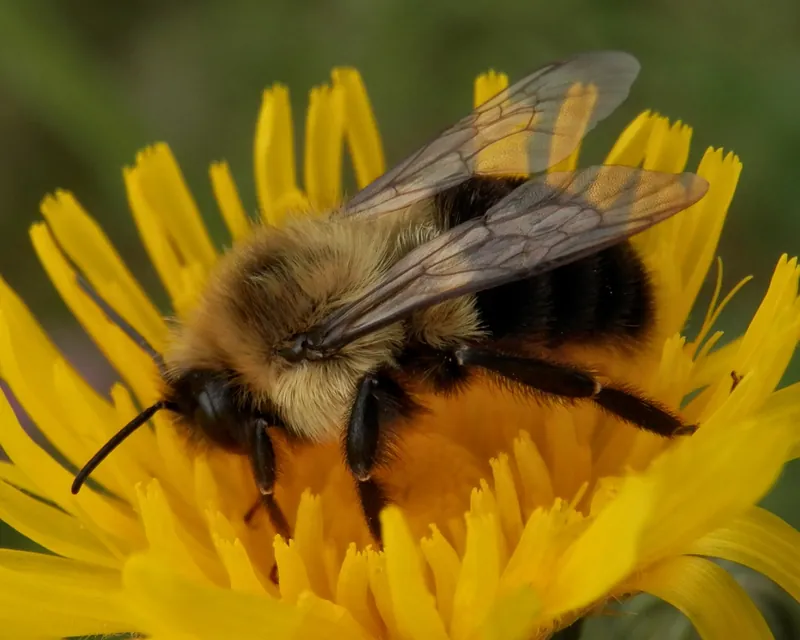
Females have a mostly pale yellow thorax and first abdominal segment, with some black hairs mixed in between the wing bases.
Confirmed fact[1]Only the first abdominal segment is yellow; all the remaining segments are black.
Confirmed fact[6]Queens are 17 to 21 mm long, males 12 to 17 mm and workers 8.5 to 16 mm.
Confirmed fact[5]
Where it lives
It is one of the most widespread and abundant bumble bees in the eastern United States and adjacent Canada.
Confirmed fact[2]Having been developed as a managed commercial pollinator, it has been exported to several Canadian provinces outside its native range of southern Ontario and Quebec.
Confirmed fact[3]It is now established beyond its natural range in New Brunswick, Nova Scotia, Prince Edward Island and British Columbia.
Confirmed fact[3]
Life cycle and colony
Nest
Colonies nest underground, and the entry tunnels can run from about 18 inches to 9 feet deep.
Confirmed fact[7]
Flowers and food
Its food plants include thistles, Eupatorium, Gelsemium, goldenrods and pickerel weeds.
Confirmed fact[1]
Bees and people
Of the five bumble bee species reared for crop pollination, the two major ones are Bombus terrestris from Eurasia and Bombus impatiens from North America.
Confirmed fact[4]
Conservation
An assessment completed in December 2014 by the IUCN Bumble Bee Specialist Group gave it a preliminary category of Least Concern, finding no declines in its range, persistence or relative abundance.
Confirmed fact[2]While a number of bumble bee species in Wisconsin have declined over the past 30 years, this species has stayed stable or perhaps even increased in abundance; this is thought to be because it can withstand agricultural landscapes and disturbance.
Open question[6]
Where it has been recorded
Each hexagon contains at least one record of Bombus impatiens shared with GBIF: museum specimens, surveys and photographs.
329,520 records
- United States276,033
- Canada53,106
- Costa Rica67
- Mexico61
- Guatemala2
- Cape Verde1
GBIF.org occurrence data for taxon key 1340350, retrieved 2026-10-19. Observation[8]
Records show where the bee has been found and reported, not its full range or its abundance. Isolated points far from the main cluster can be misidentifications, captive or imported bees, or genuine rare finds.
More from this part of the bee family tree
Sources
- Colla, S., Richardson, L. & Williams, P. (2011). Bumble Bees of the Eastern United States. USDA Forest Service and the Pollinator Partnership, publication FS-972. Link
- Hatfield, R., Colla, S., Jepsen, S., Richardson, L., Thorp, R. & Foltz Jordan, S. (2015). IUCN Assessments for North American Bombus spp. for the North American IUCN Bumble Bee Specialist Group. Assessments completed December 2014, updated 2 March 2015. Link
- Palmier, K. M. & Sheffield, C. S. (2019). First records of the Common Eastern Bumble Bee, Bombus impatiens Cresson (Hymenoptera: Apidae, Apinae, Bombini) from the Prairies Ecozone in Canada. Biodiversity Data Journal 7: e30953. Link
- Velthuis, H. H. W. & van Doorn, A. (2006). A century of advances in bumblebee domestication and the economic and environmental aspects of its commercialization for pollination. Apidologie 37(4): 421-451. Link
- Hauze, D. (2020). Bombus impatiens. Animal Diversity Web, University of Michigan Museum of Zoology. Link
- Gratton Lab, University of Wisconsin-Madison. Common eastern bumble bee (Bombus impatiens). Bumble Bees of Wisconsin online guide. Link
- Ferguson, F. & Cressman, A. (2021). Common Eastern Bumble Bee (Bombus impatiens). Penn State Huck Institutes / Department of Entomology species profile, July 2021. Link
- GBIF.org (2026). Occurrence search and density maps for Bombus impatiens, taxon key 1340350. Link
Last checked: 30 October 2026. Every statement on this page was compared with the source it cites. Spotted an error? Report it.