Apidae
Bombus pascuorum
Common carder bee, Common carder bumblebee
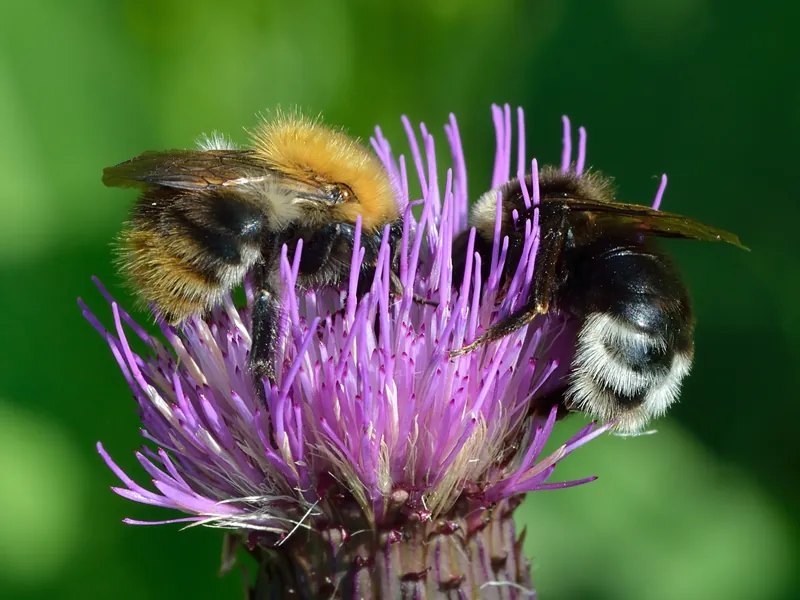
A ginger-brown bumblebee found across most of Europe and Asia to China. It is a carder bee: it builds small nests on or near the ground surface under a covering of moss and dry grass it gathers itself. Colonies of 60 to 150 workers last unusually long, often into October, and the bees favour deep flowers such as clovers.
What we know
How to recognise it
It is almost entirely pale ginger-brown, usually with patches of black hair on the abdomen and sometimes on the thorax.
Confirmed fact[3]It is one of four brown bumblebees in the British Isles and can be very hard to identify in the field; records are best based on males, whose genitalia are diagnostic.
Confirmed fact[1]Adults are about 10 to 18 mm long: queens about 16 to 18 mm, workers 10 to 15 mm and males 13 to 14 mm.
Confirmed fact[2]
Where it lives
Life cycle and colony
Queens emerge from hibernation between March and June, workers are present from April, and males and new queens fly from July to October.
Confirmed fact[1]Nests are fairly small, with 60 to 150 workers.
Confirmed fact[1]The life of a nest is remarkably long, with workers still present in September and October in some cases.
Confirmed fact[1]
Nest
Nests are built above ground in tall but open grassland, under hedges and in piles of plant litter.
Confirmed fact[1]
Flowers and food
It is associated with flowers that have longer corollas, especially the pea family and the figwort family.
Confirmed fact[1]
Behaviour
It is one of the carder bees, which gather moss and dry grass to make a covering for the nest.
Confirmed fact[1]In a genetic study on arable farmland in the UK, its estimated maximum foraging range was the shortest of four bumblebee species compared, about 449 m from the nest.
Statistical estimate[4]Its nests are attacked by the cuckoo bumblebee Bombus campestris, a social parasite.
Confirmed fact[1]
Conservation
In Britain it may well be less frequent than it used to be, yet it is currently extending its range northward and has recently reached Orkney.
Confirmed fact[1]
Where it has been recorded
Each hexagon contains at least one record of Bombus pascuorum shared with GBIF: museum specimens, surveys and photographs.
811,724 records
- Netherlands249,002
- United Kingdom165,838
- Germany123,344
- Belgium53,757
- Switzerland48,741
- Ireland29,683
GBIF.org occurrence data for taxon key 1340405, retrieved 2026-10-19. Observation[5]
Records show where the bee has been found and reported, not its full range or its abundance. Isolated points far from the main cluster can be misidentifications, captive or imported bees, or genuine rare finds.
More from this part of the bee family tree
Sources
- Edwards, M. Bombus pascuorum (Scopoli, 1763), species account. Bees, Wasps & Ants Recording Society (BWARS). Link
- Watson, L. & Dallwitz, M. J. (2003 onwards). Insects of Britain and Ireland: the bumblebees and cuckoo bees (Bombus and Psithyrus). Bombus pascuorum (Scopoli). DELTA database, version 27 July 2019. Link
- Aberdeenshire Council / North East Scotland Biological Records Centre (2017). Pollinator Survey identification leaflet (GDT24425, March 2017). Link
- Knight, M. E., Martin, A. P., Bishop, S., Osborne, J. L., Hale, R. J., Sanderson, A. & Goulson, D. (2005). An interspecific comparison of foraging range and nest density of four bumblebees (Bombus) species. Molecular Ecology 14(6): 1811-1820. Link
- GBIF.org (2026). Occurrence search and density maps for Bombus pascuorum, taxon key 1340405. Link
Last checked: 30 October 2026. Every statement on this page was compared with the source it cites. Spotted an error? Report it.