Apidae
Bombus affinis
Rusty patched bumble bee
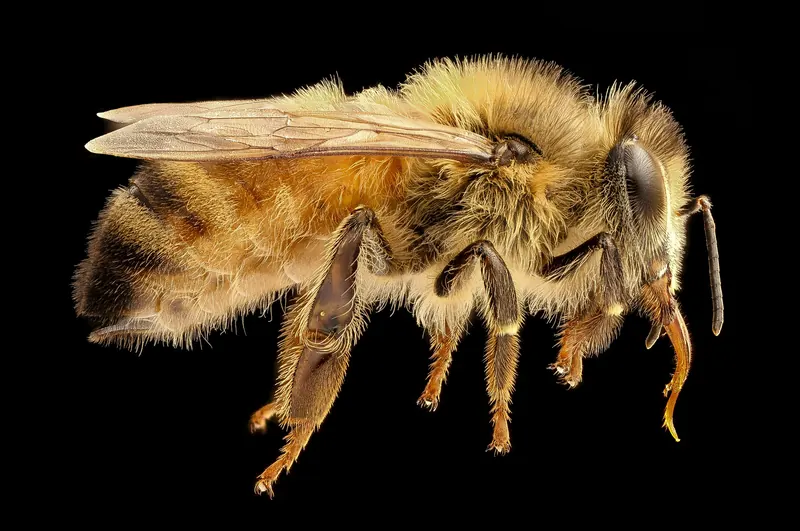
The rusty patched bumble bee once lived across the eastern and midwestern United States and southern Canada. Workers and males carry a rusty reddish patch in the middle of the back. After a steep decline it was listed as federally endangered in the United States in 2017, and as endangered in Canada in 2012.
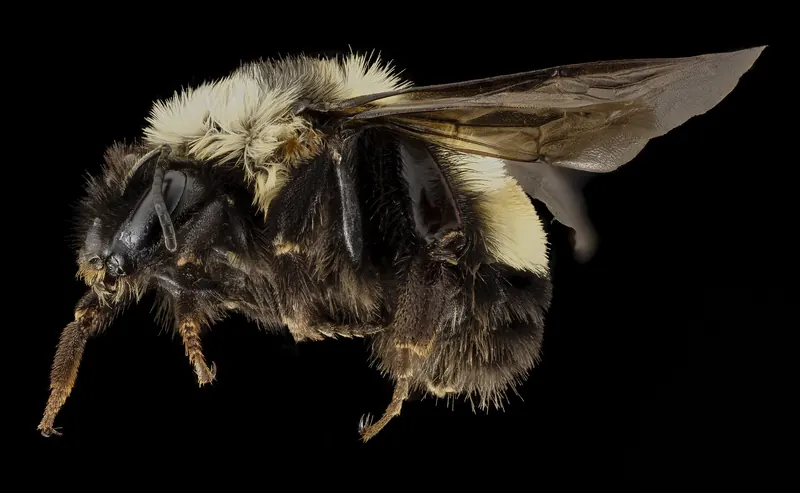
What we know
How to recognise it
Where it lives
Life cycle and colony
Each colony lasts a single year. Before winter the old queen, workers and males die, and only new queens survive the winter to start new colonies in spring.
Confirmed fact[2]Healthy colonies are large and can hold more than a thousand workers.
Confirmed fact[2]It is one of the first bumble bees to appear in spring and one of the last to go into hibernation.
Confirmed fact[2]
Nest
Nests are usually 1 to 4 feet underground, in abandoned rodent nests or other mammal burrows.
Confirmed fact[2]
Flowers and food
Conservation
Since 1999 it has been seen at 103 populations, an 88 percent drop from the number of populations recorded before 2000.
Statistical estimate[1]The US Fish and Wildlife Service listed it as endangered in a rule that took effect on February 10, 2017.
Confirmed fact[1]Its main threats include habitat loss and degradation, disease-causing organisms, pesticides and the problems of very small populations.
Confirmed fact[1]The exact cause of its decline is still unknown; evidence points to an introduced pathogen acting together with insecticide and fungicide exposure.
Open question[2]
Where it has been recorded
Each hexagon contains at least one record of Bombus affinis shared with GBIF: museum specimens, surveys and photographs.
16,913 records
- United States15,050
- Canada302
- ZZ2
- Germany1
GBIF.org occurrence data for taxon key 1340481, retrieved 2026-10-19. Observation[3]
Records show where the bee has been found and reported, not its full range or its abundance. Isolated points far from the main cluster can be misidentifications, captive or imported bees, or genuine rare finds.
More from this part of the bee family tree
Sources
- U.S. Fish and Wildlife Service (2017). Endangered and Threatened Wildlife and Plants; Endangered Species Status for Rusty Patched Bumble Bee. Final rule. Federal Register 82(7): 3186 (January 11, 2017). Document 2017-00195. Link
- U.S. Fish and Wildlife Service. Rusty patched bumble bee (Bombus affinis), species profile. fws.gov (accessed 2026-10-19). Link
- GBIF.org (2026). Occurrence search and density maps for Bombus affinis, taxon key 1340481. Link
Last checked: 20 October 2026. Every statement on this page was compared with the source it cites. Spotted an error? Report it.