Apidae
Bombus dahlbomii
Abejorro gigante de la Patagonia, Abejorro colorado, Moscardón
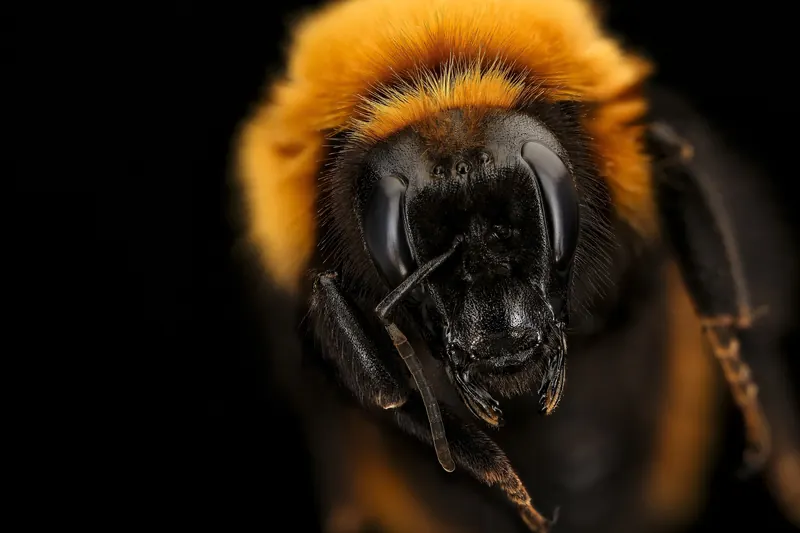
A large orange-haired bumble bee native to Chile and southern Argentina, with queens up to 33 mm long. It visits mostly native plants. Since introduced European bumble bees arrived, it has vanished from much of its range, and Chile classes it as Endangered.
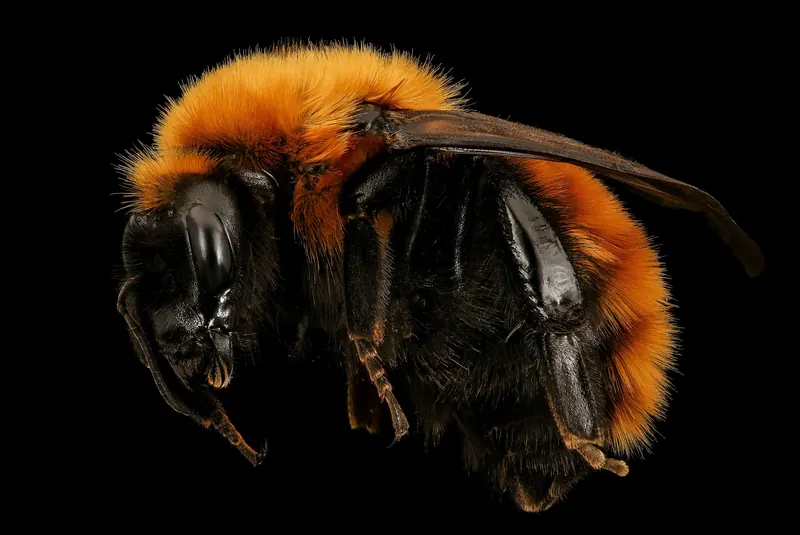
What we know
How to recognise it
Where it lives
Life cycle and colony
Nest
Colonies nest underground in well-protected spots, using holes dug by other animals or natural cavities in the soil.
Confirmed fact[1]
Flowers and food
It has been recorded on 84 plant species from 42 families, about 75 percent of them native, and native bumble bees in Chile prefer native plants.
Confirmed fact[2]
Conservation
Over the last 20 years it has disappeared from much of its former range, with a decline of more than 50 percent in 10 years.
Statistical estimate[1]Two European bumble bees were introduced to Chile: Bombus ruderatus in 1982 to 1983 and Bombus terrestris in 1997, to pollinate greenhouse tomatoes.
Confirmed fact[1]Wherever Bombus terrestris spreads, Bombus dahlbomii disappears, although the exact reasons are still unclear.
Open question[3]The parasite Apicystis bombi was not found in samples of B. dahlbomii and B. ruderatus collected before B. terrestris arrived, but afterwards it was present in all three species.
Confirmed fact[4]Six parasite species have been found in it, and these may be among the main causes of its rapid disappearance.
Confirmed fact[1]Chile's species classification committee rated it Endangered in 2015, based on a population fall of more than 50 percent in 10 years.
Confirmed fact[1]
Where it has been recorded
Each hexagon contains at least one record of Bombus dahlbomii shared with GBIF: museum specimens, surveys and photographs.
3,914 records
- Chile3,215
- Argentina632
- Costa Rica7
- Brazil4
- Panama3
- Cape Verde2
GBIF.org occurrence data for taxon key 1340388, retrieved 2026-10-19. Observation[5]
Records show where the bee has been found and reported, not its full range or its abundance. Isolated points far from the main cluster can be misidentifications, captive or imported bees, or genuine rare finds.
More from this part of the bee family tree
Sources
- Ministerio del Medio Ambiente, Chile (2015). Ficha de antecedentes de especie: Bombus dahlbomii Guérin-Meneville, 1835. Reglamento de Clasificación de Especies Silvestres, 12th process; Comité de Clasificación session of 18 November 2015. Link
- Montalva, J., Dudley, L., Arroyo, M. K., Retamales, H. & Abrahamovich, A. H. (2011). Geographic distribution and associated flora of native and introduced bumble bees (Bombus spp.) in Chile. Journal of Apicultural Research 50(1): 11-21. Link
- Schmid-Hempel, R., Eckhardt, M., Goulson, D., Heinzmann, D., Lange, C., Plischuk, S., Escudero, L. R., Salathé, R., Scriven, J. J. & Schmid-Hempel, P. (2014). The invasion of southern South America by imported bumblebees and associated parasites. Journal of Animal Ecology 83(4): 823-837. Link
- Arbetman, M. P., Meeus, I., Morales, C. L., Aizen, M. A. & Smagghe, G. (2013). Alien parasite hitchhikes to Patagonia on invasive bumblebee. Biological Invasions 15(3): 489-494. Link
- GBIF.org (2026). Occurrence search and density maps for Bombus dahlbomii, taxon key 1340388. Link
Last checked: 20 October 2026. Every statement on this page was compared with the source it cites. Spotted an error? Report it.