Andrenidae
Andrena fulva
Tawny mining bee
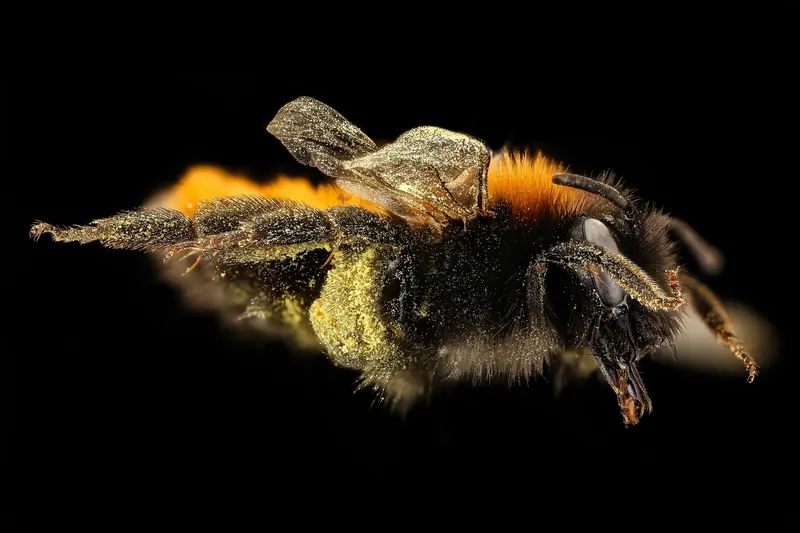
The tawny mining bee is a spring bee whose females wear a bright reddish coat. Females dig nest burrows in open grassland, parks and garden lawns, leaving a small mound of soil around each entrance. It is widespread across much of Europe, including lowland England and Wales.
What we know
How to recognise it
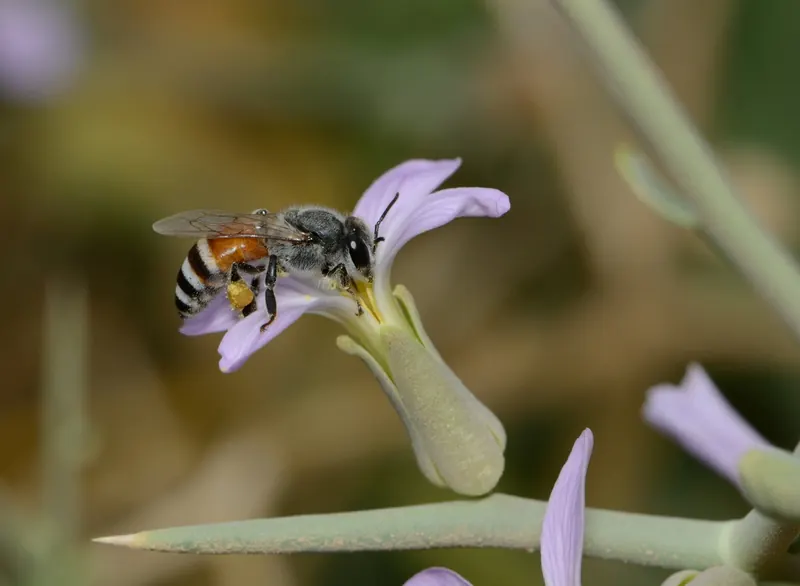
The female has long, dense, bright reddish hairs on the top of her body, contrasting with black hairs on the rest of the body and head.
Confirmed fact[1]The red mason bee, Osmia bicornis, can look similar, but it has two small horns on its face and a pollen brush under its abdomen.
Confirmed fact[1]The male has long white hairs on the face and a large tooth at the base of each jaw.
Confirmed fact[1]
Where it lives
Life cycle and colony
It has one generation a year and flies in spring, from late March to mid June.
Confirmed fact[1]A nest usually holds four or five brood cells, and one female can build two or three nests.
Confirmed fact[1]Two cuckoo bees, Nomada panzeri and Nomada signata, raise their young in its nests; at one South Wales site N. panzeri took 18% of cells.
Observation[1]
Nest
Flowers and food
It collects food from a wide range of herbs, shrubs and trees.
Confirmed fact[1]
Conservation
It is not considered scarce or threatened in Britain. In Ireland it had not been seen since 1925 and was listed as Regionally Extinct in 2006, but it was rediscovered in County Kilkenny in 2012 and has since been seen in several other counties.
Confirmed fact[2]
Where it has been recorded
Each hexagon contains at least one record of Andrena fulva shared with GBIF: museum specimens, surveys and photographs.
53,954 records
- Netherlands14,842
- United Kingdom14,195
- Belgium6,571
- Germany6,196
- Sweden3,827
- Switzerland2,160
GBIF.org occurrence data for taxon key 9805254, retrieved 2026-10-19. Observation[3]
Records show where the bee has been found and reported, not its full range or its abundance. Isolated points far from the main cluster can be misidentifications, captive or imported bees, or genuine rare finds.
More from this part of the bee family tree
Sources
- Else, G. R. (2005; identification section by N. Jones, 2011). Andrena fulva (Müller, 1766), Tawny mining-bee, species account. Bees, Wasps & Ants Recording Society (BWARS). Link
- National Museum of Ireland. Tawny mining bee (Andrena fulva). Irish bee species collection. Link
- GBIF.org (2026). Occurrence search and density maps for Andrena fulva, taxon key 9805254. Link
Last checked: 20 October 2026. Every statement on this page was compared with the source it cites. Spotted an error? Report it.