Andrenidae
Perdita minima
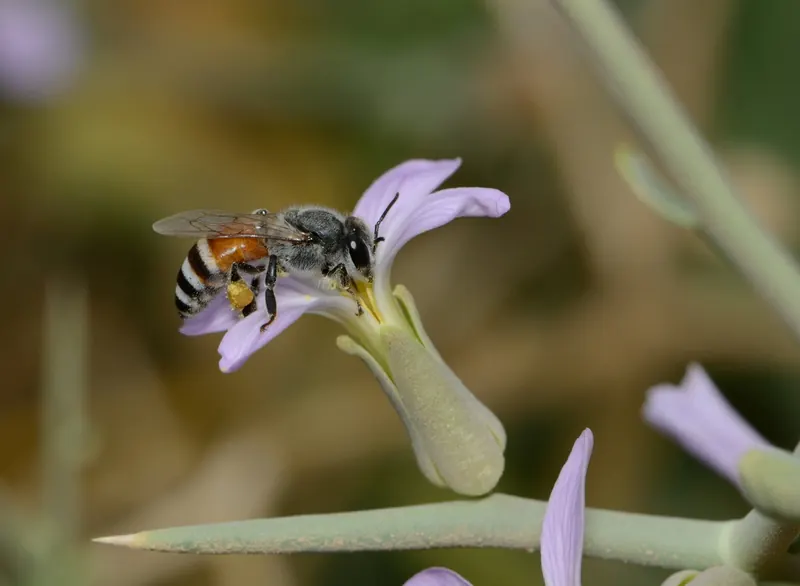
Perdita minima is a tiny solitary desert bee, slightly less than 2 mm long, and is reported as the smallest bee species in the Americas. It lives in the southwestern United States and northern Mexico, nests in sandy soil, and collects pollen from spurges (Euphorbia), such as whitemargin sandmat.
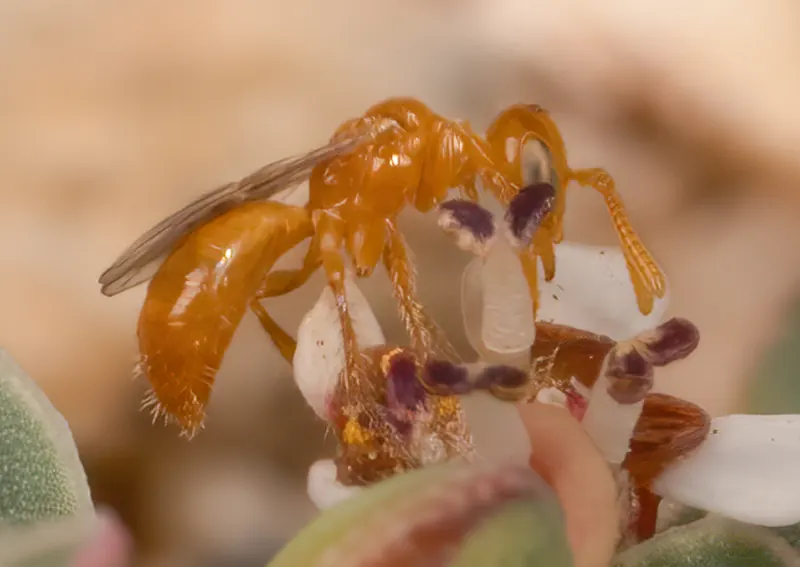
What we know
How to recognise it
Where it lives
Life cycle and colony
It is a solitary bee, so unlike honey bees it does not live in colonies.
Confirmed fact[1]
Nest
It builds a tiny nest in sandy desert soil.
Confirmed fact[1]
Flowers and food
Behaviour
Despite its size, its hairy legs can be packed with very large loads of pollen.
Confirmed fact[1]
Bees and people
Where it has been recorded
Each hexagon contains at least one record of Perdita minima shared with GBIF: museum specimens, surveys and photographs.
1,070 records
- United States827
- Mexico237
GBIF.org occurrence data for taxon key 1356055, retrieved 2026-10-19. Observation[3]
Records show where the bee has been found and reported, not its full range or its abundance. Isolated points far from the main cluster can be misidentifications, captive or imported bees, or genuine rare finds.
More from this part of the bee family tree
Sources
- Buchmann, S. (The Bee Works). Perdita minima. Pollinator of the Month, Celebrating Wildflowers. USDA Forest Service (undated). Link
- De Pedro, D., Ceccarelli, F. S., Sagot, P., López-Reyes, E., Mullins, J. L., Mérida-Rivas, J. A., Falcon-Brindis, A., Griswold, T., Ascher, J. S., Gardner, J., Ayala, R., Vides-Borrell, E. & Vandame, R. (2024). Revealing the Baja California Peninsula's hidden treasures: an annotated checklist of the native bees (Hymenoptera: Apoidea: Anthophila). Zootaxa 5522(1) (species treatment on p. 117). doi:10.11646/zootaxa.5522.1.1. Treatment for Perdita (Perditella) minima as deposited by Plazi on Zenodo. Link
- GBIF.org (2026). Occurrence search and density maps for Perdita minima, taxon key 1356055. Link
Last checked: 20 October 2026. Every statement on this page was compared with the source it cites. Spotted an error? Report it.