Apidae
Xylocopa violacea
Violet carpenter bee
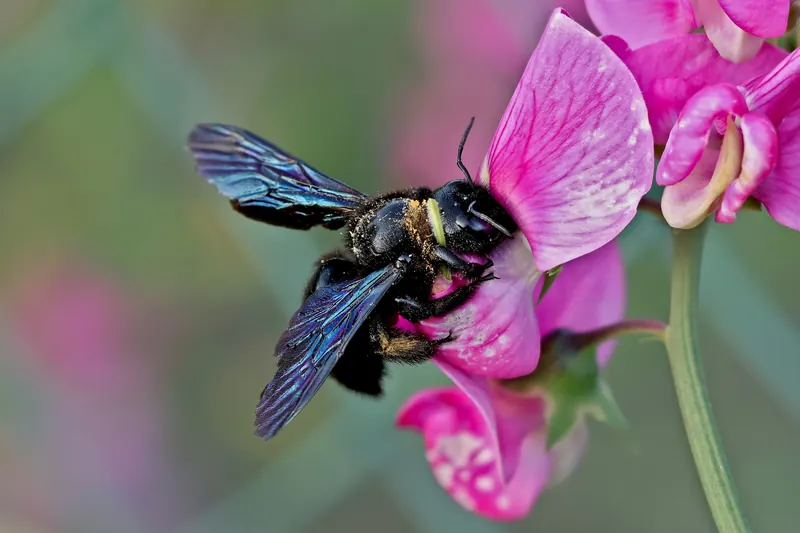
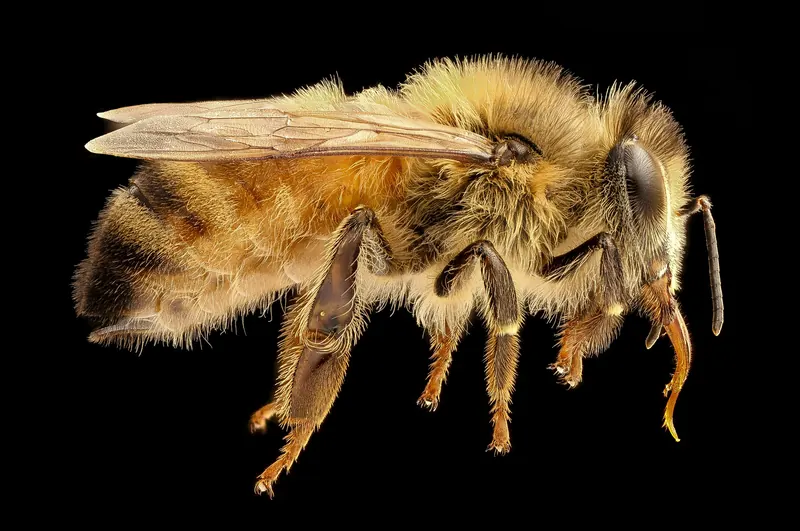
The violet carpenter bee is a big, black, wood-nesting bee with blue-violet shining wings, found from the Mediterranean to Asia. Females gnaw nest tunnels in dead wood, and adults spend the winter in old burrows. It has been spreading northwards in Europe and has bred in Britain.
What we know
How to recognise it
This is a large bee: individuals can reach up to 25 mm long.
Confirmed fact[2]It is covered in black hair, and its wings shine with a metallic blue-violet gloss, which gives the bee its name.
Confirmed fact[2]Males can be told from the similar Xylocopa valga by two reddish segments near the tip of the antennae; X. valga has entirely black antennae.
Confirmed fact[1]
Where it lives
Its natural range stretches from the Mediterranean region to Asia.
Confirmed fact[2]According to a Bavarian state forestry institute, the species seems to have kept spreading in Germany since 2000.
Confirmed fact[2]It has bred in Britain: in 2006 bees nested in an old apple tree at Shepshed, Leicestershire.
Observation[1]
Life cycle and colony
It is usually regarded as a solitary bee that raises a single generation each year.
Confirmed fact[3]At the end of summer both males and females move into old nest burrows and spend the winter there as adults.
Confirmed fact[1]In Bavaria adults can be seen flying from April to October.
Confirmed fact[2]Larvae grow inside the tunnels on pollen cakes that the adult bees carry in.
Confirmed fact[2]
Nest
Females gnaw their own nest tunnels into wood that already breaks easily, such as branches, stems, stakes and beams.
Confirmed fact[2]
Flowers and food
In Britain it has been seen visiting the flowers of tree mallow and buddleia.
Observation[1]
Behaviour
Females guard their nests and can defend them fiercely against other violet carpenter bees.
Confirmed fact[3]
Bees and people
Despite its imposing size, it is not aggressive, although it can sting.
Confirmed fact[2]
Where it has been recorded
Each hexagon contains at least one record of Xylocopa violacea shared with GBIF: museum specimens, surveys and photographs.
60,554 records
- Germany32,805
- France10,119
- Spain4,878
- Portugal2,458
- Switzerland2,116
- Italy1,456
GBIF.org occurrence data for taxon key 1342108, retrieved 2026-10-19. Observation[4]
Records show where the bee has been found and reported, not its full range or its abundance. Isolated points far from the main cluster can be misidentifications, captive or imported bees, or genuine rare finds.
More from this part of the bee family tree
Sources
- Bees, Wasps & Ants Recording Society (BWARS). Xylocopa in Britain (compiled records and notes, 2006 to 2010, by S. Roberts, L. Peat, D. Baldock, S. Nixon and G. Allen). BWARS website. Link
- Bußler, H. (2007, online 2022). The violet carpenter bee: imposing but harmless. Bayerische Landesanstalt für Wald und Forstwirtschaft (LWF), originally LWF aktuell 58: 50-51. Published on waldwissen.net. Link
- Vicidomini, S. (1996). Biology of Xylocopa (Xylocopa) violacea (L., 1758): Giant Nest! (Hymenoptera: Apidae). Entomologica (Bari) 30: 19-32. Link
- GBIF.org (2026). Occurrence search and density maps for Xylocopa violacea, taxon key 1342108. Link
Last checked: 20 October 2026. Every statement on this page was compared with the source it cites. Spotted an error? Report it.