Apidae
Nomada goodeniana
Gooden's nomad bee
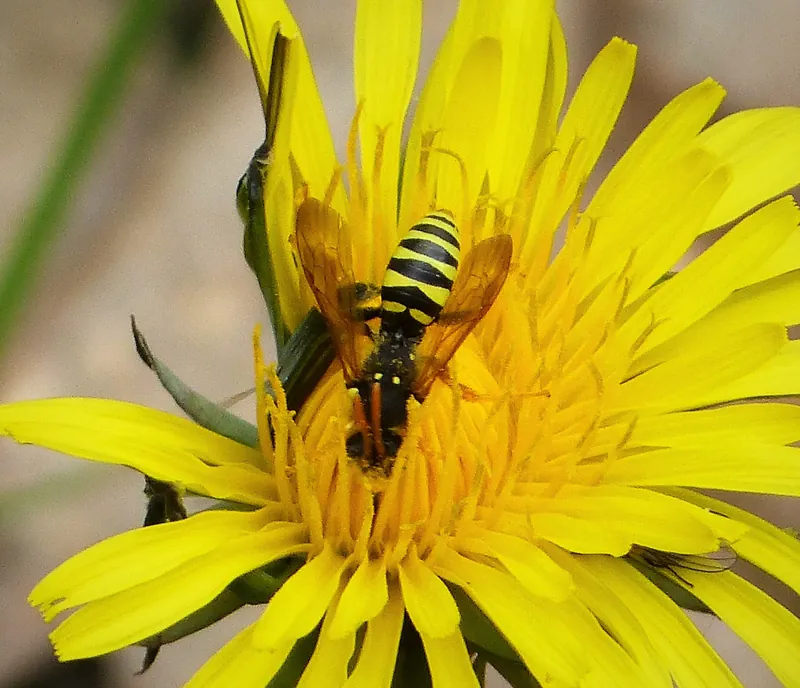
Nomada goodeniana is a bright black and yellow cuckoo bee of Europe that makes no nest of its own. It lays its eggs in the nests of Andrena mining bees (in Britain mainly the Andrena nigroaenea group, in Switzerland probably Andrena cineraria and Andrena nitida) and flies mostly in spring. It is widespread and not regarded as threatened in Britain or Switzerland.
What we know
How to recognise it
It is a very bright black and yellow cuckoo bee, and one of the largest Nomada species in Britain.
Confirmed fact[1]Adults are large for the genus, about 10 to 13 mm long, with a body patterned entirely in yellow and black.
Confirmed fact[2]It looks very much like Nomada succincta, and the two are often confused in the literature, which makes many old host records hard to interpret.
Open question[2]
Where it lives
Life cycle and colony
It is a cuckoo bee: it builds no nest of its own but lays its eggs in the nests of mining bees of the Andrena nigroaenea group.
Confirmed fact[1]In Britain adults fly from April to June, with a small second generation in July and August.
Confirmed fact[1]In Switzerland it has a single generation a year and flies from April to the end of May.
Confirmed fact[2]
Nest
Flowers and food
Adults visit a wide variety of flowers for nectar.
Confirmed fact[1]
Behaviour
Females enter only host nests that are open and do not close them again when they leave.
Observation[2]
Conservation
Where it has been recorded
Each hexagon contains at least one record of Nomada goodeniana shared with GBIF: museum specimens, surveys and photographs.
15,281 records
- United Kingdom4,916
- Switzerland2,785
- Sweden1,901
- Netherlands1,585
- Belgium1,501
- Germany731
GBIF.org occurrence data for taxon key 1343694, retrieved 2026-10-19. Observation[3]
Records show where the bee has been found and reported, not its full range or its abundance. Isolated points far from the main cluster can be misidentifications, captive or imported bees, or genuine rare finds.
More from this part of the bee family tree
Sources
- Edwards, M. (2016). Nomada goodeniana (Kirby, 1802). BWARS (Bees, Wasps and Ants Recording Society) species account. Link
- Benon, D. (n.d.). Nomada goodeniana (Kirby, 1802): species account. info fauna, Swiss national data and information centre on fauna (Neuchatel), with Red List status from Muller & Praz (2024). Link
- GBIF.org (2026). Occurrence search and density maps for Nomada goodeniana, taxon key 1343694. Link
Last checked: 30 October 2026. Every statement on this page was compared with the source it cites. Spotted an error? Report it.