Apidae
Euglossa dilemma
Green orchid bee
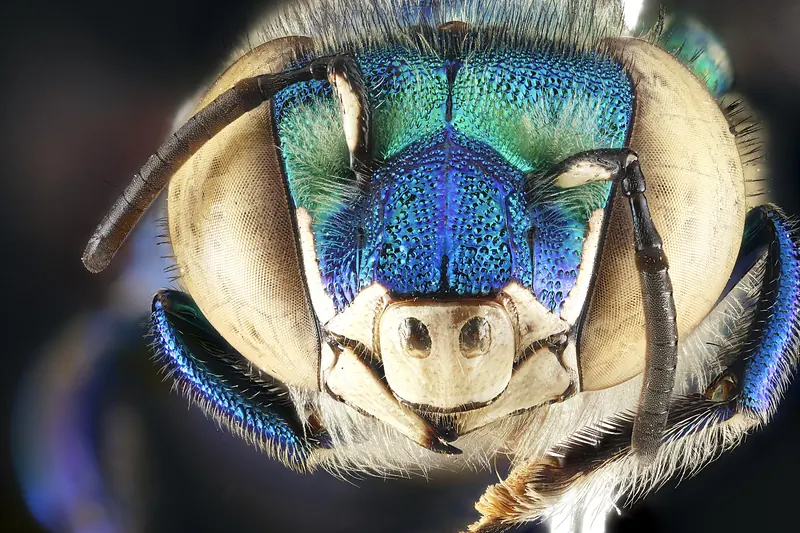
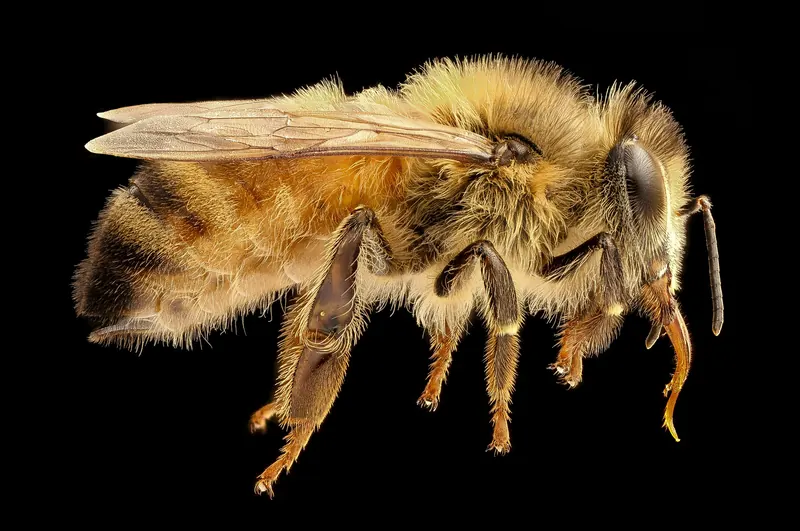
The green orchid bee is a bright metallic-green bee from Central America that has been established in south Florida since the early 2000s. Males collect fragrant compounds and store them in their enlarged hind legs, presumably to show off to females. Females build resin nest cells, alone or in small groups.
What we know
How to recognise it
It is about the size of a honey bee or slightly smaller, usually around 1.3 cm long.
Confirmed fact[1]It draws attention mainly because of its large size and bright metallic-green colour.
Confirmed fact[1]It was split from the very similar Euglossa viridissima in 2011; males of the two species can be told apart by the teeth on their jaws.
Confirmed fact[3]
Where it lives
It lives across Central America alongside its sibling species, and the orchid bees introduced to Florida belong to this species.
Confirmed fact[3]Males were first trapped around Fort Lauderdale, Florida, in summer 2003, by staff of a USDA fruit fly monitoring program.
Observation[2]In Florida it is reported mostly from Broward, Palm Beach and Dade counties, and its future range is predicted to cover almost half of the peninsula.
Statistical estimate[1]
Life cycle and colony
Females can nest alone or share a nest in small groups, where one dominant, queen-like bee eats eggs laid by the others and replaces them with her own.
Confirmed fact[4]Researchers suspect group size may be limited by how well the dominant bee can keep up with replacing eggs; larger groups showed more reproductive conflict.
Open question[4]
Nest
Females build nest cells from plant resin inside any enclosed cavity, often sealing the entrance with resin and plant debris.
Confirmed fact[1]
Flowers and food
In Florida it visits blue and violet flowers of pickerel weed, among other plants.
Observation[2]
Behaviour
Bees and people
Where it has been recorded
Each hexagon contains at least one record of Euglossa dilemma shared with GBIF: museum specimens, surveys and photographs.
2,393 records
- United States1,457
- Costa Rica508
- Mexico183
- Guatemala93
- Dominican Republic79
- Nicaragua33
GBIF.org occurrence data for taxon key 9167800, retrieved 2026-10-19. Observation[5]
Records show where the bee has been found and reported, not its full range or its abundance. Isolated points far from the main cluster can be misidentifications, captive or imported bees, or genuine rare finds.
More from this part of the bee family tree
Sources
- Mullins, A. (2024). Green Orchid Bee Euglossa dilemma (Insecta: Hymenoptera: Apidae). EENY576 / IN1013, Featured Creatures, UF/IFAS Extension, University of Florida. Link
- Skov, C. & Wiley, J. (2005). Establishment of the Neotropical orchid bee Euglossa viridissima (Hymenoptera: Apidae) in Florida. Florida Entomologist 88(2): 225-227. Link
- Eltz, T., Fritzsch, F., Pech, J., Zimmermann, Y., Ramírez, S. R., Quezada-Euan, J. J. G. & Bembé, B. (2011). Characterization of the orchid bee Euglossa viridissima (Apidae: Euglossini) and a novel cryptic sibling species, by morphological, chemical, and genetic characters. Zoological Journal of the Linnean Society 163(4): 1064-1076. Link
- Saleh, N. W., Delva, J., Ramírez, S. R., Kapheim, K. M. & Chouvenc, T. (2024). Reproductive inefficiency and increased behavioral variation are associated with large group size in the orchid bee, Euglossa dilemma. Insectes Sociaux 71(2): 211-219. Link
- GBIF.org (2026). Occurrence search and density maps for Euglossa dilemma, taxon key 9167800. Link
Last checked: 20 October 2026. Every statement on this page was compared with the source it cites. Spotted an error? Report it.