Apidae
Bombus terrestris
Buff-tailed bumble bee
A widespread Eurasian bumble bee that nests underground and feeds on a very wide range of flowers. It is one of the two main bumble bees reared commercially to pollinate crops, above all greenhouse tomatoes. Shipped colonies have let it establish abroad, and it now spreads rapidly through southern South America.
What we know
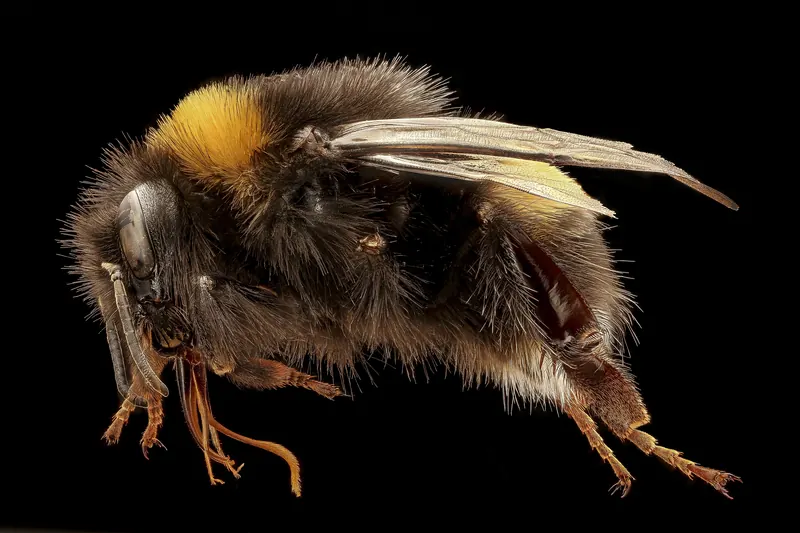
How to recognise it
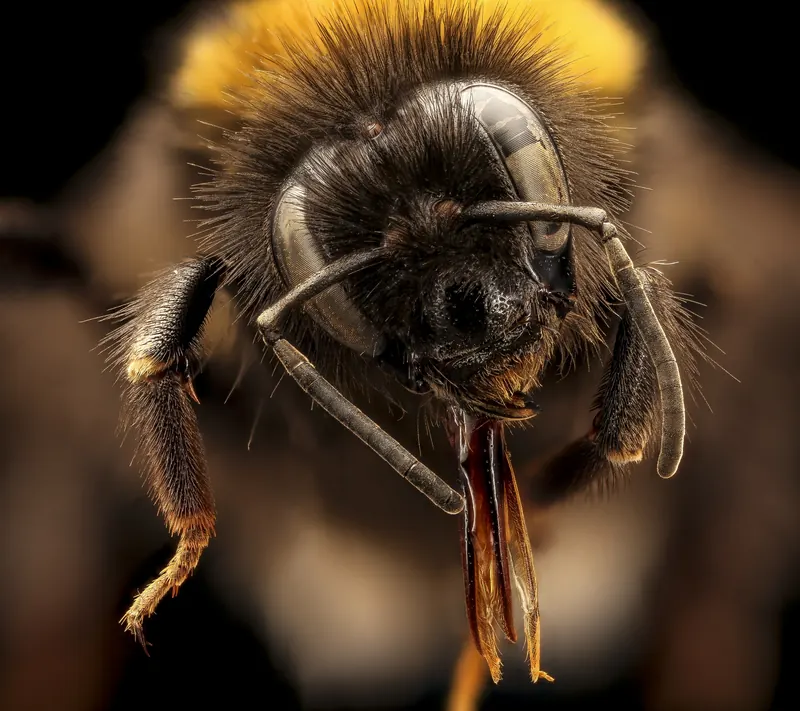
It has a white tail; fresh workers often show a narrow band of brownish hairs at the base of the tail. Workers are hard to tell from related species.
Confirmed fact[1]
Where it lives
It is widespread in Europe and across middle and northern Asia, east to northern Mongolia.
Confirmed fact[1]It is now considered an invasive species in New Zealand, Japan and throughout South America.
Confirmed fact[5]It was deliberately brought to Chile in 1997 to pollinate tomatoes, and since then more than 320,000 colonies have been introduced there.
Confirmed fact[4]In South America it spread by some 200 km a year and reached the Atlantic coast of Argentina by the end of 2011.
Statistical estimate[3]
Life cycle and colony
Nest
It nests underground, in old mouse or vole nests.
Confirmed fact[1]
Flowers and food
It visits a wide variety of flowers for pollen and nectar and probably has the widest diet of any British bumble bee.
Confirmed fact[1]
Bees and people
It is one of the two main bumble bees reared commercially for crop pollination, alongside the North American Bombus impatiens.
Confirmed fact[2]Greenhouse tomatoes are the most important crop pollinated by bumble bees: in 2004 about 40,000 hectares were pollinated, a crop worth 12,000 million euros.
Statistical estimate[2]Captive nests of non-British forms are used by commercial tomato and fruit growers in Britain, and some young queens and males may escape and breed with wild bees.
Confirmed fact[1]
Conservation
Where it has been recorded
Each hexagon contains at least one record of Bombus terrestris shared with GBIF: museum specimens, surveys and photographs.
638,905 records
- Netherlands200,280
- Germany151,843
- United Kingdom118,774
- Sweden25,904
- France23,290
- Switzerland21,353
GBIF.org occurrence data for taxon key 1340503, retrieved 2026-10-19. Observation[6]
Records show where the bee has been found and reported, not its full range or its abundance. Isolated points far from the main cluster can be misidentifications, captive or imported bees, or genuine rare finds.
More from this part of the bee family tree
Sources
- Edwards, M. Bombus terrestris (Linnaeus, 1758), species account. Bees, Wasps & Ants Recording Society (BWARS), profile last updated 2009. Link
- Velthuis, H. H. W. & van Doorn, A. (2006). A century of advances in bumblebee domestication and the economic and environmental aspects of its commercialization for pollination. Apidologie 37(4): 421-451. Link
- Schmid-Hempel, R., Eckhardt, M., Goulson, D., Heinzmann, D., Lange, C., Plischuk, S., Escudero, L. R., Salathé, R., Scriven, J. J. & Schmid-Hempel, P. (2014). The invasion of southern South America by imported bumblebees and associated parasites. Journal of Animal Ecology 83(4): 823-837. Link
- Fontúrbel, F. E., Murúa, M. M. & Vieli, L. (2021). Invasion dynamics of the European bumblebee Bombus terrestris in the southern part of South America. Scientific Reports 11: 15306. Link
- Rendoll-Carcamo, J. A., Contador, T. A., Saavedra, L. & Montalva, J. (2017). First record of the invasive bumblebee Bombus terrestris (Hymenoptera: Apidae) on Navarino Island, southern Chile (55°S). Journal of Melittology 71: 1-5. Link
- GBIF.org (2026). Occurrence search and density maps for Bombus terrestris, taxon key 1340503. Link
Last checked: 20 October 2026. Every statement on this page was compared with the source it cites. Spotted an error? Report it.