Colletidae
Colletes hederae
Ivy bee
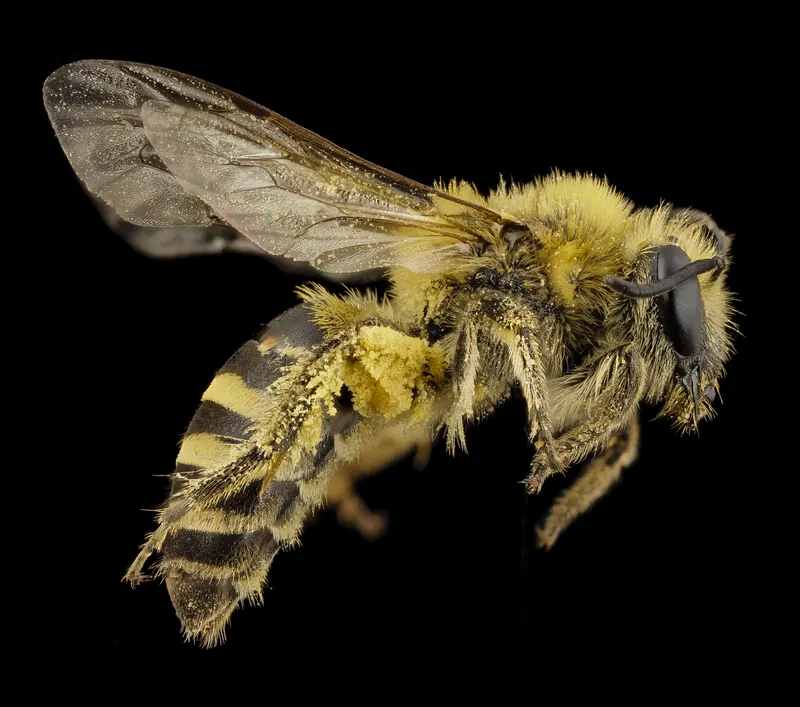
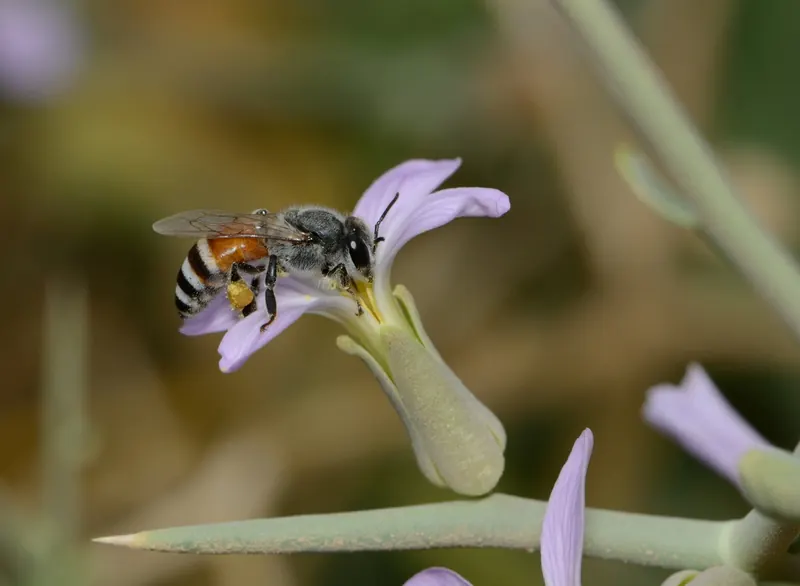
The ivy bee is a solitary plasterer bee native to mainland Europe, described only in 1993. Females collect pollen almost entirely from ivy and fly in autumn, when ivy blooms. Since its first British record in 2001 it has spread rapidly, reaching Scotland and Ireland by 2021.
What we know
How to recognise it
Where it lives
The ivy bee is native to mainland Europe and belongs to a group of plasterer bees related to Colletes succinctus.
Confirmed fact[2]In Britain, the ivy bee was first recorded in September 2001 at Worth Matravers in Dorset, on the south coast of England.
Observation[2]The ivy bee has also been expanding its range in continental Europe, and by 2021 it had reached Scotland and Ireland.
Confirmed fact[2]Researchers estimate that the ivy bee colonised Britain at a rate of roughly 25 to 50 km per year.
Statistical estimate[2]
Life cycle and colony
It has one generation a year and flies in autumn, from late August or early September to late October, sometimes into early November.
Confirmed fact[1]
Nest
Each female digs her own burrow, but nests are often packed together in large groups that can contain several thousand nests.
Confirmed fact[1]
Flowers and food
Behaviour
Bees and people
The ivy bee is a recently recognised species: it was described as new to science only in 1993.
Confirmed fact[1]
Conservation
Unlike many specialist bees, the ivy bee is not considered scarce or threatened in Britain.
Confirmed fact[1]
Where it has been recorded
Each hexagon contains at least one record of Colletes hederae shared with GBIF: museum specimens, surveys and photographs.
22,561 records
- United Kingdom12,364
- Belgium2,939
- France2,304
- Germany1,937
- Netherlands1,343
- Switzerland1,081
GBIF.org occurrence data for taxon key 1348914, retrieved 2026-10-19. Observation[4]
Records show where the bee has been found and reported, not its full range or its abundance. Isolated points far from the main cluster can be misidentifications, captive or imported bees, or genuine rare finds.
More from this part of the bee family tree
Sources
- Bees, Wasps & Ants Recording Society (BWARS). Colletes hederae Schmidt & Westrich, 1993. Species account. Link
- Carreck, N.L., Andernach, J., Ariss, A., Dowd, H., Gant, A., Garbuzov, M., Hennessy, G., Nash, L., Stagg, A. & Ratnieks, F.L.W. (2023). Distribution and abundance of the ivy bee, Colletes hederae Schmidt & Westrich, 1993, in Sussex, southern England. BioInvasions Records 12(3): 681-697. Link
- Dellicour, S., Mardulyn, P., Hardy, O.J., Hardy, C., Roberts, S.P.M. & Vereecken, N.J. (2014). Inferring the mode of colonization of the rapid range expansion of a solitary bee from multilocus DNA sequence variation. Journal of Evolutionary Biology 27: 116-132. Link
- GBIF.org (2026). Occurrence search and density maps for Colletes hederae, taxon key 1348914. Link
Last checked: 20 October 2026. Every statement on this page was compared with the source it cites. Spotted an error? Report it.