Colletidae
Hylaeus anthracinus
Anthricinan yellow-faced bee, Hawaiian yellow-faced bee
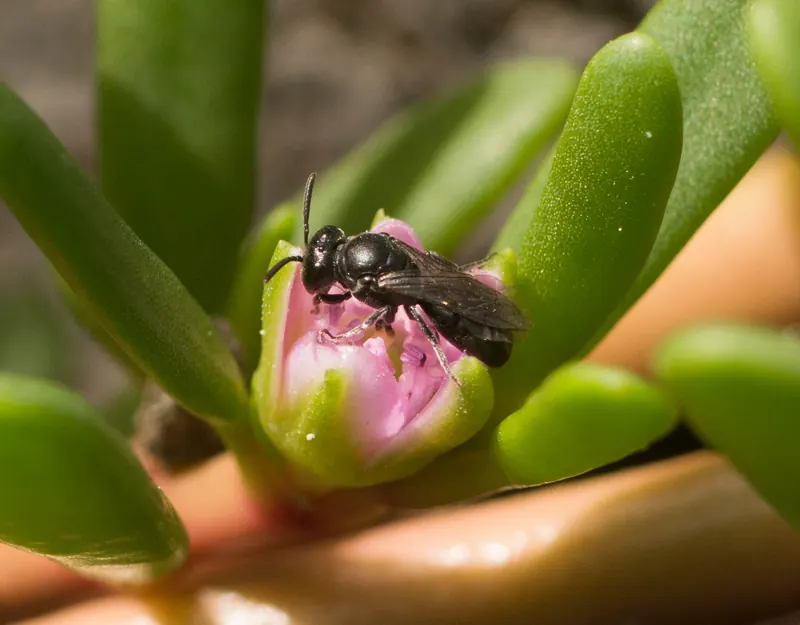
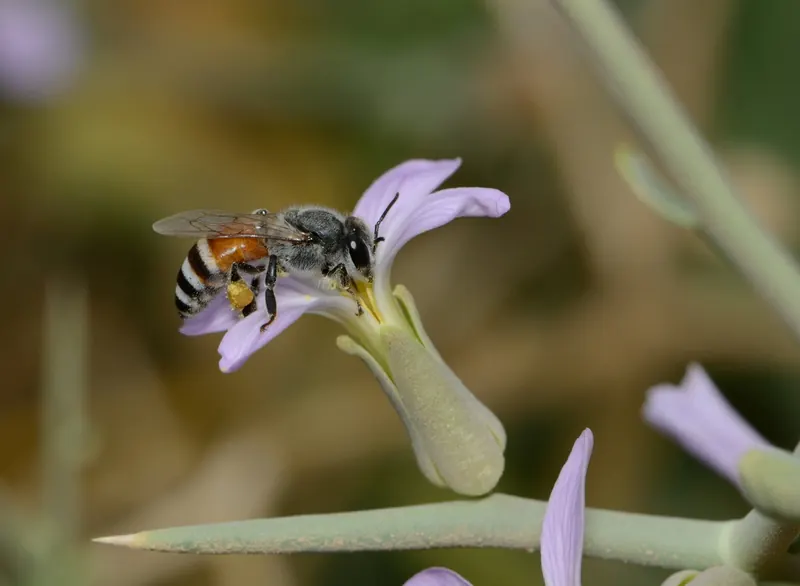
A medium-sized black bee of the Hawaiian Islands, where it lives in coastal and lowland dry forest habitat. Like other Hawaiian yellow-faced bees, it has no external pollen-carrying structure and carries pollen inside its body. It was listed as endangered under the US Endangered Species Act in 2016.
What we know
How to recognise it
Where it lives
Historically it lived in many coastal and lowland dry forest habitats in the Hawaiian Islands.
Confirmed fact[2]When assessed in 2011, it was known from only 13 small patches of coastal and lowland dry forest habitat.
Confirmed fact[2]On Oahu it seems to have declined sharply since collections made between 1892 and 1906.
Confirmed fact[2]It has not been seen on Lanai for more than 100 years and has probably disappeared from that island.
Confirmed fact[2]
Nest
Scientists think it nests inside the stems of coastal shrubs, though this has not been confirmed in detail.
Open question[2]
Flowers and food
Bees and people
Hawaiian yellow-faced bees collect nectar and pollen almost exclusively from native plants.
Confirmed fact[2]
Conservation
In 2016 the US Fish and Wildlife Service listed this bee as endangered, together with six other Hawaiian yellow-faced bees.
Confirmed fact[1]The endangered listing came into force on 31 October 2016.
Confirmed fact[1]Because it lives in coastal areas, the listing rule names tsunamis as one of the threats it faces.
Confirmed fact[1]
Where it has been recorded
Each hexagon contains at least one record of Hylaeus anthracinus shared with GBIF: museum specimens, surveys and photographs.
164 records
- United States80
GBIF.org occurrence data for taxon key 1349739, retrieved 2026-10-19. Observation[4]
Records show where the bee has been found and reported, not its full range or its abundance. Isolated points far from the main cluster can be misidentifications, captive or imported bees, or genuine rare finds.
More from this part of the bee family tree
Sources
- U.S. Fish and Wildlife Service (2016). Endangered and Threatened Wildlife and Plants; Endangered Status for 49 Species From the Hawaiian Islands. Final rule. Federal Register 81(190): 67786-67860 (30 September 2016). Link
- U.S. Fish and Wildlife Service (2011). Endangered and Threatened Wildlife and Plants; 12-Month Finding on Five Petitions To List Seven Species of Hawaiian Yellow-faced Bees as Endangered. Federal Register 76: 55170 (6 September 2011). Link
- U.S. Fish and Wildlife Service. Anthricinan yellow-faced bee (Hylaeus anthracinus). Species profile. Link
- GBIF.org (2026). Occurrence search and density maps for Hylaeus anthracinus, taxon key 1349739. Link
Last checked: 20 October 2026. Every statement on this page was compared with the source it cites. Spotted an error? Report it.