Varroa destructor: the mite that changed beekeeping
A parasite that jumped from the Asian honey bee to the western honey bee, spread worldwide and now spreads viruses linked to colony deaths.
Applies to: Varroa destructor as a parasite of Apis mellifera (western honey bee); its original host is Apis cerana (Eastern honey bee). Statements about damage concern Apis mellifera. Region: Biology is worldwide; the winter-loss study is from Germany and the legal categories are for Switzerland and Austria.
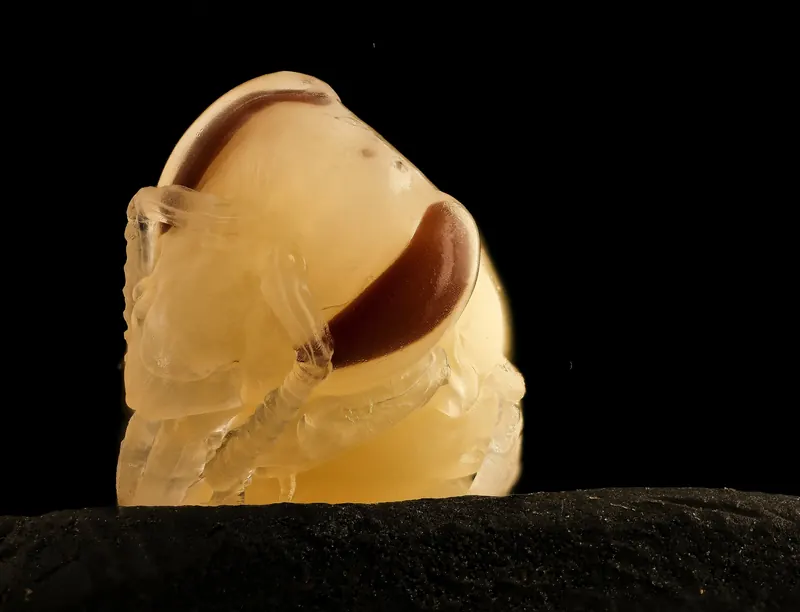
Where Varroa came from
Varroa destructor was originally a parasite only of the Eastern honey bee, Apis cerana, in Asia.Confirmed fact, source 1 Exactly how and when the mite jumped to the western honey bee is still unclear.Open question, source open question 1 The mites harming western honey bees were once called Varroa jacobsoni; DNA work later recognised them as a separate species, V. destructor.Confirmed fact, source 1 On its original host, Apis cerana, the mite reproduces only in drone brood, for reasons still not understood.Confirmed fact, source 1
A fast spread across the world
After the host shift, Varroa destructor spread across almost the whole world within a short time.Confirmed fact, source 1 Rosenkranz and colleagues list 1977 as the year the mite was found in Germany.Confirmed fact, source 1 Switzerland's food safety office describes varroosis as occurring worldwide and as common in Switzerland.Confirmed fact, source 2 Rosenkranz and colleagues still called Varroa the greatest threat to beekeeping in their 2010 review.Reported by the farm, source reported 1
How the mite lives
Female mites switch between riding on adult bees and reproducing inside sealed brood cells.Confirmed fact, source 1 Varroa can reproduce only inside a capped brood cell, alongside the developing bee.Confirmed fact, source 1 In western honey bee colonies the mite strongly prefers drone brood, infesting it eight to ten times more than worker brood.Confirmed fact, source 1 Researchers long described Varroa as feeding on bee blood (haemolymph), as the 2010 review above does. A 2019 study by Ramsey and colleagues found instead that it feeds primarily on the honey bee's fat body tissue, and this has updated the earlier view.Confirmed fact, source 3 The fat body matters for immune function, detoxifying pesticides and surviving the winter, so feeding on it weakens the bee.Confirmed fact, source 3
Why it matters: viruses
Varroa transmits several honey bee viruses; the best known is deformed wing virus, which leaves bees with crippled wings.Confirmed fact, source 1 In Hawaii, the arrival of Varroa raised the prevalence of deformed wing virus in the honey bee population from about 10 to 100 percent.Observation, source obs. 4 The mite also narrowed the virus population, so that a single strain of deformed wing virus came to dominate.Observation, source obs. 4 Deformed wing virus is a recent, human-made worldwide epidemic, spread from European honey bees by trade and the movement of colonies.Confirmed fact, source 5
Why it matters: colony losses in Central Europe
The German bee monitoring project followed more than 1,200 colonies from about 120 apiaries over four winters, from 2004/05 to 2007/08.Confirmed fact, source 6 That study identified Varroa destructor as the main killer of honey bee colonies in German winters.Confirmed fact, source 6 In that study, colonies infected with deformed wing virus or acute bee paralysis virus in autumn were significantly more likely to die over winter.Confirmed fact, source 6 Without regular control, most honey bee colonies in temperate climates would collapse within two to three years.Statistical estimate, source est. 1
Control follows national rules and advice
In Switzerland, varroosis is legally a disease to be monitored, one of the official animal disease categories.Confirmed fact, source 2 Under Austria's Animal Health Act 2024, varroosis counts as a legally defined bee disease only when it occurs as an epidemic.Confirmed fact, source 7 Swiss authorities point beekeepers to the national Bee Health Service for guidance on Varroa control.Confirmed fact, source 2 The Swiss Bee Health Service supports beekeepers on all questions of bee health and runs a free hotline.Confirmed fact, source 8
Sources
- Rosenkranz, P., Aumeier, P. & Ziegelmann, B. (2010). Biology and control of Varroa destructor. Journal of Invertebrate Pathology 103: S96-S119. doi:10.1016/j.jip.2009.07.016 Link
- Federal Food Safety and Veterinary Office (BLV/FSVO), Switzerland. Varroatose der Bienen (web page). Link
- Ramsey, S.D., Ochoa, R., Bauchan, G., Gulbronson, C., Mowery, J.D., Cohen, A., Lim, D., Joklik, J., Cicero, J.M., Ellis, J.D., Hawthorne, D. & vanEngelsdorp, D. (2019). Varroa destructor feeds primarily on honey bee fat body tissue and not hemolymph. PNAS 116(5): 1792-1801. doi:10.1073/pnas.1818371116 Link
- Martin, S.J., Highfield, A.C., Brettell, L., Villalobos, E.M., Budge, G.E., Powell, M., Nikaido, S. & Schroeder, D.C. (2012). Global honey bee viral landscape altered by a parasitic mite. Science 336(6086): 1304-1306. doi:10.1126/science.1220941 Link
- Wilfert, L., Long, G., Leggett, H.C., Schmid-Hempel, P., Butlin, R., Martin, S.J.M. & Boots, M. (2016). Deformed wing virus is a recent global epidemic in honeybees driven by Varroa mites. Science 351(6273): 594-597. doi:10.1126/science.aac9976 Link
- Genersch, E., von der Ohe, W., Kaatz, H., Schroeder, A., Otten, C., Büchler, R., Berg, S., Ritter, W., Mühlen, W., Gisder, S., Meixner, M., Liebig, G. & Rosenkranz, P. (2010). The German bee monitoring project: a long term study to understand periodically high winter losses of honey bee colonies. Apidologie 41(3): 332-352. doi:10.1051/apido/2010014 Link
- Tiergesundheitsgesetz 2024 (TGG 2024), Austria, BGBl. I Nr. 53/2024, § 3 Abs. 2 Z 11; in force since 1 July 2024. Rechtsinformationssystem des Bundes (RIS). Link
- Bienengesundheitsdienst (BGD), apiservice, Switzerland. Über uns / apiservice (web page). Link
Last checked: 20 October 2026. Every statement in this article was compared with the source it cites. Spotted an error? Report it.