How a honey bee colony swarms and finds a new home
Swarming is how honey bee colonies reproduce, and choosing the new home is a remarkable act of group decision making.
Applies to: Apis mellifera (western honey bee); Seeley and Visscher studied European-race honey bees in the northeastern USA. FAO (s1) also covers Apis cerana.
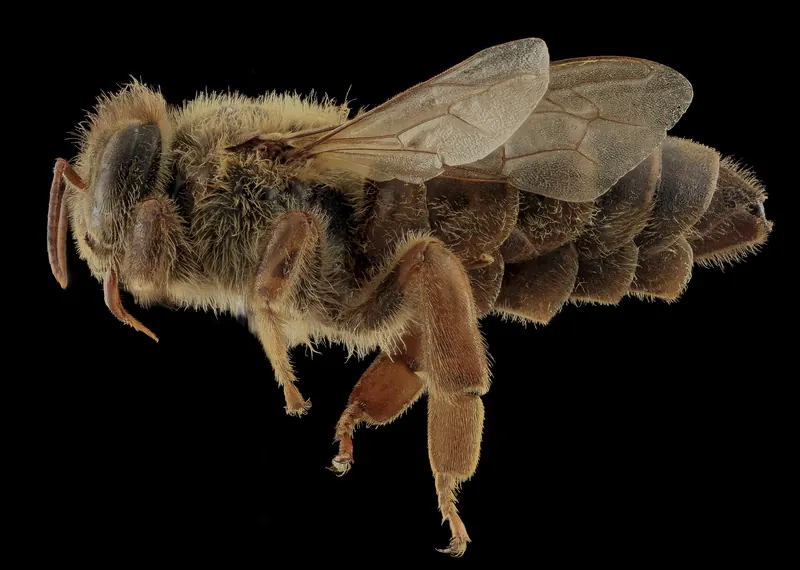
A colony splits in two
A strong honey bee colony reproduces by dividing itself, a process called swarming.Confirmed fact, source 4 The mother queen and roughly half the workers leave the nest to found a new colony.Confirmed fact, source 2 A newly reared daughter queen and the remaining workers stay behind and carry on the old colony.Confirmed fact, source 2 Overcrowding and congestion in the hive are among the signals that set swarming in motion.Reported by the farm, source reported 1
Swarm cells and departure
Before swarming, workers build queen cells along the lower edge of the comb, often many of them.Observation, source obs. 1 Before leaving, a large share of the departing workers fill their stomachs with honey as a travel reserve.Observation, source obs. 1 The swarm first gathers into a cluster near the parent hive and waits there while scouts search for a new site.Observation, source obs. 1 A swarm usually has just one queen, so it can found only one fully functioning colony.Confirmed fact, source 3
The scouts
Several hundred scout bees fly out from the swarm cluster to search for tree cavities.Observation, source obs. 2 Around 95 percent of the swarm stays quiet, saving the swarm's energy while the scouts work.Statistical estimate, source est. 3 Scouts that find a promising cavity advertise it with waggle dances on the surface of the swarm.Confirmed fact, source 3 Each scout dances less strongly for a site on every return, by about 15 waggle runs per return.Observation, source obs. 3
Quorum, not consensus
Writing in American Scientist, Seeley, Visscher and Passino argue that reaching a quorum at one site, not building a consensus among dancers, is the heart of the decision.Confirmed fact, source 4 In experiments with small swarms, the start of the signal to prepare for flight was consistently associated with a buildup of 10 to 15 or more bees at one of the nest boxes.Observation, source obs. 3 The signal is worker piping, a high-pitched sound produced in roughly the last hour before departure.Observation, source obs. 3 Piping stimulates the other bees to warm their flight muscles, readying the swarm for take-off.Confirmed fact, source 2 In one studied swarm of about 4,000 bees, the whole decision took about 16 hours of scout dancing spread over three days.Observation, source obs. 4
What a good home looks like
An attractive nest site has a cavity larger than 10 litres and an entrance smaller than 30 square centimetres.Observation, source obs. 3 In a Nature commentary, Visscher summarised that the best site among those the scouts discover is usually the one the swarm chooses.Observation, source obs. 5 Once the choice is made, the whole swarm flies to the selected cavity.Confirmed fact, source 5
Sources
- Akratanakul, P. (1990). Beekeeping in Asia. FAO Agricultural Services Bulletin 68/4. Rome: Food and Agriculture Organization of the United Nations. Chapter 2: Honeybee biology. Link
- Seeley, T. D., and Visscher, P. K. (2003). Choosing a home: how the scouts in a honey bee swarm perceive the completion of their group decision making. Behavioral Ecology and Sociobiology 54: 511-520. https://doi.org/10.1007/s00265-003-0664-6 Link
- Seeley, T. D., and Visscher, P. K. (2004). Group decision making in nest-site selection by honey bees. Apidologie 35(2): 101-116. https://doi.org/10.1051/apido:2004004 Link
- Seeley, T. D., Visscher, P. K., and Passino, K. M. (2006). Group decision making in honey bee swarms. American Scientist 94(3): 220-229. (Magazine feature by the researchers, not a primary research paper.) Link
- Visscher, P. K. (2003). How self-organization evolves. Nature 421: 799-800. News and Views commentary. Link
Last checked: 20 October 2026. Every statement in this article was compared with the source it cites. Spotted an error? Report it.