How honey bees heat and cool their home
Honey bees keep their brood warm and steady, fight off the cold in a winter cluster, and even employ dedicated heater bees.
Applies to: Apis mellifera (western honey bee). Winter clustering facts apply to colonies in cold temperate climates. Region: Winter cluster and winter-bee facts: cold temperate climates (studies from Austria, the Czech Republic and Wisconsin, USA).
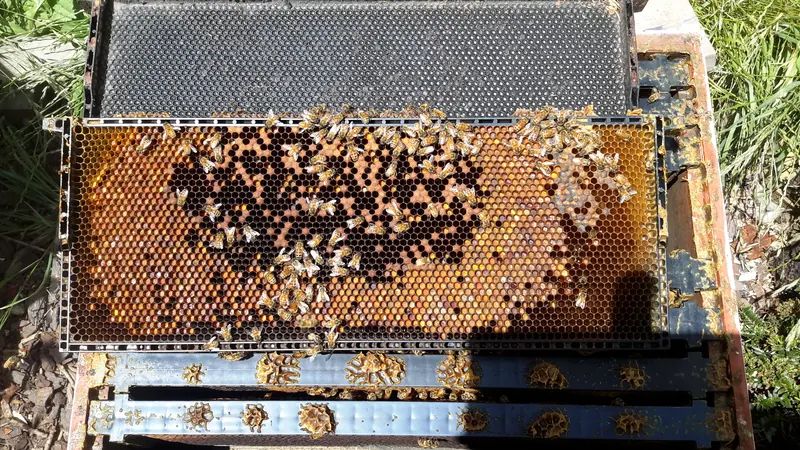
A nursery kept at a steady temperature
In normal honey bee colonies the brood nest is kept at a remarkably constant 32 to 36 °C.Confirmed fact, source 1 A study in Germany gives a similar range: honey bee colonies maintain brood nest temperatures of 33 to 36 °C.Confirmed fact, source 2 Workers help regulate brood temperature by producing heat while sitting still on the caps of brood cells.Confirmed fact, source 2
Heater bees
Some heater bees climb into empty cells scattered between sealed brood cells to warm the brood from inside the comb.Confirmed fact, source 2 Heat-producing bees inside empty cells reached mean thorax temperatures of up to 40.6 °C.Observation, source obs. 2 Heating inside an empty cell can raise the temperature of neighbouring brood by up to 2.5 °C within 30 minutes.Observation, source obs. 2 Heat from one bee could be detected moving through the comb up to three brood cells away.Observation, source obs. 2 A heater pressing its thorax against a brood cap transfers heat about 1.9 to 2.6 times more efficiently than when it is not touching the cap.Observation, source obs. 2
Cooling down and huddling up
To cool the nest, honey bees fan their wings and evaporate films of water held on their tongues.Confirmed fact, source 1 When it is cold, honey bees reduce heat loss by clustering together.Confirmed fact, source 1 The lower the temperature, the more tightly the honey bees pack their cluster.Confirmed fact, source 1
The winter cluster
To survive cold northern winters, honey bees crowd tightly together in a winter cluster.Confirmed fact, source 3 Earlier studies, summarised by Severson and Erickson in 1990, report that the core of the winter cluster in colonies without brood is generally kept between 20 and 30 °C.Reported by the farm, source reported 4 Those earlier studies report that the outer layer of the cluster stays at roughly 9 °C.Reported by the farm, source reported 4 When the colony is rearing brood, earlier studies report core temperatures of 29 to 36 °C.Reported by the farm, source reported 4 A study of colonies in Wisconsin, USA, found that the winter cluster expands and contracts in a predictable way as outside temperatures change.Confirmed fact, source 4
Who keeps the cluster warm
Measurements show that bees in a winter cluster actively produce heat with their bodies.Confirmed fact, source 3 Heat-producing bees are most common in the core and become rarer toward the surface of the cluster.Observation, source obs. 3 Models of winter cluster heating at the time treated the tightly packed outer bees as an insulating layer, the decisive factor for survival at low temperatures.Reported by the farm, source reported 3 The core bees play an active role in controlling the temperature of the winter cluster.Confirmed fact, source 3 The long-lived winter generation of workers is the one that regulates colony temperature through the winter.Confirmed fact, source 5
Sources
- Akratanakul, P. (1990). Beekeeping in Asia. FAO Agricultural Services Bulletin 68/4. Rome: Food and Agriculture Organization of the United Nations. Chapter 2: Honeybee biology. Link
- Kleinhenz, M., Bujok, B., Fuchs, S., and Tautz, J. (2003). Hot bees in empty broodnest cells: heating from within. Journal of Experimental Biology 206(23): 4217-4231. https://doi.org/10.1242/jeb.00680 Link
- Stabentheiner, A., Pressl, H., Papst, T., Hrassnigg, N., and Crailsheim, K. (2003). Endothermic heat production in honeybee winter clusters. Journal of Experimental Biology 206(2): 353-358. https://doi.org/10.1242/jeb.00082 Link
- Severson, D. W., and Erickson, E. H. Jr. (1990). Quantification of cluster size and low ambient temperature relationships in the honey bee. Apidologie 21(2): 135-142. https://doi.org/10.1051/apido:19900207 Link
- Kunc, M., Dobeš, P., Hurychová, J., Vojtek, L., Poiani, S. B., Danihlík, J., Havlík, J., Titěra, D., and Hyršl, P. (2019). The Year of the Honey Bee (Apis mellifera L.) with Respect to Its Physiology and Immunity: A Search for Biochemical Markers of Longevity. Insects 10(8): 244. https://doi.org/10.3390/insects10080244 Link
Last checked: 20 October 2026. Every statement in this article was compared with the source it cites. Spotted an error? Report it.