The honey bee dance language
How a returning forager tells her sisters where food is, how we know it works, and what scientists still argue about.
Applies to: Apis mellifera (western honey bee) unless stated. FAO's description (s1) is written for Asian beekeeping and covers Apis cerana too.
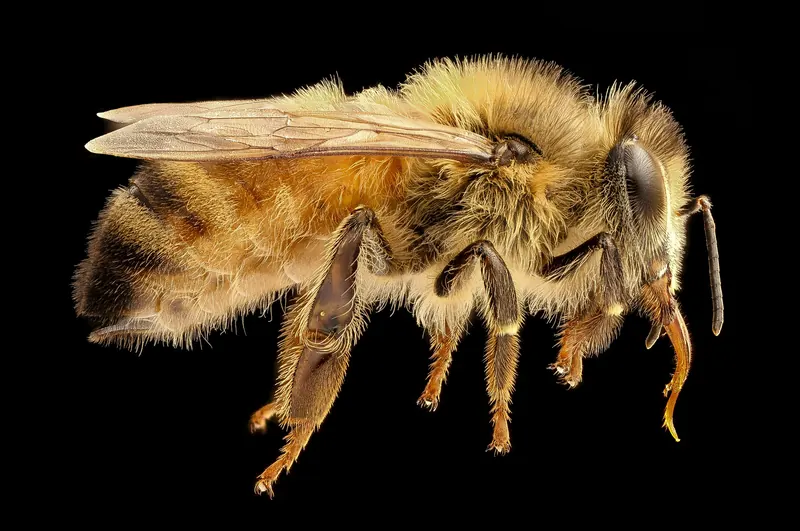
A message about food
With the waggle dance, a successful honey bee forager tells nestmates where the flowers she visited are.Confirmed fact, source 2 The dance is aimed at nestmate foragers that are not yet busy with a food source of their own.Confirmed fact, source 2 A lively dance about a rich food source attracts many recruits.Observation, source obs. 1 While dancing, the forager also shares samples of nectar, and followers can smell the pollen she carries.Observation, source obs. 1
Round dance and waggle dance
The round dance means food is close to the hive, and it gives no direction.Confirmed fact, source 1 In the waggle dance, the angle of the bee's straight run from the vertical shows the direction of food relative to the sun.Confirmed fact, source 1 A straight run pointing upward on the comb tells foragers to fly toward the sun.Confirmed fact, source 1 Distance is coded by how long the waggle run lasts: longer waggle runs mean food farther away.Confirmed fact, source 3 Researchers decode dances to map where colonies forage. Near Brighton, England, bees danced for the farthest sites in summer.Observation, source obs. 2
Karl von Frisch
The discovery and decoding of the waggle dance earned Karl von Frisch a Nobel Prize in 1973.Confirmed fact, source 4 Von Frisch concluded that recruited bees used the information in the dance to fly straight to the food.Reported by the farm, source reported 5 His idea met early scepticism, but almost all biologists now accept that von Frisch was right.Confirmed fact, source 5 Von Frisch chose to work only with good dancers, which, according to later researchers, probably led to dance errors being underestimated.Reported by the farm, source reported 3
Radar follows the recruits
In 2005, Riley and colleagues used harmonic radar to record the real flight paths of bees recruited by dances.Confirmed fact, source 5 In that study, 19 of 23 recruits released from the hive flew off and produced usable radar tracks.Observation, source obs. 5 The authors concluded from the radar tracks that most recruits probably need scent and visual cues for the final part of the flight to the food.Observation, source obs. 5 The authors expressed the hope that their results would be accepted as a vindication of von Frisch's dance hypothesis.Reported by the farm, source reported 5
What is still debated
Dance followers often seem to ignore the location information after leaving the nest.Observation, source obs. 6 Grüter and Farina argue that location information is often a backup, used when bees lack good information of their own.Open question, source open question 6 Dances are imprecise, and the accuracy with which a follower can estimate distance from a dance is limited.Confirmed fact, source 3 A 2015 analysis by Schürch and Ratnieks estimated that a dance conveys 2.9 bits of information about direction and 4.5 bits about distance.Statistical estimate, source est. 3
Sources
- Akratanakul, P. (1990). Beekeeping in Asia. FAO Agricultural Services Bulletin 68/4. Rome: Food and Agriculture Organization of the United Nations. Chapter 2: Honeybee biology. Link
- Couvillon, M. J., Schürch, R., and Ratnieks, F. L. W. (2014). Waggle Dance Distances as Integrative Indicators of Seasonal Foraging Challenges. PLoS ONE 9(4): e93495. https://doi.org/10.1371/journal.pone.0093495 Link
- Schürch, R., and Ratnieks, F. L. W. (2015). The spatial information content of the honey bee waggle dance. Frontiers in Ecology and Evolution 3: 22. https://doi.org/10.3389/fevo.2015.00022 Link
- Schürch, R., Couvillon, M. J., and Beekman, M. (2016). Editorial: Ballroom Biology: Recent Insights into Honey Bee Waggle Dance Communications. Frontiers in Ecology and Evolution 3: 147. https://doi.org/10.3389/fevo.2015.00147 Link
- Riley, J. R., Greggers, U., Smith, A. D., Reynolds, D. R., and Menzel, R. (2005). The flight paths of honeybees recruited by the waggle dance. Nature 435: 205-207. https://doi.org/10.1038/nature03526 Link
- Grüter, C., and Farina, W. M. (2009). The honeybee waggle dance: can we follow the steps? Trends in Ecology and Evolution 24(5): 242-247. https://doi.org/10.1016/j.tree.2008.12.007 (abstract read via Universidad de Buenos Aires digital library record). Link
Last checked: 20 October 2026. Every statement in this article was compared with the source it cites. Spotted an error? Report it.