Who does what in a honey bee colony
A honey bee colony runs on three castes and on workers whose jobs change as they age.
Applies to: Apis mellifera (western honey bee). Some general statements come from an FAO handbook written for Asia, which also covers Apis cerana; see notes. Region: Lifespan figures: US Mid-Atlantic extension guidance (summer six weeks) and a Czech Republic study citing earlier work (15 to 48 days; up to eight months). Drone eviction: regions with cold winters.
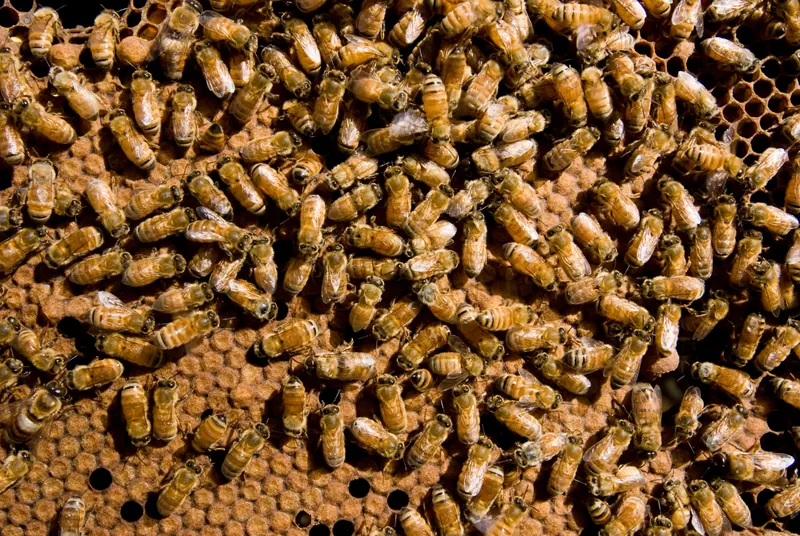
Three kinds of bee
Biologists group the members of a honey bee colony, queen, workers and drones, into three categories called castes.Confirmed fact, source 1 A colony normally has only one queen, and her main job is to lay eggs.Confirmed fact, source 2 A single queen may lay up to about 250,000 eggs in a year.Reported by the farm, source reported 2 Drones are males. They gather no food, and their biological role is to mate with queens.Confirmed fact, source 1 Workers are the smallest bees in the colony and make up the great majority of its members.Confirmed fact, source 2
A career that follows age
According to an FAO handbook on beekeeping in Asia, which covers both Asian and western honey bees, a newly emerged worker is too weak in her first few days to do much more than inspect and clean empty cells.Observation, source obs. 1 Young nurse bees feed larvae with a fat and protein rich secretion from glands in their heads, the hypopharyngeal glands.Confirmed fact, source 1 The same FAO handbook says workers more than about two weeks old are often the ones guarding the hive entrance.Observation, source obs. 1 The FAO handbook gives about two to three weeks as the usual age at which workers start foraging; the exact age varies.Statistical estimate, source est. 1 Foraging is a worker's last job; once she starts, she keeps foraging for the rest of her life.Confirmed fact, source 1
A flexible schedule
Scientists call this age-based division of labour temporal polyethism: young workers stay inside, older workers move outward and finally forage.Confirmed fact, source 3 The age schedule is not fixed. It can speed up, pause or even run backwards when the colony's needs change.Confirmed fact, source 3 If a colony loses its foragers, more young workers start foraging earlier than usual.Confirmed fact, source 3 Nurse bees usually carry less juvenile hormone and more vitellogenin, a yolk protein, than foragers do.Confirmed fact, source 3 A widely held model says vitellogenin holds juvenile hormone in check, and as it is used up, rising hormone levels push nurses toward foraging.Reported by the farm, source reported 3
Short summer lives, long winter lives
A honey bee worker in summer lives about six weeks, according to US Mid-Atlantic extension guidance.Statistical estimate, source est. 2 Researchers in the Czech Republic, citing earlier lifespan observations, give summer worker lifespans of 15 to 48 days.Observation, source obs. 4 The same source, citing earlier work, says workers of the winter generation can survive up to about eight months.Observation, source obs. 4 Long-lived winter bees store more vitellogenin and have a larger fat body, the insect organ that stores nutrients.Confirmed fact, source 4 In regions with cold winters, drones are usually pushed out of the hive in autumn as forage runs short, and they die.Observation, source obs. 2
Sources
- Akratanakul, P. (1990). Beekeeping in Asia. FAO Agricultural Services Bulletin 68/4. Rome: Food and Agriculture Organization of the United Nations. Chapter 2: Honeybee biology. Link
- Mid-Atlantic Apiculture Research and Extension Consortium (MAAREC). The Colony and Its Organization. University of Delaware, College of Agriculture and Natural Resources. Link
- Schilcher, F., Hilsmann, L., Ankenbrand, M. J., Krischke, M., Mueller, M. J., Steffan-Dewenter, I., and Scheiner, R. (2022). Honeybees are buffered against undernourishment during larval stages. Frontiers in Insect Science 2: 951317. https://doi.org/10.3389/finsc.2022.951317 Link
- Kunc, M., Dobeš, P., Hurychová, J., Vojtek, L., Poiani, S. B., Danihlík, J., Havlík, J., Titěra, D., and Hyršl, P. (2019). The Year of the Honey Bee (Apis mellifera L.) with Respect to Its Physiology and Immunity: A Search for Biochemical Markers of Longevity. Insects 10(8): 244. https://doi.org/10.3390/insects10080244 Link
Last checked: 20 October 2026. Every statement in this article was compared with the source it cites. Spotted an error? Report it.