Megachilidae
Osmia bicolor
Two-coloured mason bee, Red-tailed mason bee
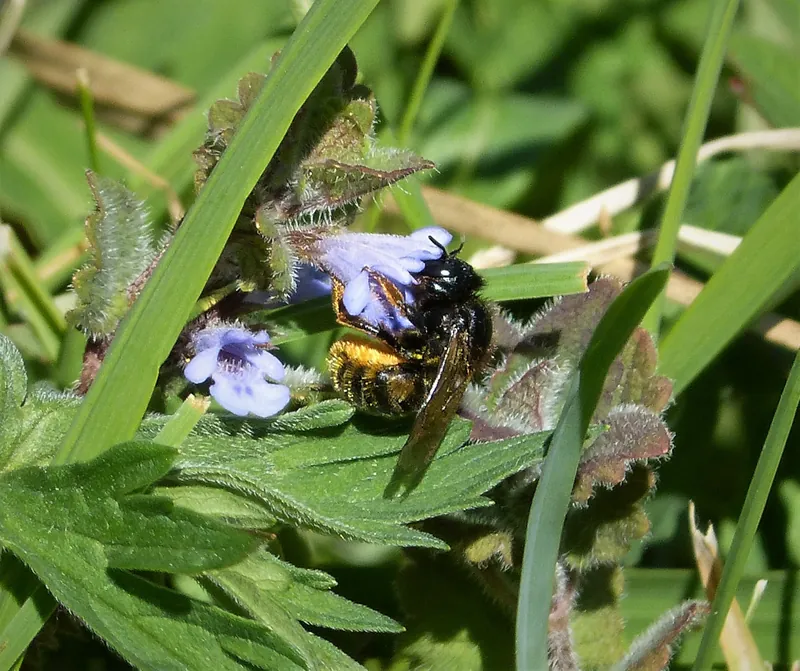
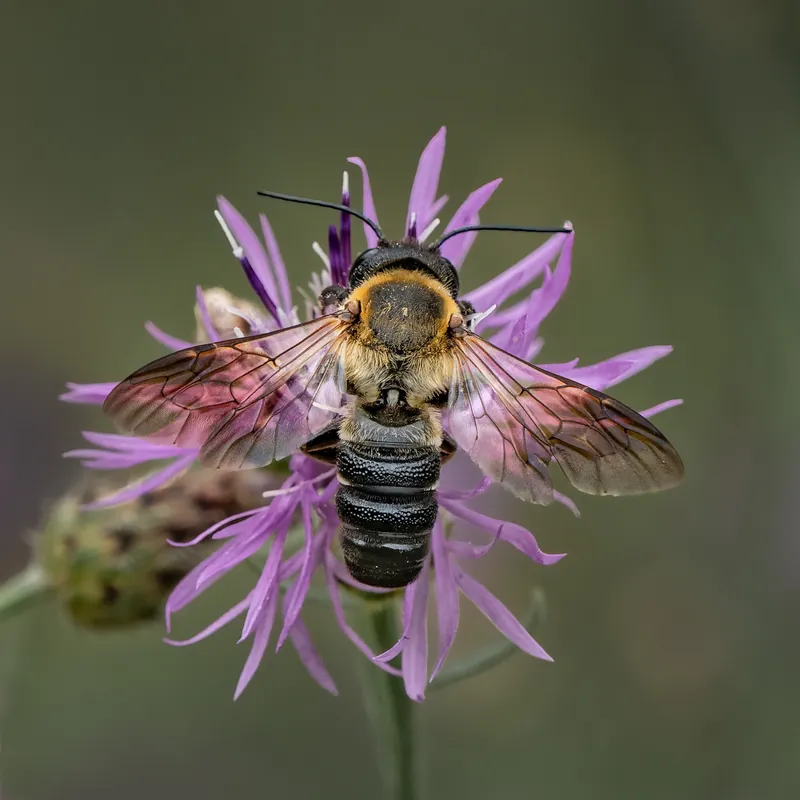
A spring mason bee of chalk and limestone country in Europe. Females nest inside empty snail shells, building leaf-pulp partitions, packing the entrance with pebbles and shell fragments, turning the shell mouth to the ground and then hiding it under a heap of pine needles, grass or dead leaves. Adults overwinter in their cocoons inside the shell.
What we know
Where it lives
It is mainly a central European species that becomes rare and sporadic north of Belgium, with a range from southern Finland to Spain and east to the former Yugoslavia and Romania.
Confirmed fact[1]In Britain it is found mostly in southern England and south Wales, and its range closely follows chalk and limestone soils.
Confirmed fact[1]Typical habitat is calcareous grassland and open deciduous woodland on chalk and limestone soils.
Confirmed fact[1]
Life cycle and colony
Nest
Females nest in empty snail shells, including those of the Roman snail, banded snails of the genus Cepaea and the Kentish snail.
Confirmed fact[1]Cells inside the shell are separated by thin partitions of chewed leaf pulp from plants such as cinquefoil, strawberry, willow and rose.
Confirmed fact[2]The nest plug is a 1 to 2 cm space densely packed with small pebbles, earth crumbs, broken snail shells, chalk or wood particles, closed by a final leaf-pulp partition.
Confirmed fact[2]Provisioning a single cell takes 27 to 39 foraging trips, and nests hold mostly one or two, rarely up to five, brood cells.
Confirmed fact[2]
Flowers and food
It is polylectic, with pollen sources recorded from many plant families including carrot, asparagus, daisy, borage, cabbage, pea, mint, rose, willow and violet families.
Confirmed fact[2]Flowers visited in Britain include wood anemone, bluebell, bird's-foot trefoil, horseshoe vetch, sainfoin, sallow, ground-ivy, daisy and dandelion.
Confirmed fact[1]
Behaviour
Once the shell is closed the female turns it so the opening faces the ground, then covers it with hundreds of pine needles, dry grass blades or fragments of dead leaves.
Confirmed fact[2]Males keep to small home ranges, patrolling flowers and snail shells on the ground along roughly fixed circular routes, and sleep singly or in small groups inside empty snail shells.
Confirmed fact[2]Known nest enemies include the cuckoo wasps Chrysura cuprea, C. refulgens and C. trimaculata, the parasitoid Eulophus osmiarum and the sapygid wasp Sapyga quinquepunctata.
Confirmed fact[2]
Where it has been recorded
Each hexagon contains at least one record of Osmia bicolor shared with GBIF: museum specimens, surveys and photographs.
12,207 records
- Switzerland3,351
- United Kingdom1,997
- Sweden1,920
- Estonia1,425
- Germany829
- Austria825
GBIF.org occurrence data for taxon key 5039228, retrieved 2026-10-19. Observation[3]
Records show where the bee has been found and reported, not its full range or its abundance. Isolated points far from the main cluster can be misidentifications, captive or imported bees, or genuine rare finds.
More from this part of the bee family tree
Sources
- BWARS (Bees, Wasps and Ants Recording Society). Osmia bicolor (Schrank, 1781). Species account, BWARS website. Link
- Muller, A. (ongoing). Palaearctic Osmiine Bees: Systematics and Biology of a Fascinating Group of Solitary Bees. Subgenus Neosmia, species account Osmia bicolor. ETH Zurich. Link
- GBIF.org (2026). Occurrence search and density maps for Osmia bicolor, taxon key 5039228. Link
Last checked: 30 October 2026. Every statement on this page was compared with the source it cites. Spotted an error? Report it.