Megachilidae
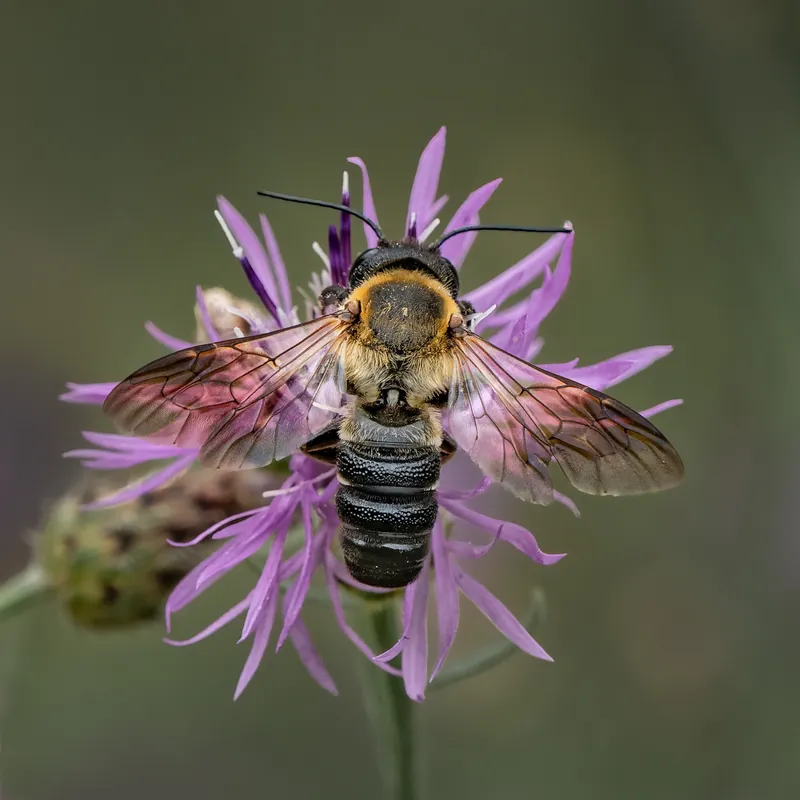
Megachile willughbiella
Willughby's leafcutter bee
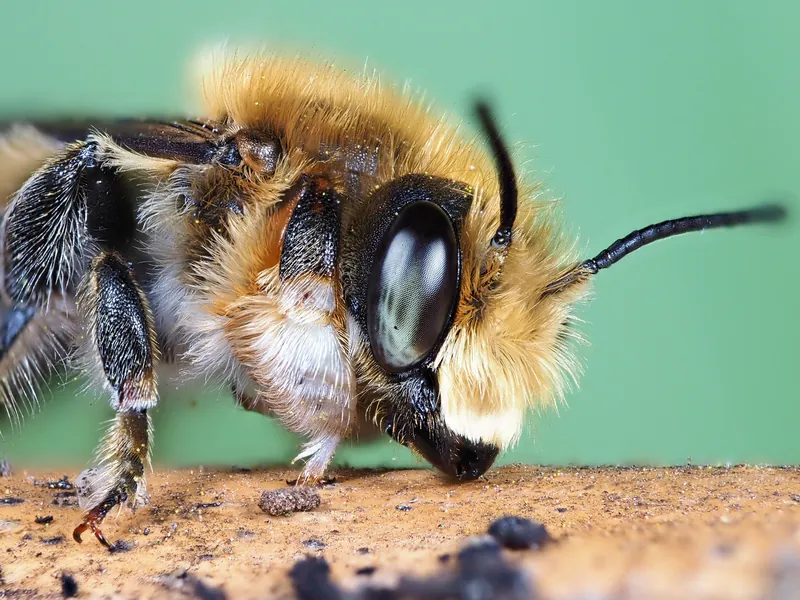
One of the most often seen leafcutter bees in the British Isles, found across western Europe from Spain to Finland. This solitary summer bee nests in existing holes in wood or soil, lining its cells with cut leaf pieces, and carries dry pollen under its abdomen. It visits many flowers, including bellflowers, and is a frequent garden resident.
What we know
How to recognise it
Females from mainland Britain and the Isle of Man have black pollen-carrying hairs on the fifth and sixth belly segments, while Irish females have an entirely reddish-golden pollen brush.
Confirmed fact[1]
Where it lives
It is one of the most frequently observed and widely distributed leafcutter bees in the British Isles.
Confirmed fact[1]Beyond Britain it occurs in western Europe from Spain to Lithuania and Finland.
Confirmed fact[1]Gardens and brownfield sites are frequently visited and used for nesting, and the species is found in a variety of habitats with suitable nesting and forage.
Confirmed fact[1]
Life cycle and colony
Nest
Nests can be made either in wood or in soil, and there is even a record of a nest in a length of rubber hose in a greenhouse.
Confirmed fact[1]The brood cells are built from pieces of leaf, including beech and tutsan.
Confirmed fact[1]It is a renter that uses existing cavities in dead wood, walls or the ground rather than digging new ones.
Confirmed fact[3]
Flowers and food
Behaviour
Three cuckoo bees of the genus Coelioxys, C. quadridentata, C. rufescens and C. elongata, are recorded as cleptoparasites of its nests.
Confirmed fact[1]
Conservation
In Britain the species is not regarded as scarce or threatened, and the European Red List of Bees classes it as Least Concern.
Confirmed fact[1]
Where it has been recorded
Each hexagon contains at least one record of Megachile willughbiella shared with GBIF: museum specimens, surveys and photographs.
22,573 records
- Netherlands5,920
- Switzerland5,718
- Belgium2,230
- United Kingdom1,840
- Sweden1,484
- Germany1,227
GBIF.org occurrence data for taxon key 1335556, retrieved 2026-10-19. Observation[4]
Records show where the bee has been found and reported, not its full range or its abundance. Isolated points far from the main cluster can be misidentifications, captive or imported bees, or genuine rare finds.
More from this part of the bee family tree
Sources
- BWARS (Bees, Wasps and Ants Recording Society). Megachile willughbiella (Kirby, 1802). Species account, BWARS website. Link
- Naturalis Biodiversity Center. Bee Traits database: Megachile (Xanthosarus) willughbiella (Kirby, 1802), General traits and Status tabs. Link
- D'Haeseleer, J., Pauly, A., Rasmont, P., Vanormelingen, P. & Vereecken, N. Megachile (Macromegachile) willughbiella (Kirby, 1802). Atlas Hymenoptera, University of Mons. Link
- GBIF.org (2026). Occurrence search and density maps for Megachile willughbiella, taxon key 1335556. Link
Last checked: 30 October 2026. Every statement on this page was compared with the source it cites. Spotted an error? Report it.