Megachilidae
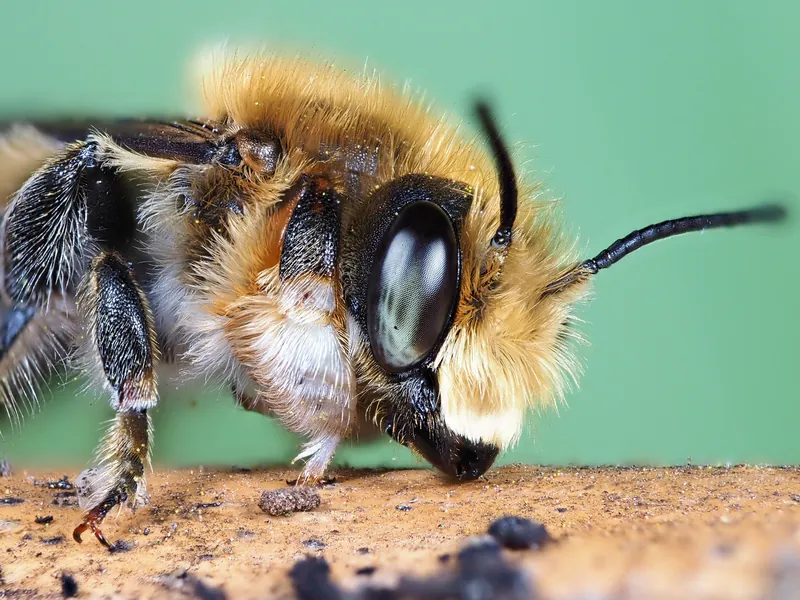
Megachile sculpturalis
Giant resin bee, Sculptured resin bee
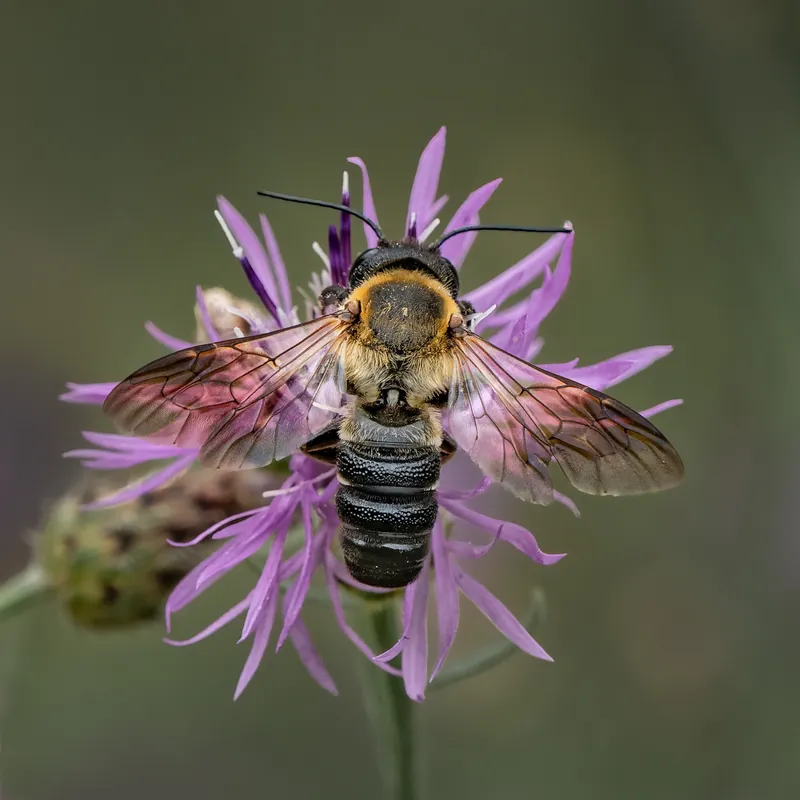
A very large solitary bee native to eastern Asia that has spread, probably as a stowaway in shipping, to North America since 1994 and to Europe since 2008. Females cannot bore wood, so they take over existing holes, sometimes evicting carpenter bees, and seal their cells with resin. They fly in summer and favour pollen from the Japanese pagoda tree.
What we know
How to recognise it
Where it lives
The species is native to China, Japan and a few other places in eastern Asia.
Confirmed fact[3]It was first collected in North America in North Carolina in 1994 and then spread rapidly, reaching Alabama by 1999 and Canada by 2002.
Confirmed fact[1]Later records extended its known US range southwest through Arkansas, Louisiana, Mississippi, Missouri and Texas.
Confirmed fact[1]In Europe it was first found in 2008 near Marseille in France, most likely arriving by ship, and by 2020 there were many records from Switzerland, Liechtenstein and Austria.
Confirmed fact[2]
Life cycle and colony
Nest
Females prefer to nest in existing cavities because they cannot bore their own holes in wood, and they will occupy abandoned nests of similar-sized bees.
Confirmed fact[1]In Europe females use existing holes in dead wood or reed; the cavity walls and entrance are sealed with resin and the partitions between cells are covered with a layer of mud.
Confirmed fact[2]
Flowers and food
Behaviour
Females have been seen aggressively evicting carpenter bee females from their nest tunnels in order to nest there themselves.
Observation[1]
Bees and people
Females can sting but are not aggressive and usually fly away from people; the species is thought to have travelled along maritime trade routes as a stowaway.
Confirmed fact[3]
Where it has been recorded
Each hexagon contains at least one record of Megachile sculpturalis shared with GBIF: museum specimens, surveys and photographs.
9,024 records
- United States5,812
- France905
- Japan372
- Italy335
- Austria240
- Canada229
GBIF.org occurrence data for taxon key 1335213, retrieved 2026-10-19. Observation[4]
Records show where the bee has been found and reported, not its full range or its abundance. Isolated points far from the main cluster can be misidentifications, captive or imported bees, or genuine rare finds.
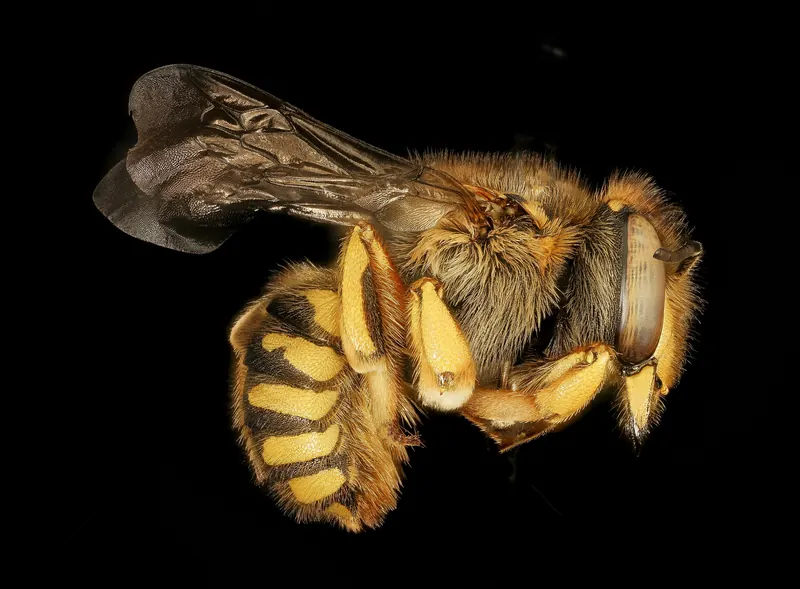
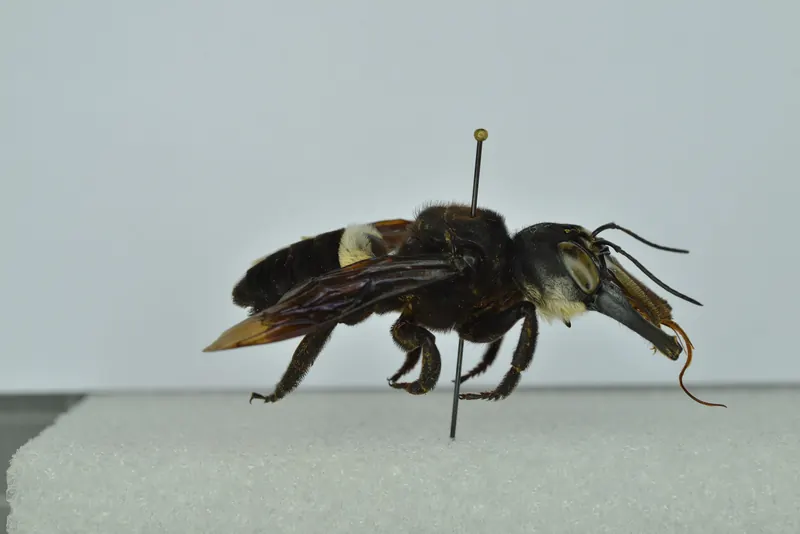
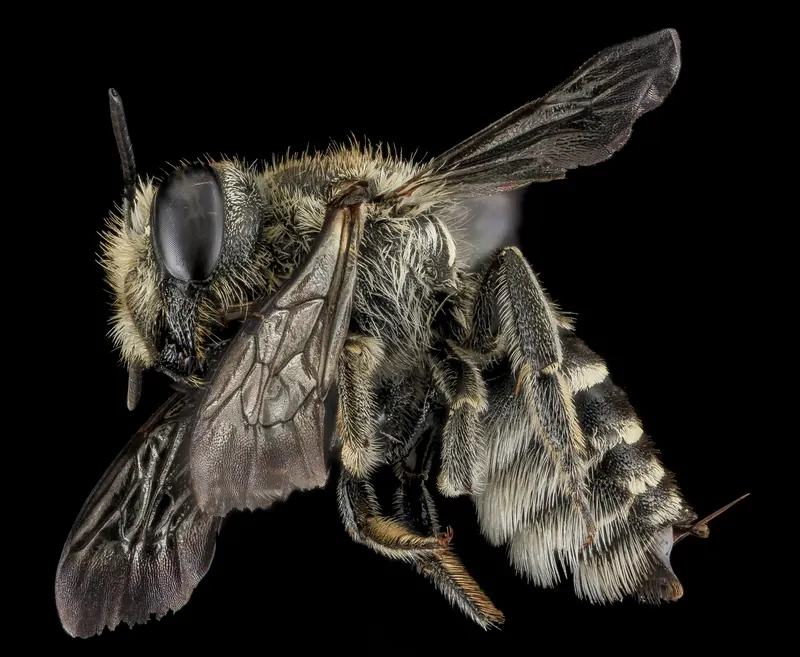
More from this part of the bee family tree
Sources
- Parys, K. A., Tripodi, A. D. & Sampson, B. J. (2015). The Giant Resin Bee, Megachile sculpturalis Smith: New Distributional Records for the Mid- and Gulf-south USA. Biodiversity Data Journal 3: e6733. doi:10.3897/BDJ.3.e6733 Link
- Lanner, J., Huchler, K., Pachinger, B., Sedivy, C. & Meimberg, H. (2020). Dispersal patterns of an introduced wild bee, Megachile sculpturalis Smith, 1853 (Hymenoptera: Megachilidae) in European alpine countries. PLoS ONE 15(7): e0236042. doi:10.1371/journal.pone.0236042 Link
- Stevens, K. C., Jack, C. J. & Ellis, J. D. (2019, revised 2023). Giant Resin Bee Megachile sculpturalis (Smith) (Insecta: Hymenoptera: Megachilidae). EENY-733, UF/IFAS Extension, University of Florida. doi:10.32473/EDIS-in1258-2019 Link
- GBIF.org (2026). Occurrence search and density maps for Megachile sculpturalis, taxon key 1335213. Link
Last checked: 30 October 2026. Every statement on this page was compared with the source it cites. Spotted an error? Report it.