Megachilidae
Megachile rotundata
Alfalfa leafcutting bee, Alfalfa leaf-cutter bee
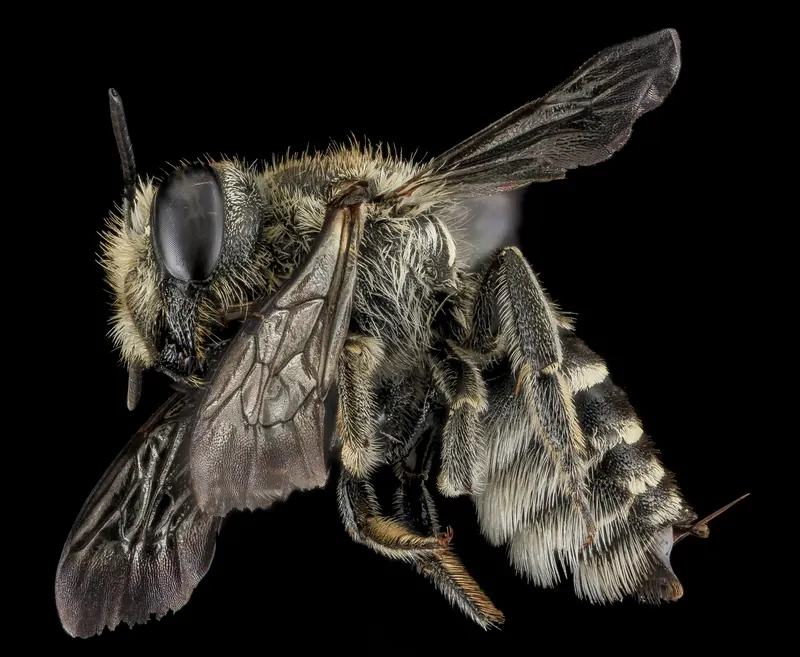
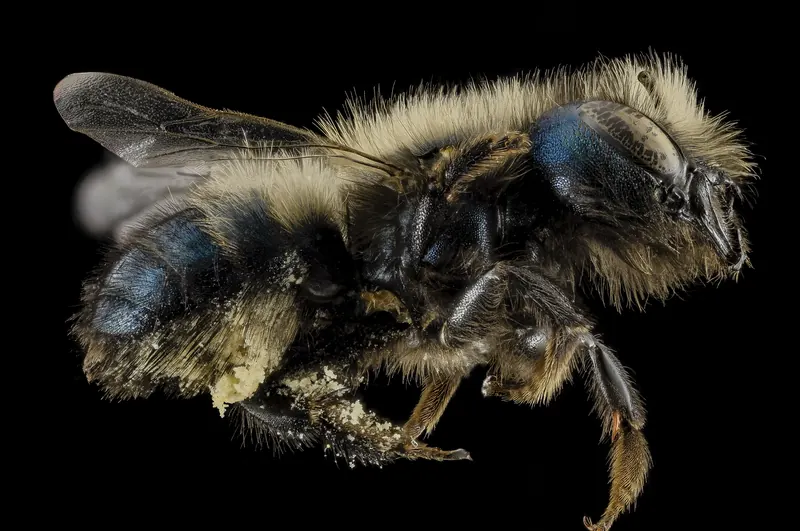
The alfalfa leafcutting bee is a small black solitary bee from Eurasia that lines its nest cells with cut leaf pieces. Accidentally introduced to the United States by the 1940s, it is now managed in huge numbers to pollinate alfalfa grown for seed, and it trips alfalfa flowers far more often than honey bees do.
What we know
How to recognise it
Adults have a robust, cylindrical body that is mostly black with white bands on the abdomen.
Confirmed fact[2]
Where it lives
Life cycle and colony
Gregarious nesting, with many females nesting close together, is one of the traits that made it suitable for commercial management.
Confirmed fact[1]The young spend the winter as non-feeding pre-pupae, a resting larval stage.
Confirmed fact[2]In most of North America, adults emerge and mate in June and July.
Confirmed fact[2]
Nest
Each nest cell is built from cut leaf pieces, usually 14 to 15 per cell.
Confirmed fact[3]
Flowers and food
It is polylectic, meaning it collects food from many different kinds of plants.
Confirmed fact[2]
Behaviour
In a US study, female alfalfa leafcutting bees tripped (opened) 78% of the alfalfa flowers they visited; honey bees tripped only 22%.
Confirmed fact[4]
Bees and people
Managing this bee in nests transformed the North American alfalfa seed industry, tripling seed production.
Confirmed fact[1]The most common way to manage it is the loose cell system, in which cocooned bees are taken out of the nest cavities for cleaning and storage.
Confirmed fact[1]Besides alfalfa, it is used to pollinate canola for hybrid seed, native legumes and blueberries.
Confirmed fact[2]Managed populations can be affected by many fungal diseases, including the fungus that causes chalkbrood.
Confirmed fact[3]
Where it has been recorded
Each hexagon contains at least one record of Megachile rotundata shared with GBIF: museum specimens, surveys and photographs.
11,160 records
- United States5,103
- Canada1,672
- Germany1,041
- Chile626
- Switzerland622
- Finland521
GBIF.org occurrence data for taxon key 1335648, retrieved 2026-10-19. Observation[5]
Records show where the bee has been found and reported, not its full range or its abundance. Isolated points far from the main cluster can be misidentifications, captive or imported bees, or genuine rare finds.
More from this part of the bee family tree
Sources
- Pitts-Singer, T.L. and Cane, J.H. (2011). The alfalfa leafcutting bee, Megachile rotundata: the world's most intensively managed solitary bee. Annual Review of Entomology 56: 221-237. doi:10.1146/annurev-ento-120709-144836 Link
- Gonzalez, A.L. and Jack, C.J. (2025). Alfalfa leaf-cutter bee Megachile rotundata (Insecta: Hymenoptera: Megachilidae). University of Florida IFAS Extension, EENY-820. Link
- Clements, J., Saeed, A. and Rashed, A. (2023). Alfalfa Leafcutting Bee Facts. University of Idaho Extension, BUL 1050. Link
- Cane, J.H. (2002). Pollinating bees (Hymenoptera: Apiformes) of U.S. alfalfa compared for rates of pod and seed set. Journal of Economic Entomology 95(1): 22-27. doi:10.1603/0022-0493-95.1.22 Link
- GBIF.org (2026). Occurrence search and density maps for Megachile rotundata, taxon key 1335648. Link
Last checked: 20 October 2026. Every statement on this page was compared with the source it cites. Spotted an error? Report it.