Megachilidae
Anthidium manicatum
European wool carder bee, Wool-carder bee
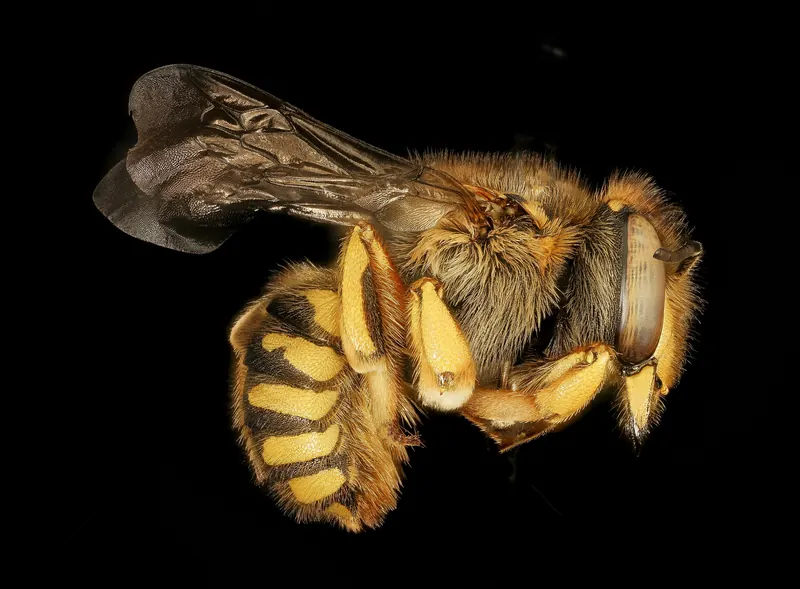
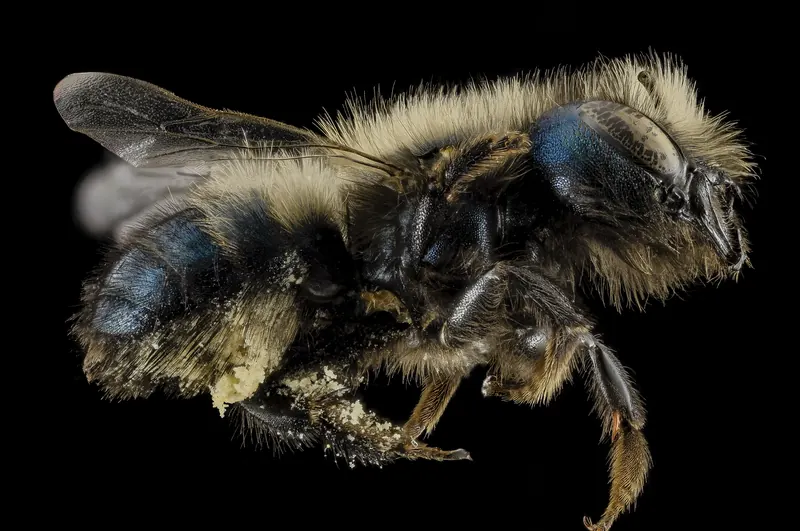
The European wool carder bee lines its nest cells with soft plant hairs scraped from woolly leaves such as lamb's ears. Males are larger than females and fiercely guard flower patches. Native to Europe, western Asia and northern Africa, it has spread to North and South America and New Zealand.
What we know
How to recognise it
Where it lives
Its native range covers Europe, western Asia and northern Africa.
Confirmed fact[2]It was accidentally brought to the United States, where it was first recorded near Ithaca, New York, in 1963.
Confirmed fact[2]It has also spread into South America, where a 2015 study reported it for the first time in Chile.
Confirmed fact[3]
Life cycle and colony
Nest
Females scrape the fine hairs off woolly plants with their toothed jaws, and this habit gives the bee its name, wool carder.
Confirmed fact[1]The walls of each nest cell and the plug that closes the nest are made from pressed layers of long, silky plant hairs.
Confirmed fact[1]Favoured plants for hair collection include woundworts such as lamb's ears (Stachys byzantina) and yarrow.
Confirmed fact[1]Females nest in existing holes, such as beetle exit holes in dead wood and hollow stems.
Confirmed fact[1]
Flowers and food
Dead nettles are the flowers most often reported for its foraging, though it takes nectar from many different plants.
Confirmed fact[2]
Behaviour
Large males vigorously defend patches of favoured flowers and chase away any other insect that enters their territory.
Confirmed fact[1]
Conservation
Where it has been introduced, scientists are concerned that it may compete with native bees.
Open question[2]
Where it has been recorded
Each hexagon contains at least one record of Anthidium manicatum shared with GBIF: museum specimens, surveys and photographs.
56,366 records
- Netherlands11,168
- United States11,066
- Germany7,471
- Switzerland4,588
- Belgium3,923
- United Kingdom3,885
GBIF.org occurrence data for taxon key 1334821, retrieved 2026-10-19. Observation[4]
Records show where the bee has been found and reported, not its full range or its abundance. Isolated points far from the main cluster can be misidentifications, captive or imported bees, or genuine rare finds.
More from this part of the bee family tree
Sources
- Else, G. R. & O'Toole, C. (1998, proofed 2012). Anthidium manicatum (Linnaeus, 1758), species account. Bees, Wasps & Ants Recording Society (BWARS). Link
- Gallagher, S. & Lucky, A. (2020). European Wool Carder Bee, Anthidium manicatum (Linnaeus) (Insecta: Hymenoptera: Megachilidae). EENY-746 / IN1274. UF/IFAS Extension, University of Florida (EDIS). Link
- Montalva, J., Ríos, M. & Vivallo, F. (2015). First record of the invasive bee Anthidium manicatum (Hymenoptera: Megachilidae) in Chile. Journal of Melittology 56: 1-5. doi:10.17161/jom.v0i56.4912 Link
- GBIF.org (2026). Occurrence search and density maps for Anthidium manicatum, taxon key 1334821. Link
Last checked: 20 October 2026. Every statement on this page was compared with the source it cites. Spotted an error? Report it.