Apidae
Xylocopa virginica
Eastern carpenter bee
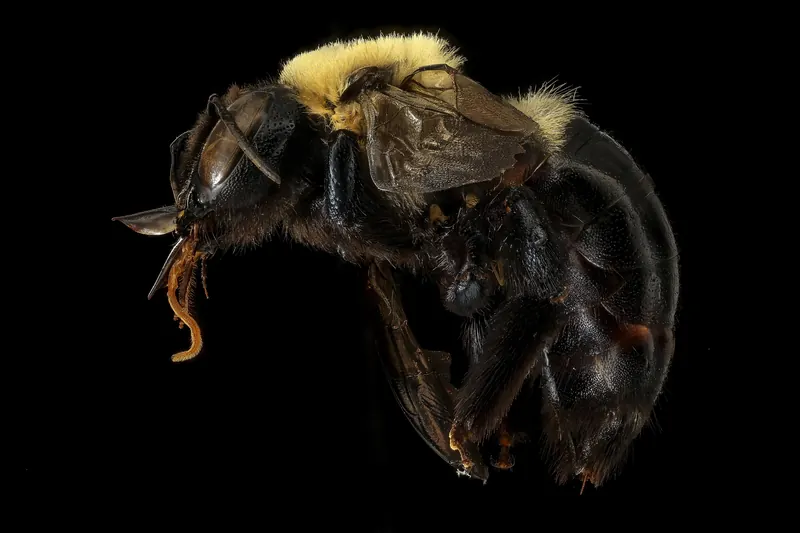
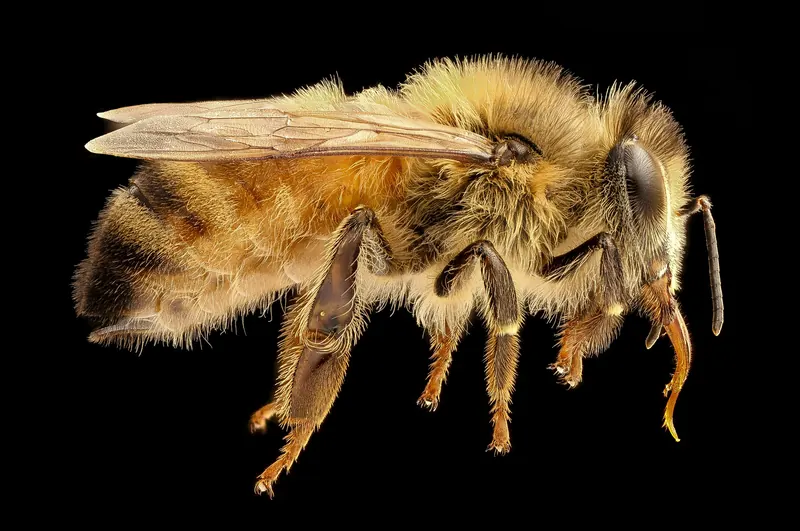
The eastern carpenter bee is a large black and yellow bee of eastern North America with a shiny, nearly hairless abdomen. Females chew long tunnels in bare wood, sometimes in buildings. Nests may be shared by small groups of females and reused by successive generations, and adults spend the winter inside them.
What we know
How to recognise it
Where it lives
The eastern carpenter bee is found widely across eastern North America.
Confirmed fact[1]
Life cycle and colony
Females can nest alone or in small groups, usually of two to five females and occasionally up to eight.
Confirmed fact[2]In shared nests, the dominant female takes over both the foraging and the egg-laying.
Confirmed fact[2]Adults spend the winter inside the nest where they grew up, and females come out of hibernation in spring.
Confirmed fact[2]In populations studied in southern Ontario, most females live about one year.
Confirmed fact[2]
Nest
Flowers and food
The flower-cutting habit of carpenter bees has been shown to make honey bees better pollinators of rabbiteye blueberries.
Confirmed fact[1]
Behaviour
Bees and people
Woodpeckers that hunt carpenter bees in wooden structures can add to the damage the bees cause.
Confirmed fact[1]
Where it has been recorded
Each hexagon contains at least one record of Xylocopa virginica shared with GBIF: museum specimens, surveys and photographs.
114,612 records
- United States108,932
- Canada5,095
- Rwanda5
- ZZ3
- Belgium2
- Germany1
GBIF.org occurrence data for taxon key 1342324, retrieved 2026-10-19. Observation[4]
Records show where the bee has been found and reported, not its full range or its abundance. Isolated points far from the main cluster can be misidentifications, captive or imported bees, or genuine rare finds.
More from this part of the bee family tree
Sources
- Fellows, C.J. and Carlton, C.E. (2021). Xylocopa virginica, Eastern Carpenter Bee (Hymenoptera: Apidae). LSU AgCenter, publication 3783. Link
- Vickruck, J.L. and Richards, M.H. (2021). Competition drives group formation and reduces within nest relatedness in a facultatively social carpenter bee. Frontiers in Ecology and Evolution 9: 738809. Link
- Grissell, E.E., Sanford, M.T. and Fasulo, T.R. (1999, revised 2014). Large carpenter bees, Xylocopa spp. (Insecta: Hymenoptera: Apidae: Xylocopinae). University of Florida IFAS Extension, EENY-100 (copy hosted by Texas A&M AgriLife Extension Entomology). Link
- GBIF.org (2026). Occurrence search and density maps for Xylocopa virginica, taxon key 1342324. Link
Last checked: 20 October 2026. Every statement on this page was compared with the source it cites. Spotted an error? Report it.