From hollow logs to movable frames: the kinds of beehive
People have housed honey bees in logs, baskets and clay for millennia; the movable frame and the bee space changed how hives could be managed.
Applies to: Apis mellifera (western honey bee) unless stated; frame sizes and bee space values are given for this species. Region: History is global; the section on frame systems in use today applies to Bavaria, Germany (Central Europe).
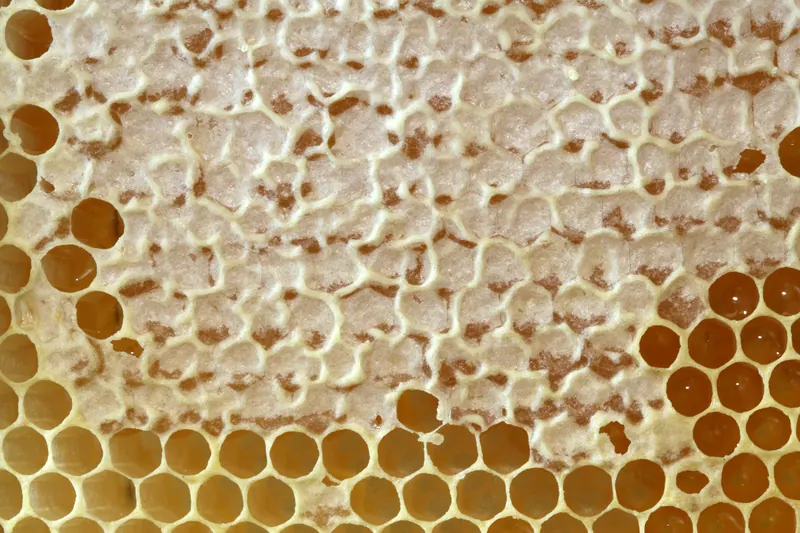
Hives before frames
The oldest form of hive was probably simply a log from a fallen tree that bees had already occupied.Reported by the farm, source reported 1 In ancient Egypt and neighbouring regions, bees were kept in pipe hives: long horizontal tubes piled together, made of clay and other materials.Confirmed fact, source 1 Straw skeps are coiled-straw baskets, made today in the same way as baskets were made thousands of years ago.Reported by the farm, source reported 1 Traditional hives around the world are made of hollowed logs, rolled bark, clay pots or woven grass and cane.Confirmed fact, source 2 FAO describes the sole purpose of a traditional hive as encouraging bees to nest in a place the beekeeper can reach.Confirmed fact, source 2
Top-bar hives: movable combs without frames
In a top-bar hive, bees build each comb hanging down from a wooden bar laid across the top of the hive.Confirmed fact, source 3 Because each comb hangs from its own bar, the beekeeper can lift combs out one at a time.Confirmed fact, source 2 FAO says top-bar hives offer the same manageability and efficiency in honey harvesting as movable-frame hives, without their high manufacturing costs.Confirmed fact, source 2 Traditional Greek basket hives, shaped like a round waste-paper basket, have bars laid across their open top.Confirmed fact, source 4 Between 1650 and 1850 many hives with top bars and even frames were invented, but bees still fixed their combs to the walls.Reported by the farm, source reported 1
Langstroth's movable-frame hive
Movable-comb hives existed before Langstroth: around 1806 Peter Prokopovich produced one that was used on a commercial scale.Reported by the farm, source reported 1 According to the bee historian Eva Crane, Lorenzo Langstroth of Philadelphia discovered the bee space in 1851, a discovery she says laid the foundation of modern beekeeping.Confirmed fact, source 1 Langstroth's patent, US 9,300, was granted on 5 October 1852 for a beehive built around a movable frame.Confirmed fact, source 5 The patent's stated aim was to let beekeepers take combs out without cutting them or seriously disturbing the bees.Confirmed fact, source 5 In his 1853 book, Langstroth wrote that his frames hung in the hive without touching its top, bottom or sides.Confirmed fact, source 6
What the bee space is
The bee space is a gap just wide enough for honey bees to work back to back between two combs.Confirmed fact, source 7 For western honey bees the bee space is about 1/4 to 3/8 inch, which converts to roughly 6 to 10 mm.Confirmed fact, source 7 Honey bees seal gaps smaller than the bee space with propolis, a resinous material they collect mainly from trees.Confirmed fact, source 7 Gaps larger than the bee space encourage honey bees to build lots of burr comb.Confirmed fact, source 7 FAO notes that frame spacing must match a natural nest, and that standard frame hives developed for European honey bees are not necessarily suitable for other races and species of honey bees.Confirmed fact, source 2
Frame hives in use today: a Bavarian snapshot
The Bavarian state bee centre lists Zander, Dadant, Zadant and several regional magazine hives among the most common hive systems in Bavaria.Confirmed fact, source 8 LWG Bayern groups the Dadant hive among systems with a tall brood box and shallow honey boxes.Confirmed fact, source 8 LWG Bayern lists wood, various plastics such as polystyrene foam, and straw as hive materials, and notes that straw cannot be disinfected.Confirmed fact, source 8 Frame sizes differ between systems, and frames must keep a fixed spacing, so the centre recommends staying with one system.Confirmed fact, source 9 FAO notes that frame hives need seasoned timber that is accurately cut and planed, plus wire, nails and foundation, so they are relatively labour-intensive to make and maintain.Confirmed fact, source 2
Sources
- Crane, E. (1963). The world's beekeeping: past and present. In R.A. Grout (ed.), The Hive and the Honey Bee, pp. 1-10. Hamilton, IL: Dadant & Sons. Hosted by the Eva Crane Trust. Link
- Bradbear, N. (2004). Beekeeping and Sustainable Livelihoods. FAO Diversification Booklet 1. Rome: FAO. Link
- Adjare, S.O. (1990). Beekeeping in Africa, Chapter 4: Traditional and modern beehives and beekeeping equipment. FAO Agricultural Services Bulletin 68/6. Rome: FAO. Link
- Crane, E., Vu Van Luyen & Mulder, V. (1993). Traditional management of Apis cerana using movable-comb hives in Vietnam. Bee World 74(2): 75-85. Link
- Langstroth, L.L. Beehive. US Patent 9,300, granted 5 October 1852. Link
- Langstroth, L.L. (1853). Langstroth on the Hive and the Honey-Bee: A Bee Keeper's Manual. Northampton: Hopkins, Bridgman & Company. Project Gutenberg eBook 24583. Link
- Zawislak, J. Beekeeping Basics, Part 2: Introduction to the Bee Hive. University of Arkansas System Division of Agriculture, Cooperative Extension Service (undated). Link
- Bayerische Landesanstalt für Weinbau und Gartenbau (LWG), Fachzentrum Bienen, Veitshöchheim. Beuten (information sheet 'Die Qual der Wahl: die Beute', undated). Link
- Bayerische Landesanstalt für Weinbau und Gartenbau (LWG), Fachzentrum Bienen, Veitshöchheim. Rähmchen (information sheet 'Welches Rähmchen soll ich verwenden?', undated). Link
Last checked: 20 October 2026. Every statement in this article was compared with the source it cites. Spotted an error? Report it.