Melittidae
Macropis europaea
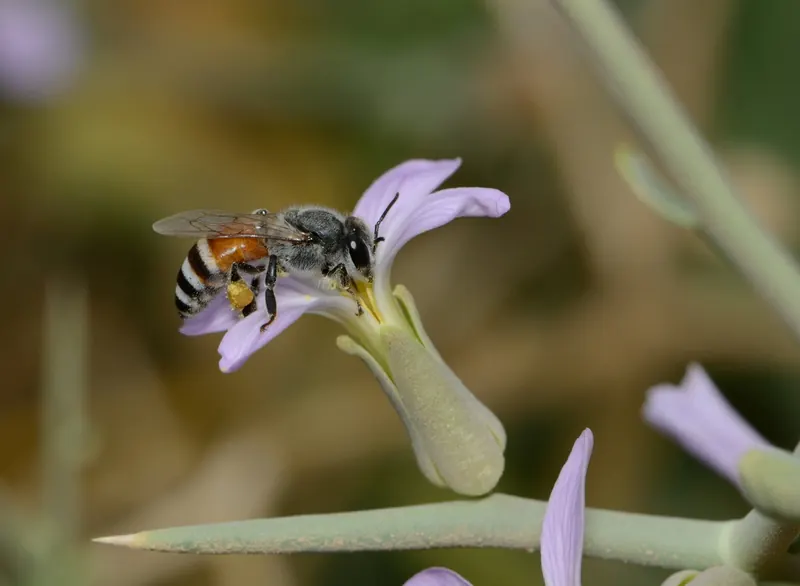
Macropis europaea is a European oil-collecting bee tied to yellow loosestrife (Lysimachia vulgaris) in wetlands. Females provision their nests with floral oils as well as pollen, and line their underground brood cells with a waterproof, wax-like substance. Adults fly in midsummer, in step with loosestrife flowering.
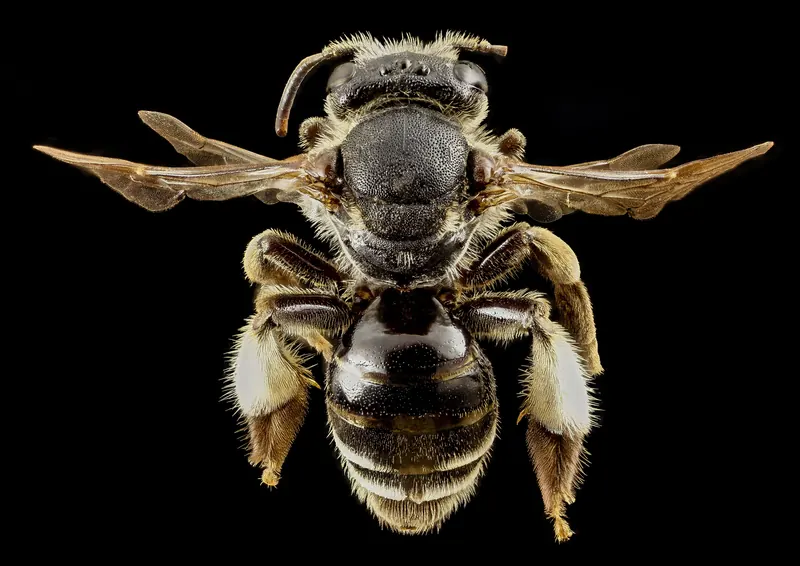
What we know
How to recognise it
Where it lives
It ranges across Europe from southern Fennoscandia south to central Spain, and east as far as Kazakhstan.
Confirmed fact[1]In Britain it is found only in southern England, from Devon to Kent and north to Somerset and Norfolk.
Confirmed fact[1]It lives at wetland sites where its main food plant, yellow loosestrife (Lysimachia vulgaris), grows.
Confirmed fact[1]In a study of populations across Europe, Turkey and Georgia, most of the sampled populations were in open, damp habitats such as swamps and wet fields.
Observation[2]
Life cycle and colony
It has one generation a year, flying from mid July to early September, closely in step with the flowering of its host plant.
Confirmed fact[1]
Nest
Flowers and food
Females stock their nests with fatty oils produced by flowers, in addition to pollen.
Confirmed fact[1]Yellow loosestrife (Lysimachia vulgaris) appears to be its main source of floral oil.
Confirmed fact[2]Whether it ever uses other oil-producing plants is unresolved: researchers have found no convincing evidence that it does.
Open question[2]
Behaviour
In mainland Europe the cuckoo bee Epeoloides coecutiens lays its eggs in this bee's nests, but it is not known from Britain.
Confirmed fact[1]
Conservation
In Britain it was listed as Rare in 1987 and as Nationally Notable in 1991, though recording work suggested its status should be reviewed.
Confirmed fact[1]
Where it has been recorded
Each hexagon contains at least one record of Macropis europaea shared with GBIF: museum specimens, surveys and photographs.
16,325 records
- Netherlands5,413
- Sweden2,403
- Belgium2,156
- Switzerland1,732
- Finland1,117
- Germany933
GBIF.org occurrence data for taxon key 1345909, retrieved 2026-10-19. Observation[4]
Records show where the bee has been found and reported, not its full range or its abundance. Isolated points far from the main cluster can be misidentifications, captive or imported bees, or genuine rare finds.
More from this part of the bee family tree
Sources
- Else, G.R. Bees, Wasps & Ants Recording Society (BWARS). Macropis europaea Warncke, 1973. Species account (written 1998, proofed January 2012). Link
- Bassin, L., Alvarez, N., Pellissier, L. & Triponez, Y. (2011). Ecological niche overlap in sister species: how do oil-collecting bees Macropis europaea and Macropis fulvipes (Hymenoptera: Melittidae) avoid hybridization and competition? Apidologie 42: 579-595. Link
- Michez, D. Melittidae: Macropis. Atlas Hymenoptera, University of Mons. Link
- GBIF.org (2026). Occurrence search and density maps for Macropis europaea, taxon key 1345909. Link
Last checked: 20 October 2026. Every statement on this page was compared with the source it cites. Spotted an error? Report it.