Melittidae
Dasypoda hirtipes
Pantaloon bee
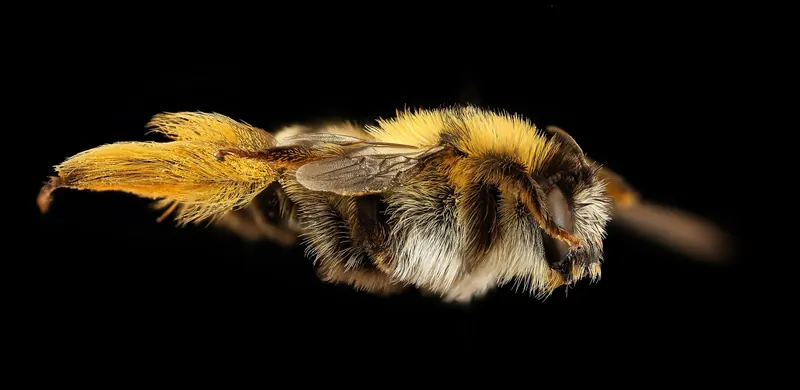
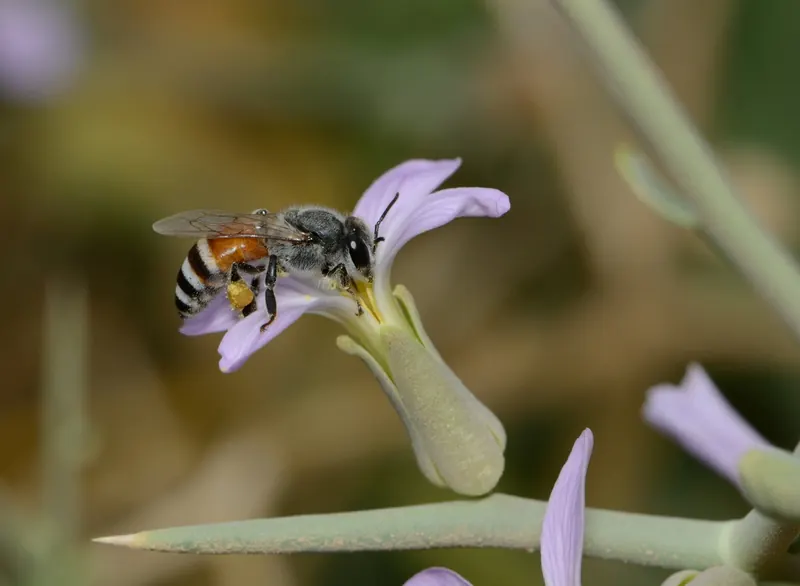
The pantaloon bee is a ground-nesting bee named for the extremely long, golden pollen-collecting hairs on the female's hind legs. It lives on sandy heaths and dunes, collects pollen only from yellow dandelion-like daisy flowers, and flies in high summer.
What we know
How to recognise it
Where it lives
It is widespread in Europe, from southern Finland south to Spain and the Canary Islands.
Confirmed fact[1]In Britain it occurs in southern England and Wales, north to Merionethshire and Norfolk, and on Guernsey and Jersey.
Confirmed fact[1]It lives on sandy soils, especially heathland and coastal dunes.
Confirmed fact[1]
Life cycle and colony
Nest
The female digs a very long main burrow, 8 to 60 cm, at a slant, leaving a fan of spoil beside the entrance.
Confirmed fact[1]
Flowers and food
In a German study, females collected pollen only from yellow daisy-family flowers made entirely of strap-shaped florets, like dandelions.
Confirmed fact[2]
Behaviour
Compared with a bee that shares its sites, it stays active for more of the day and keeps flying at lower temperatures.
Confirmed fact[2]It works flowers quickly: one study measured about 0.7 seconds per flower.
Observation[3]Flesh flies of the genus Miltogramma seem to be important parasites in its nests.
Confirmed fact[1]
Bees and people
In Britain this bee is known as the pantaloon bee, a name also used for the genus Dasypoda as a whole.
Confirmed fact[4]
Conservation
In Britain it is classed as a Nationally Notable (Nb) species.
Confirmed fact[1]
Where it has been recorded
Each hexagon contains at least one record of Dasypoda hirtipes shared with GBIF: museum specimens, surveys and photographs.
66,112 records
- Netherlands43,411
- Germany5,681
- Sweden5,108
- Belgium4,594
- United Kingdom1,386
- Denmark1,164
GBIF.org occurrence data for taxon key 1345858, retrieved 2026-10-19. Observation[5]
Records show where the bee has been found and reported, not its full range or its abundance. Isolated points far from the main cluster can be misidentifications, captive or imported bees, or genuine rare finds.
More from this part of the bee family tree
Sources
- Bees, Wasps & Ants Recording Society (BWARS). Dasypoda hirtipes (Fabricius, 1793). Species account. Link
- Levermann, E.-M., Bischoff, I. & Wagner, T. (2000). Species-specific foraging strategies of the syntopical and synchronous bees Panurgus calcaratus (Scopoli, 1763) and Dasypoda hirtipes (Fabricius, 1793) (Hymenoptera: Apidae). Beitraege zur Entomologie 50(1): 179-191. Link
- El Abdouni, I., Lhomme, P., Hamroud, L., Wood, T., Christmann, S., Rasmont, P. & Michez, D. (2021). Comparative ecology of two specialist bees: Dasypoda visnaga Rossi, 1790 and Dasypoda maura Perez, 1895 (Hymenoptera, Melittidae). Journal of Hymenoptera Research 81: 109-126. Link
- Gallon, R. Species focus: Pantaloon bee. Cofnod, North Wales Environmental Information Service (Local Environmental Records Centre). Link
- GBIF.org (2026). Occurrence search and density maps for Dasypoda hirtipes, taxon key 1345858. Link
Last checked: 20 October 2026. Every statement on this page was compared with the source it cites. Spotted an error? Report it.