Stenotritidae
Ctenocolletes nicholsoni
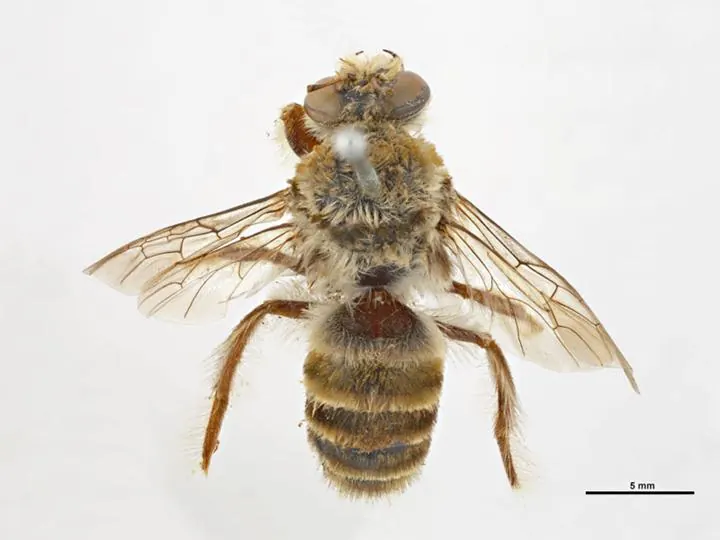
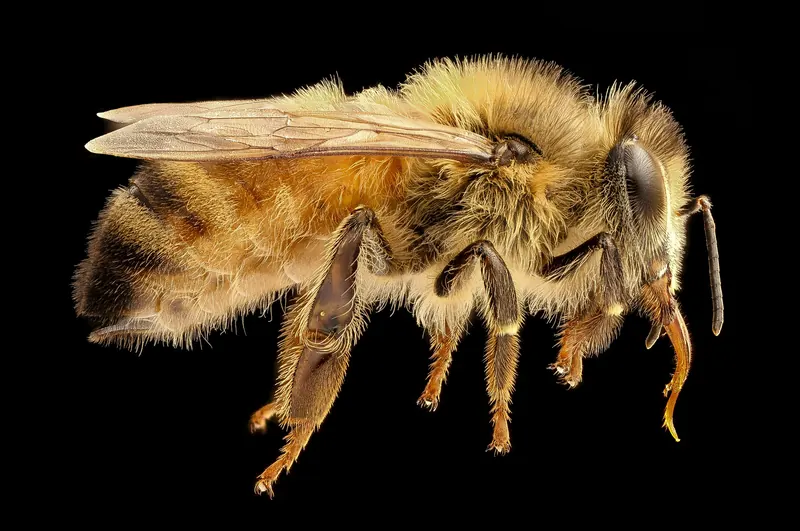
Ctenocolletes nicholsoni is a large, fast-flying bee of southern Western Australia, about 17 to 20.5 mm long. It belongs to the Stenotritidae, a small bee family found only in Australia. Adults may appear as early as July, are active for only about a month, and rely largely on Acacia pollen.
What we know
How to recognise it
Females are large bees, measuring 18.0 to 20.5 mm in body length.
Confirmed fact[1]Males are slightly smaller, with a body length of 17 to 19 mm.
Confirmed fact[1]Males have rich buff hair on the face and the front of the thorax, contrasting with whiter hair at the back of the head.
Confirmed fact[1]Females have patches of black or sooty brown hairs on the head, thorax and abdomen.
Confirmed fact[1]
Where it lives
Life cycle and colony
Flowers and food
Behaviour
Where it has been recorded
Each hexagon contains at least one record of Ctenocolletes nicholsoni shared with GBIF: museum specimens, surveys and photographs.
213 records
- Australia207
GBIF.org occurrence data for taxon key 1345943, retrieved 2026-10-19. Observation[3]
Records show where the bee has been found and reported, not its full range or its abundance. Isolated points far from the main cluster can be misidentifications, captive or imported bees, or genuine rare finds.
More from this part of the bee family tree
Sources
- Houston, T.F. (1983). A revision of the bee genus Ctenocolletes (Hymenoptera: Stenotritidae). Records of the Western Australian Museum 10(3): 269-306. Link
- Houston, T.F. (1984). Biological observations of bees in the genus Ctenocolletes (Hymenoptera: Stenotritidae). Records of the Western Australian Museum 11(2): 153-172. Link
- GBIF.org (2026). Occurrence search and density maps for Ctenocolletes nicholsoni, taxon key 1345943. Link
Last checked: 20 October 2026. Every statement on this page was compared with the source it cites. Spotted an error? Report it.