Halictidae
Halictus scabiosae
Great banded furrow bee
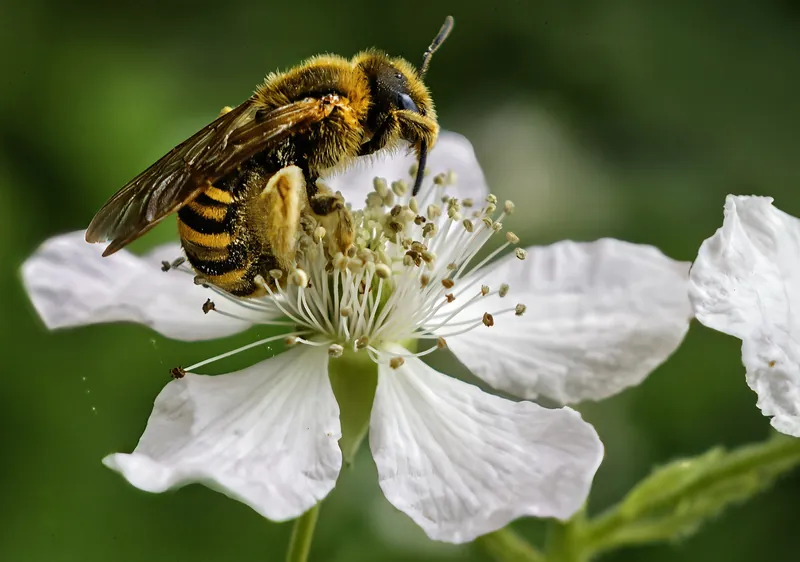
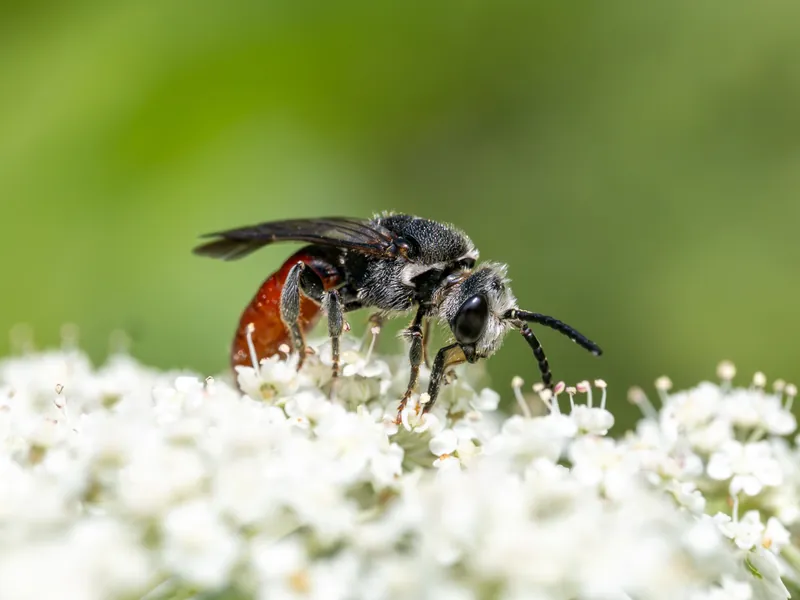
A honey-bee-sized sweat bee with pale ring-like bands on its abdomen, found from the Netherlands south to Iberia. It is eusocial: overwintered females rear a first brood of smaller helpers that emerges in June and July, then a second brood whose females mate, overwinter and found the next spring's nests. Nests are dug in the ground, often in large aggregations.
What we know
How to recognise it
It is about the size of a honey bee and is easily told apart by ring-like pale bands running around the segments of its abdomen.
Confirmed fact[1]Females carry a buff band at both the front and the back of abdominal segments 2 to 4.
Confirmed fact[1]First-brood females, which mostly act as workers, were significantly smaller and lighter and had lower fat reserves than second-brood females in a Swiss study.
Observation[2]
Where it lives
Life cycle and colony
It is a eusocial species: females that have survived the winter rear more than one generation in a single season.
Confirmed fact[1]Spring foundresses raise a first brood, mostly female, that emerges from the nests in June and July.
Confirmed fact[2]After mating, second-brood females enter a winter rest (diapause) and become the foundresses of the following spring.
Confirmed fact[2]Whether mothers deliberately shape their daughters into workers by giving the first brood smaller pollen provisions remains a hypothesis rather than a settled fact.
Open question[2]
Nest
On the European mainland, where conditions suit it, this bee nests in large aggregations.
Confirmed fact[1]
Flowers and food
In a study in Friuli, north-east Italy, the plants most visited by females were sunflower and dandelion.
Observation[4]
Behaviour
Conservation
The French national inventory INPN reports its European red-list category as Least Concern, meaning its risk of disappearing is considered low.
Confirmed fact[3]
Where it has been recorded
Each hexagon contains at least one record of Halictus scabiosae shared with GBIF: museum specimens, surveys and photographs.
56,614 records
- Netherlands15,863
- Germany14,048
- Switzerland10,673
- France7,509
- Spain2,744
- Belgium1,638
GBIF.org occurrence data for taxon key 1353395, retrieved 2026-10-19. Observation[5]
Records show where the bee has been found and reported, not its full range or its abundance. Isolated points far from the main cluster can be misidentifications, captive or imported bees, or genuine rare finds.
More from this part of the bee family tree
Sources
- Else, G. R. (2019). Halictus scabiosae (Rossi, 1790). Species account, Bees, Wasps & Ants Recording Society (BWARS). Link
- Brand, N. and Chapuisat, M. (2012). Born to be bee, fed to be worker? The caste system of a primitively eusocial insect. Frontiers in Zoology 9: 35. Link
- INPN, MNHN and OFB (accessed 2026). Halictus scabiosae (Rossi, 1790). Inventaire national du patrimoine naturel, Museum national d'Histoire naturelle, Paris. Link
- Fortunato, L. and Zandigiacomo, P. (no year on PDF). Fenologia e preferenze florali di Halictus scabiosae (Rossi) in Friuli Venezia Giulia. Dipartimento di Scienze Agrarie e Ambientali, Universita di Udine. Link
- GBIF.org (2026). Occurrence search and density maps for Halictus scabiosae, taxon key 1353395. Link
Last checked: 30 October 2026. Every statement on this page was compared with the source it cites. Spotted an error? Report it.