Halictidae
Sphecodes albilabris
Great blood bee
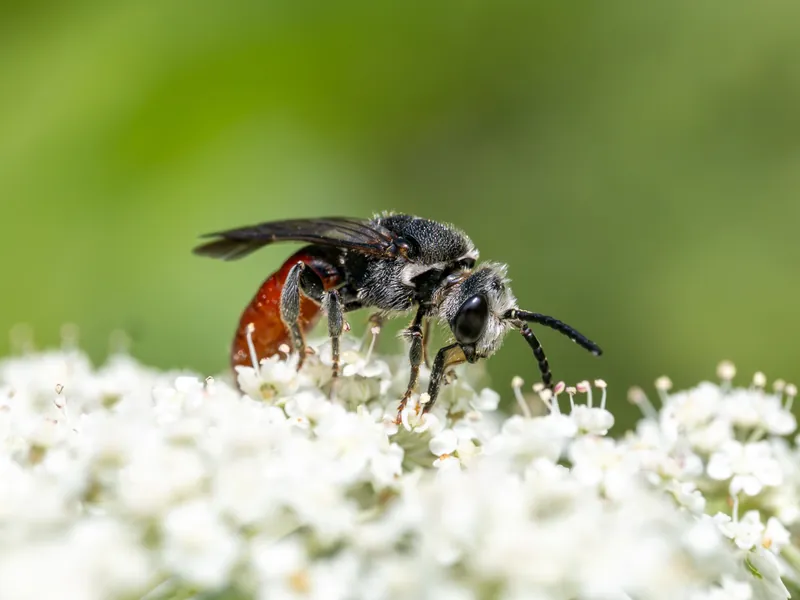
Sphecodes albilabris is a large red and black cuckoo bee of sandy places in Europe. It makes no nest of its own: females enter the burrows of the spring mining bee Colletes cunicularius. Adults emerge in July, mated females overwinter, and the species was first found in Britain in 2020.
What we know
How to recognise it
Where it lives
Life cycle and colony
It is a cuckoo bee whose main host is the spring mining bee Colletes cunicularius.
Confirmed fact[3]There is one generation a year: adults emerge in July and mate, then the females find shelter and overwinter.
Confirmed fact[3]In Britain females are on the wing from March to August and males from July to October.
Confirmed fact[1]Researchers think overwintered females very likely live a long time and still fly in early summer, when their Colletes host is not yet available, which may explain records at other hosts.
Open question[3]
Nest
Flowers and food
Conservation
The Swiss Red List of 2024 classes it as not threatened (Least Concern); in Britain it is too recently discovered to have been given a rarity status.
Confirmed fact[2]
Where it has been recorded
Each hexagon contains at least one record of Sphecodes albilabris shared with GBIF: museum specimens, surveys and photographs.
17,863 records
- Netherlands6,049
- Germany4,163
- Sweden1,796
- Switzerland1,703
- Belgium1,427
- France615
GBIF.org occurrence data for taxon key 1351582, retrieved 2026-10-19. Observation[5]
Records show where the bee has been found and reported, not its full range or its abundance. Isolated points far from the main cluster can be misidentifications, captive or imported bees, or genuine rare finds.
More from this part of the bee family tree
Sources
- Allen, G.W., Falk, S. & Knowles, A. (2022). Sphecodes albilabris (Fabricius, 1793). BWARS (Bees, Wasps and Ants Recording Society) species account. Link
- Benon, D. (n.d.). Sphecodes albilabris (Fabricius, 1793): species account. info fauna, Swiss national data and information centre on fauna (Neuchatel), with Red List status from Muller & Praz (2024). Link
- Bogusch, P. & Straka, J. (2012). Review and identification of the cuckoo bees of central Europe (Hymenoptera: Halictidae: Sphecodes). Zootaxa 3311: 1-41. Species treatment for Sphecodes albilabris as deposited by Plazi on Zenodo. Link
- Bogusch, P. & Straka, J. (2012). Review and identification of the cuckoo bees of central Europe (Hymenoptera: Halictidae: Sphecodes). Zootaxa 3311: 1-41. First page (abstract) PDF at the publisher. Link
- GBIF.org (2026). Occurrence search and density maps for Sphecodes albilabris, taxon key 1351582. Link
Last checked: 30 October 2026. Every statement on this page was compared with the source it cites. Spotted an error? Report it.