Halictidae
Agapostemon virescens
Bicolored striped sweat bee, Bicoloured Agapostemon, Virescent green metallic bee
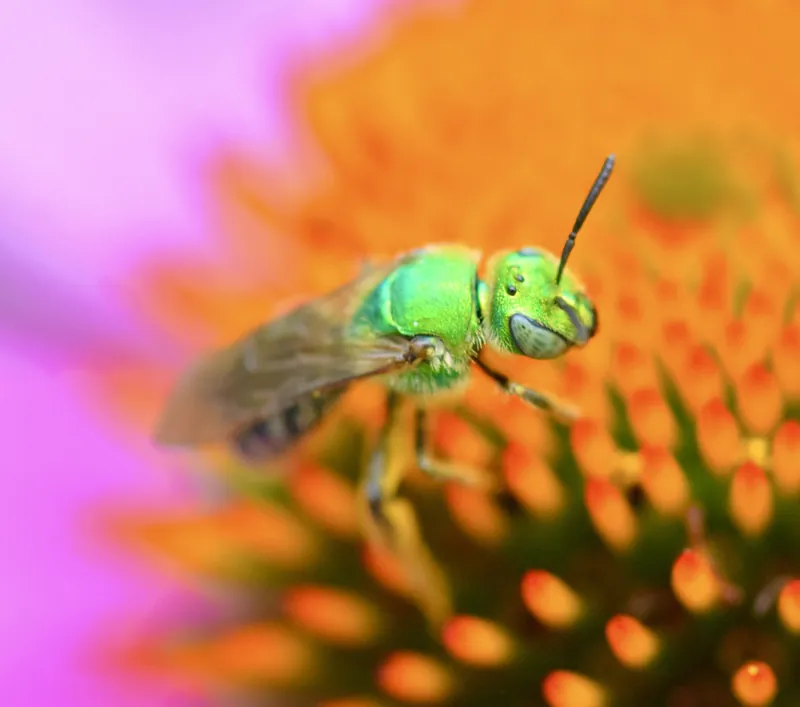
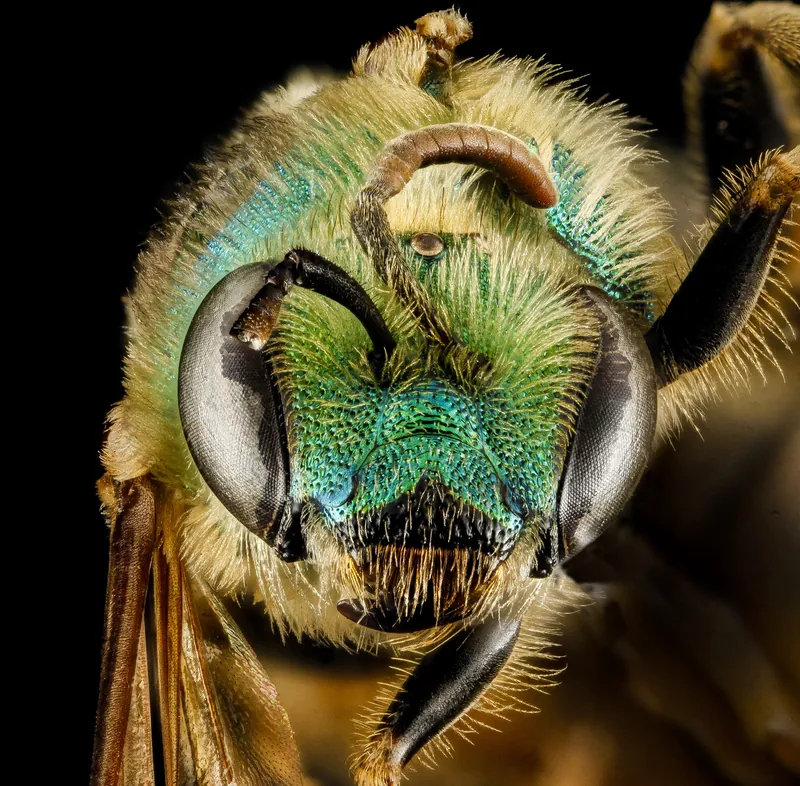
A common North American sweat bee: females have a bright metallic green head and thorax with a black-and-white striped abdomen, males a yellow-and-black striped abdomen. Females share one ground nest entrance, taking turns as a guard, yet each builds her own burrow. It visits many flowers and is Toronto's official bee.
What we know
How to recognise it
Where it lives
It lives mostly in the Midwestern and Northeastern United States, with sightings from coast to coast.
Confirmed fact[1]
Life cycle and colony
Nests are communal: a single entrance hole at the soil surface is used by several females.
Confirmed fact[1]There are no queens or workers: all females lay eggs and at least occasionally forage for pollen.
Confirmed fact[2]Mated females emerge from hibernation in mid-May and build nests underground.
Confirmed fact[1]When temperatures drop, mated females hibernate in the nests they were born in until spring, while the males die.
Confirmed fact[1]How many generations it has each year is not settled: a New York study treated it as having one generation, while other sources report a second generation emerging in late July to early August.
Open question[1]
Nest
Up to two dozen females may share one nest entrance, but each female digs her own burrow inside.
Confirmed fact[4]
Flowers and food
Females visit a wide variety of plants and are especially fond of the daisy family, such as purple coneflower and asters.
Confirmed fact[1]
Behaviour
Females take turns guarding the nest entrance, and having a guard lowers the chance of a visit from an unwanted intruder.
Confirmed fact[1]In a New York study, continuous guarding protected communal nests from the cuckoo bee Nomada articulata, which successfully attacked nests occupied by lone females.
Confirmed fact[2]In the same study, 58 percent of adult females switched nests during their adult lives.
Confirmed fact[2]
Bees and people
The City of Toronto chose this bee as its official bee, partly because it is common, easy to identify, and tolerant of newcomers at its nests.
Confirmed fact[4]
Where it has been recorded
Each hexagon contains at least one record of Agapostemon virescens shared with GBIF: museum specimens, surveys and photographs.
48,310 records
- United States42,924
- Canada5,379
- Mexico3
- Morocco1
- Peru1
GBIF.org occurrence data for taxon key 5042879, retrieved 2026-10-19. Observation[5]
Records show where the bee has been found and reported, not its full range or its abundance. Isolated points far from the main cluster can be misidentifications, captive or imported bees, or genuine rare finds.
More from this part of the bee family tree
Sources
- Markovits, C. and Dorian, N. (2021, updated 2023). Agapostemon virescens: this green metallic sweat bee loves your garden. Tufts Pollinator Initiative, Tufts University. Link
- Abrams, J. and Eickwort, G.C. (1981). Nest switching and guarding by the communal sweat bee Agapostemon virescens (Hymenoptera, Halictidae). Insectes Sociaux 28(2): 105-116. Abstract read on DigitalCommons@USU. Link
- Bees of Canada, a Royal Saskatchewan Museum Initiative. Agapostemon virescens (Fabricius, 1775), Bicoloured Striped Sweat Bee. Accessed 29 October 2026. Link
- City of Toronto (2018). Toronto's Pollinator Protection Strategy. Section 'Toronto's Official Bee: Bicoloured Agapostemon'. Toronto: City of Toronto, April 2018. Link
- GBIF.org (2026). Occurrence search and density maps for Agapostemon virescens, taxon key 5042879. Link
Last checked: 30 October 2026. Every statement on this page was compared with the source it cites. Spotted an error? Report it.