Halictidae
Lasioglossum malachurum
Sharp-collared furrow bee
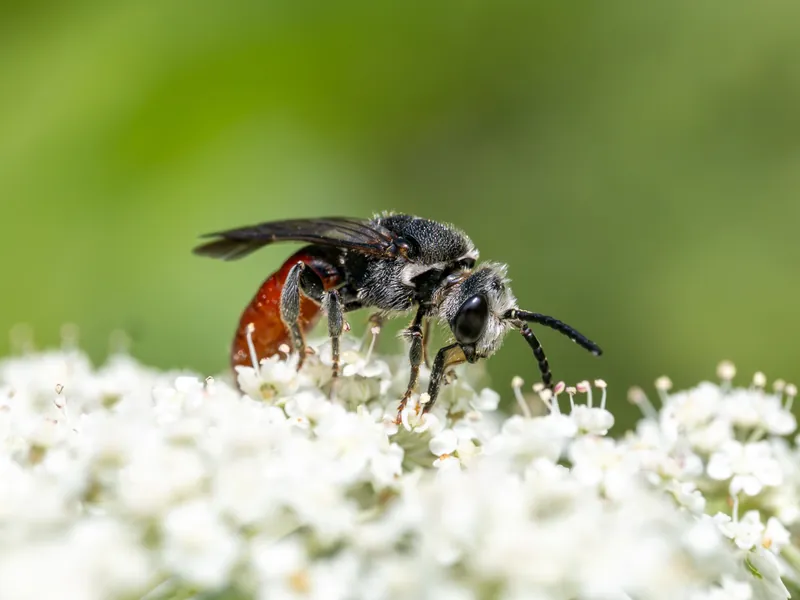
A small, widespread European sweat bee and one of the best-studied social bees. A single queen founds a nest in spring and rears one or more broods of smaller workers before a final brood of new queens and males. Nests are dug in bare, often hard-trodden soil, frequently in large aggregations.
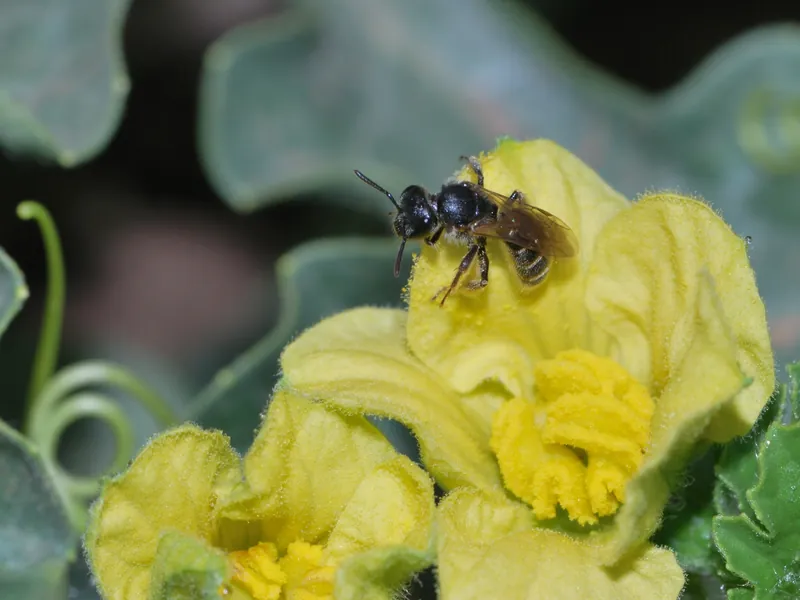
What we know
How to recognise it
Where it lives
Life cycle and colony
In Britain, females fly from early April to October, and males from early July to the beginning of October.
Confirmed fact[1]Workers are smaller than the queens, so much so that the worker was originally described as a separate species, Halictus longulus.
Confirmed fact[1]This bee, common across much of Europe, is obligately eusocial throughout its range: every colony has a queen and workers.
Confirmed fact[3]In a population studied in southern Greece, colonies produced two broods of workers and then a third brood of new queens, males and some workers.
Observation[2]Why social organisation varies between populations across Europe is still being worked out; longer breeding seasons appear to be part of the explanation.
Open question[2]
Nest
Flowers and food
It is a generalist forager, collecting pollen from at least 12 different plant families.
Confirmed fact[4]
Behaviour
Although a single queen normally monopolises egg laying, workers do lay some eggs in the final brood, producing both new queens and males.
Confirmed fact[3]
Where it has been recorded
Each hexagon contains at least one record of Lasioglossum malachurum shared with GBIF: museum specimens, surveys and photographs.
35,473 records
- Switzerland21,566
- France6,957
- United Kingdom1,461
- Spain1,308
- Belgium1,239
- Portugal914
GBIF.org occurrence data for taxon key 1355085, retrieved 2026-10-19. Observation[5]
Records show where the bee has been found and reported, not its full range or its abundance. Isolated points far from the main cluster can be misidentifications, captive or imported bees, or genuine rare finds.
More from this part of the bee family tree
Sources
- Else, G. R. (2005). Lasioglossum malachurum (Kirby, 1802). Species account, Bees, Wasps & Ants Recording Society (BWARS). Link
- Wyman, L. M. (no year shown). Intraspecific and interspecific social variation in the sweat bee Lasioglossum malachurum and other members of the subgenus Evylaeus. Thesis, Brock University (abstract in the Brock University repository). Link
- Richards, M. H., French, D. and Paxton, R. J. (2005). It's good to be queen: classically eusocial colony structure and low worker fitness in an obligately eusocial sweat bee. Molecular Ecology 14(13): 4123-4133. Link
- info fauna (2026). Lasioglossum malachurum, Hymenoptera - Anthophila (Abeilles sauvages). Swiss national fauna data and information centre. Link
- GBIF.org (2026). Occurrence search and density maps for Lasioglossum malachurum, taxon key 1355085. Link
Last checked: 30 October 2026. Every statement on this page was compared with the source it cites. Spotted an error? Report it.