Apidae
Ceratina cyanea
Small carpenter bee, Blue carpenter bee, Little blue carpenter bee
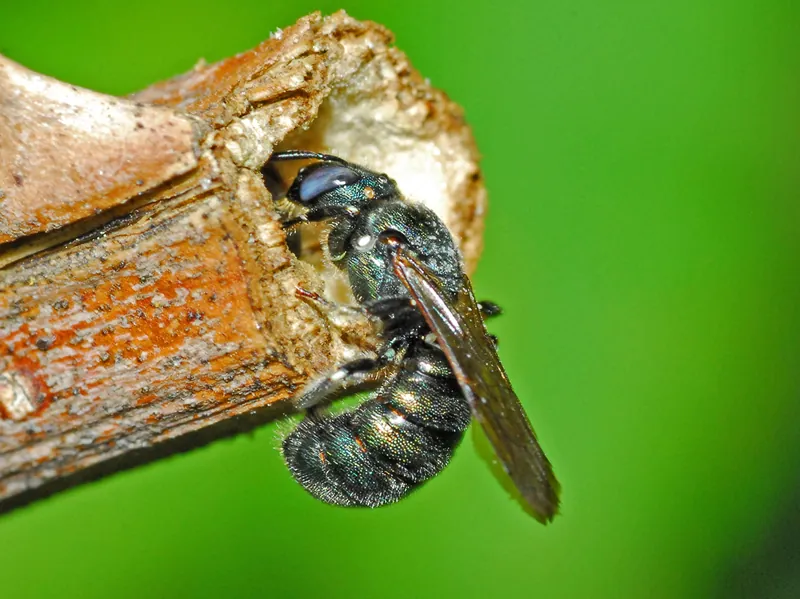
A small carpenter bee of Europe, and the only one of its kind in Britain, where it is locally common in the south-east. Females dig nests in dead, broken stems with exposed pith, especially bramble, and separate the cells with walls of wood dust. Adults of both sexes winter inside hollow stems and fly from May to late August.
What we know
How to recognise it
BWARS describes it as the only example in Britain of a small carpenter bee.
Confirmed fact[1]
Where it lives
Life cycle and colony
It has a single brood a year and flies from May to late August, although adults can be found in every month of the year.
Confirmed fact[1]From late summer onwards, adults of both sexes look for hollow stems in which to spend the winter.
Confirmed fact[1]The bees enter their winter burrows head first and stay inside, often in small groups, until the following spring.
Confirmed fact[1]A study of four European small carpenter bees found that individuals of this species mostly overwintered alone rather than in groups.
Confirmed fact[2]In the same study, some females of every species examined, including this one, tried to overwinter for a second time.
Confirmed fact[2]
Nest
Females dig their nest burrows in dead, dry, broken woody or herbaceous stems where the soft pith has been exposed.
Confirmed fact[1]Most nests have been found in bramble stems, with a few in rose.
Confirmed fact[1]Inside the stem, the brood cells are separated by upright walls made of compacted fine wood dust.
Confirmed fact[1]
Flowers and food
It visits many flowers, including bulbous buttercup, bramble, tormentil, burnet rose, viper's-bugloss, heath, germander speedwell, thyme, wild basil, self-heal, harebell and rough hawkbit.
Confirmed fact[1]
Bees and people
It was considered a great rarity in Britain until 1972, when it was found in abundance on a downland site in east Hampshire.
Confirmed fact[1]
Conservation
British Red Data Book reviews in 1987 and 1991 listed it as Rare (RDB3), and more recent records suggest it may be regarded as scarce.
Confirmed fact[1]
Where it has been recorded
Each hexagon contains at least one record of Ceratina cyanea shared with GBIF: museum specimens, surveys and photographs.
10,645 records
- Switzerland5,271
- Sweden1,120
- Belgium816
- France705
- Germany569
- Austria416
GBIF.org occurrence data for taxon key 5039824, retrieved 2026-10-19. Observation[3]
Records show where the bee has been found and reported, not its full range or its abundance. Isolated points far from the main cluster can be misidentifications, captive or imported bees, or genuine rare finds.
More from this part of the bee family tree
Sources
- Else, G.R. BWARS species account: Ceratina cyanea (Kirby, 1802). Bees, Wasps and Ants Recording Society (BWARS). Accessed 29 October 2026. Link
- Mikat, M. and Straka, J. (2021). Overwintering strategy and longevity of European small carpenter bees (Ceratina). Journal of Ethology 39(2): 155-164. doi:10.1007/s10164-020-00688-6. Abstract read on the publisher's site. Link
- GBIF.org (2026). Occurrence search and density maps for Ceratina cyanea, taxon key 5039824. Link
Last checked: 30 October 2026. Every statement on this page was compared with the source it cites. Spotted an error? Report it.