Apidae
Bombus hortorum
Garden bumblebee
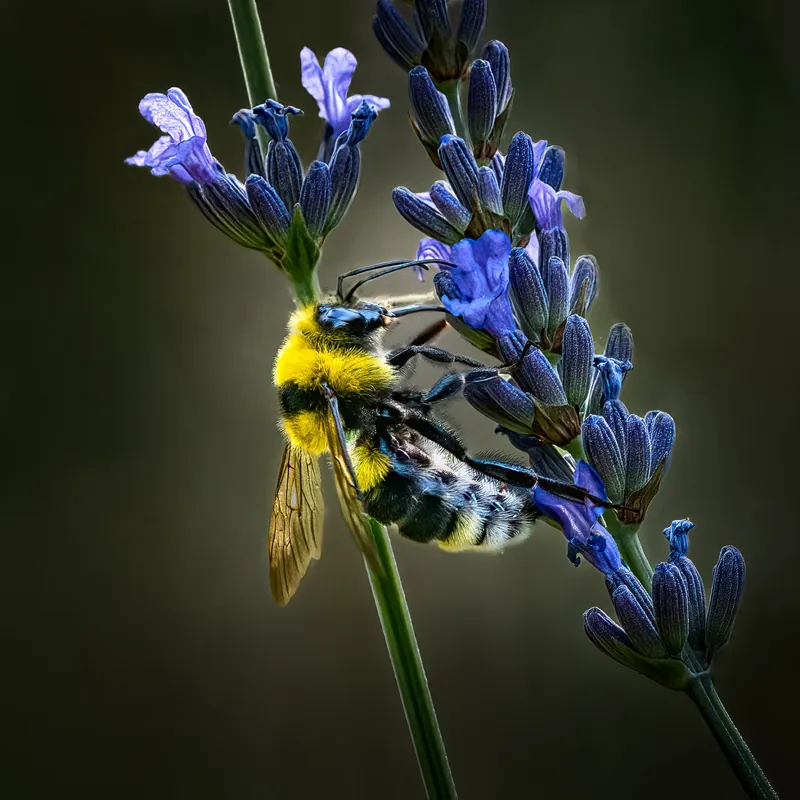
A large, long-tongued bumblebee with pale bands on the thorax and a white tail, found across northern and central Europe and Asia to western Siberia. It nests under cover in colonies of about 100 workers and strongly prefers red clover. Introduced to New Zealand from England, it is now one of the most abundant bumblebees there.
What we know
How to recognise it
It is a large bumblebee with a very long tongue, which it often holds stretched out as it approaches a flower.
Confirmed fact[1]The thorax is banded: black across the middle with pale bands at the front and back.
Confirmed fact[2]The tail is white to greyish white, and the face is long, much longer than it is wide.
Confirmed fact[2]Adults are about 12 to 22 mm long: queens about 17 to 20 mm, workers 11 to 16 mm and males 14 to 15 mm.
Confirmed fact[2]
Where it lives
It is found throughout the British Isles and, beyond them, across northern and central Europe and Asia from the Atlantic to western Siberia.
Confirmed fact[1]The New Zealand bumblebees came from England, in shipments of 1885 and 1906.
Confirmed fact[3]In a survey of the South Island of New Zealand in January 2003 it was the second most abundant bumblebee, with 771 bees recorded, after the buff-tailed bumblebee with 882.
Observation[3]
Life cycle and colony
Nest
Nests are always under cover but may be only shallowly underground, down to 50 cm.
Confirmed fact[1]
Flowers and food
It has a very marked preference for red clover flowers when they are available.
Confirmed fact[1]
Behaviour
The cuckoo bumblebee Bombus barbutellus parasitises its nests.
Confirmed fact[1]
Bees and people
Together with three other European bumblebees it was released on New Zealand's South Island to improve pollination of red clover, a forage crop.
Confirmed fact[3]
Conservation
In Britain it is not regarded as being of conservation concern.
Confirmed fact[1]
Where it has been recorded
Each hexagon contains at least one record of Bombus hortorum shared with GBIF: museum specimens, surveys and photographs.
134,130 records
- United Kingdom32,725
- Netherlands26,045
- Germany14,467
- Switzerland13,899
- Sweden7,676
- Belgium6,618
GBIF.org occurrence data for taxon key 1340542, retrieved 2026-10-19. Observation[4]
Records show where the bee has been found and reported, not its full range or its abundance. Isolated points far from the main cluster can be misidentifications, captive or imported bees, or genuine rare finds.
More from this part of the bee family tree
Sources
- Edwards, M. Bombus hortorum (Linnaeus, 1761), species account. Bees, Wasps & Ants Recording Society (BWARS), proofed February 2012. Link
- Watson, L. & Dallwitz, M. J. (2003 onwards). Insects of Britain and Ireland: the bumblebees and cuckoo bees (Bombus and Psithyrus). Bombus hortorum (Linnaeus). DELTA database, version 27 July 2019. Link
- Goulson, D. & Hanley, M. E. (2004). Distribution and forage use of exotic bumblebees in South Island, New Zealand. New Zealand Journal of Ecology 28(2): 225-232. Link
- GBIF.org (2026). Occurrence search and density maps for Bombus hortorum, taxon key 1340542. Link
Last checked: 30 October 2026. Every statement on this page was compared with the source it cites. Spotted an error? Report it.