Colletidae
Colletes cunicularius
Vernal colletes, Spring mining bee
A large, early-spring plasterer bee of sandy ground, 13 to 17 mm long, that forages mainly on willow catkins. Females dig deep burrows in sand, sometimes in aggregations of thousands of nests, while males emerge first and patrol the nest entrances for mates. In Britain it is a rare bee of coastal dunes.
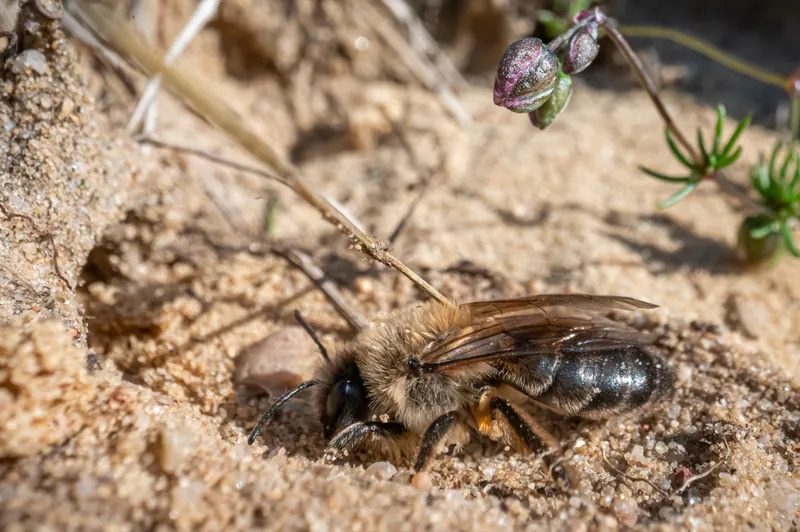
What we know
How to recognise it
Where it lives
Life cycle and colony
Nest
Flowers and food
Females forage preferentially on willow catkins.
Confirmed fact[3]
Behaviour
Males emerge before the females and patrol along the nest entrances looking for a mate.
Confirmed fact[2]A female emerging from her nest triggers a scramble among large numbers of competing males.
Confirmed fact[2]In the Mediterranean region, males pollinate several Ophrys orchids, whose flowers mimic the scent of female bees.
Confirmed fact[3]
Conservation
In Britain it is listed as Rare (RDB3) in the national Red Data Book reviews of 1987 and 1991.
Confirmed fact[1]
Where it has been recorded
Each hexagon contains at least one record of Colletes cunicularius shared with GBIF: museum specimens, surveys and photographs.
29,880 records
- Netherlands7,803
- Switzerland4,119
- Germany4,085
- Sweden3,890
- Belgium2,950
- United Kingdom1,414
GBIF.org occurrence data for taxon key 1348691, retrieved 2026-10-19. Observation[4]
Records show where the bee has been found and reported, not its full range or its abundance. Isolated points far from the main cluster can be misidentifications, captive or imported bees, or genuine rare finds.
More from this part of the bee family tree
Sources
- Else, G. R., Field, J. P. and O'Toole, C. (1999, proofed and updated January 2012). Colletes cunicularius (Linnaeus, 1761). Species account, Bees, Wasps & Ants Recording Society (BWARS). Link
- Mant, J., Brandli, C., Vereecken, N. J., Schulz, C. M., Francke, W. and Schiestl, F. P. (2005). Cuticular hydrocarbons as sex pheromone of the bee Colletes cunicularius and the key to its mimicry by the sexually deceptive orchid, Ophrys exaltata. Journal of Chemical Ecology 31(8): 1765-1787. Link
- Vereecken, N. J. (no date). Projet Colletes de Belgique - Belgian Colletes Project: Colletes cunicularius. Atlas Hymenoptera, Universite de Mons. Link
- GBIF.org (2026). Occurrence search and density maps for Colletes cunicularius, taxon key 1348691. Link
Last checked: 30 October 2026. Every statement on this page was compared with the source it cites. Spotted an error? Report it.