Andrenidae
Andrena cineraria
Ashy mining bee, Grey mining bee
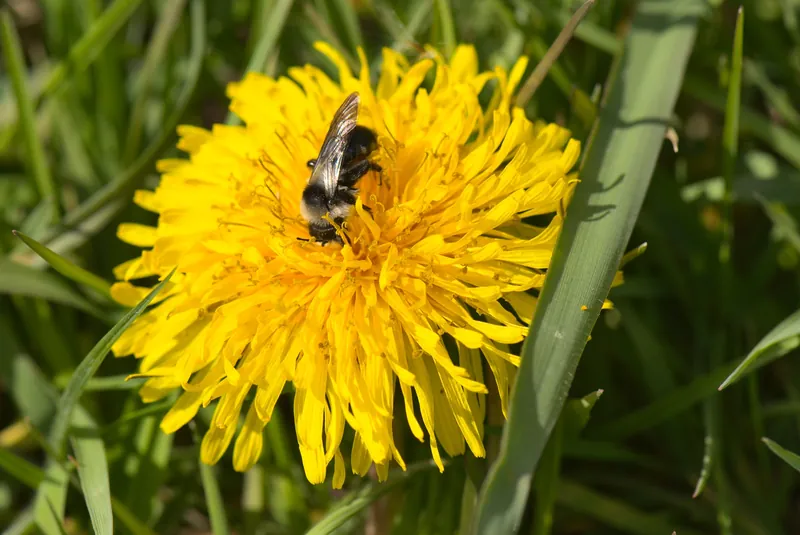
A distinctive spring mining bee with a bluish-black body and ash-grey hair bands across the thorax, found across Europe and Asia to northern China. Females dig burrows in bare sunny ground, often in large aggregations, and adults spend the winter inside the cells where they grew up.
What we know
How to recognise it
Where it lives
Life cycle and colony
There is usually one generation a year; in southern England males fly from March to May, mainly in April, and females from April to June.
Confirmed fact[1]The new adults spend the winter inside the cells in which they developed, emerging the following spring.
Confirmed fact[1]Rare records of males in July and August and females in August might represent a second brood, but this is not confirmed.
Open question[1]In orchards of the Kashmir valley it is described as one of the most distinctive spring-flying solitary bees, flying and foraging from April to July.
Observation[2]
Nest
It favours open sunny places, usually on sandy ground such as open woodland, moorland, coasts, river banks and old quarries.
Confirmed fact[1]The nest burrow is dug 10 to 20 cm deep and holds two to three cells.
Confirmed fact[1]Nests are sometimes built in large, tightly packed aggregations in bare or thinly vegetated soil.
Confirmed fact[1]
Flowers and food
It visits a wide range of flowers, including brambles, cabbages and cherries.
Confirmed fact[1]
Behaviour
The cuckoo bee Nomada lathburiana lays its eggs in the nests of this species and its larvae eat the stored food.
Confirmed fact[1]
Conservation
In Britain it is not regarded as scarce or threatened.
Confirmed fact[1]
Where it has been recorded
Each hexagon contains at least one record of Andrena cineraria shared with GBIF: museum specimens, surveys and photographs.
42,182 records
- United Kingdom12,489
- Germany8,361
- Netherlands3,976
- Sweden3,444
- Switzerland2,696
- France1,920
GBIF.org occurrence data for taxon key 1358088, retrieved 2026-10-19. Observation[3]
Records show where the bee has been found and reported, not its full range or its abundance. Isolated points far from the main cluster can be misidentifications, captive or imported bees, or genuine rare finds.
More from this part of the bee family tree
Sources
- Archer, M. E. & Else, G. R. (2002, identification notes added by N. Jones 2011). Andrena cineraria (Linnaeus, 1758), species account. Bees, Wasps & Ants Recording Society (BWARS). Link
- Dar, S. A., Sofi, M. A., El-Sharnouby, M., Hassan, M., Rashid, R., Mir, S. H., Al Naggar, Y., Salah, M., Tlak Gajger, I. & Sayed, S. (2021). Nesting behaviour and foraging characteristics of Andrena cineraria (Hymenoptera: Andrenidae). Saudi Journal of Biological Sciences 28(8): 4147-4154. Link
- GBIF.org (2026). Occurrence search and density maps for Andrena cineraria, taxon key 1358088. Link
Last checked: 30 October 2026. Every statement on this page was compared with the source it cites. Spotted an error? Report it.